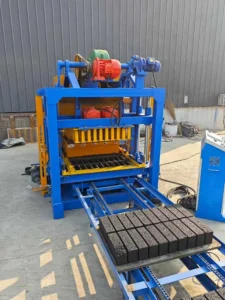
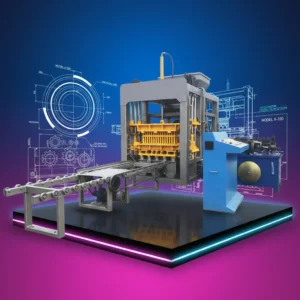
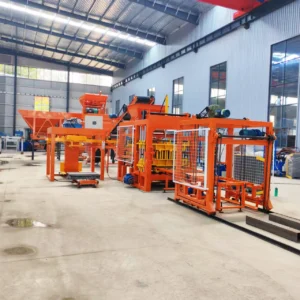
Complete Line Engineering — mixer, batching, pallet handling and stacking are specified to match the press cycle, so the machine is never left waiting for upstream or downstream stations.
Technical Specifications
| Parameter | Value |
|---|---|
| Model | QT6-15 |
| Product Type | Automatic Concrete Block Making Machine |
| Molding Way | Vibration and hydraulic pressing |
| Rated Pressure | 21 MPa |
| Molding Cycle | 15s–20s |
| Pallet Size | 900×700 mm |
| Main Machine Weight | 6000 kg |
| Voltage & Frequency | Customizable to local voltage and frequency |
| Control System | PLC (basis not stated in source — confirm brand and language) |
| Automation Level | Automatic, with semi-automatic line option |
| Output Capacity — Hollow Blocks | 1440 pcs/h based on 400×200×200 mm, 6 pcs/pallet |
| Output Capacity — Paving Bricks | 5040 pcs/h based on 200×100×60 mm, 21 pcs/pallet |
| Output Capacity — Solid Bricks | 7680 pcs/h based on 240×115×53 mm, 32 pcs/pallet |
| Raw Materials | Cement, sand, fly ash, stone powder, slag |
| Supported Formats | Hollow block, paving brick, solid brick, curbstone, interlocking brick (via mould change) |
| Simple Line Configuration | JS500 mixer, 8 m conveyor, automatic stacker |
| Full Automatic Line Upgrade | Cement silo, screw conveyor, cement scale, batching machine, pallet loader, block & pallet separator |
| Warranty | 1 year (excluding wearing parts) |
| Assembly for Shipment | Top cylinder removed for container loading |
| Standards | CE / ISO certification (basis not stated in source — confirm) |
Application Suitability
| Application | Material or Output |
|---|---|
| Hollow block production plants | Cement, sand, fly ash, stone powder, slag mixes for 400×200×200 mm blocks |
| Paving brick manufacturing | High-density concrete mixes for 200×100×60 mm interlocking pavers |
| Solid brick and curbstone output | Standard and specialty mixes for 240×115×53 mm bricks and kerbstones |
| On-site construction block production | Local aggregate and cement blends for housing or infrastructure projects |
| Format expansion for existing plants | Additional block types through mould changes on a synchronized line |
Why Cycle Time at Every Station Matters More Than Press Speed Alone
A block machine that produces faster than its mixer can feed will spend half the day idle.
When sourcing an automatic block machine production line, buyers often fixate on the press cycle — 15 to 20 seconds sounds productive on paper. Yet if the JS500 mixer takes 90 seconds to deliver a batch that the press consumes in 60 seconds, the line stalls between batches. Downstream, if the stacker cannot keep pace with pallets leaving the press, operators pile blocks by hand and real daily output falls well short of the quoted figure [NEED_CITE: line station synchronization in concrete block production]. This mismatch is the single most common reason buyers report disappointment after commissioning.
Matching Upstream Feed to the 15-Second Press Cycle
The QT6-15 automatic block machine production line pairs a JS500 mixer with an 8-meter belt conveyor to maintain a continuous material flow. The mixer batch volume and discharge interval are calculated against the press consumption rate at the chosen block format, so the hopper never runs dry mid-cycle. When the buyer’s raw material includes slow-mixing aggregates such as volcanic ash or fine stone powder, the mixer retention time must be extended, which in turn affects conveyor speed and batch scheduling across the full line.
Downstream Pallet Flow and Stacking Synchronization
Once a pallet exits the press, it moves to the automatic stacker in the simple line configuration or through the block and pallet separator in the full automatic line. The separator must release the pallet and return it to the pallet loader within the same window as the next press cycle. If pallet return lags, the press waits. Pallet size is locked at 900×700 mm, which must align with the buyer’s curing rack spacing and forklift tine width before the order is confirmed [NEED_CITE: pallet and curing rack compatibility in block plants].
Reading the Specifications Beyond the Headline Number
The rated pressure of 21 MPa combined with vibration determines the density and compressive strength of each block. Higher pressure without adequate vibration leaves voids; strong vibration without sufficient hydraulic pressure produces blocks that crumble at the edges. The 15s–20s molding cycle is a range, not a fixed number — actual cycle time depends on block height, mix consistency, and the vibration duration required for the specific format. A 400×200×200 mm hollow block at six per pallet yields 1,440 pieces per hour, while a thinner 200×100×60 mm paving brick at 21 per pallet reaches 5,040 pieces per hour. Planning daily output requires selecting the correct figure for the format actually being produced, not averaging across formats. The 6,000 kg main machine weight provides the mass needed to absorb vibration forces without frame fatigue over extended production runs.
The Hidden Cost of a Line Quoted Without Handling Equipment
A quotation that covers only the press, mixer, and conveyor — omitting pallet loaders, stackers, and separators — forces the buyer to handle heavy concrete-laden pallets manually. This slows the line, increases breakage, and creates a workplace safety liability [NEED_CITE: manual pallet handling risks in block production]. Buyers who discover these omissions after arrival face weeks of downtime while sourcing compatible equipment locally, often at higher cost than factory-supplied units.
Why Sourcing the Full Line from One Supplier Matters
Block machinery is our single focus, so the press, moulds, pallets, and handling equipment are specified as one matched system rather than assembled from separate vendors. Configuration is set against the buyer’s actual mix design and local aggregate, not a catalogue default. Mould design covers the formats the buyer’s market actually sells, including custom drawings when standard formats do not fit. Automation level is selectable — a buyer can start with the simple line and add the cement silo, batching machine, and block-pallet separator later without replacing the press. Installation and commissioning support includes operator training so the line runs at capacity from the first week.
Documentation & Verification
- Line layout drawing showing every station from raw material feed through stacking with cycle times marked at each point
- Capacity calculation document stating the exact block format, pallet count, and cycle time behind each output figure
- Voltage, frequency, and PLC display language confirmed in writing before production begins
- Pallet specification sheet listing size, material, and weight matched to buyer’s curing area and forklift
- Factory test record run on the buyer’s specified block format before dispatch
Installation, Commissioning & Support
- Foundation plan accounts for the 6,000 kg machine weight and vibration isolation requirements at the press station
- Electrical supply must match confirmed voltage and frequency with a dedicated circuit for the JS500 mixer motor
- Top cylinder is removed for container loading and must be reassembled and pressure-tested during on-site commissioning
- PLC parameters are set to the buyer’s confirmed language and block format cycle times on the first production day
- Operator training covers mould change procedure, pallet loading sequence, and daily vibration system inspection
- Wear parts list identifies hydraulic seals and vibration components with recommended replacement intervals
Preparing Your Inquiry with the Right Details
To receive a line layout that matches your actual production needs, share the block format you sell most, your target daily output, and the local raw materials available including aggregate type and source. Confirm your site voltage, frequency, and preferred PLC display language. If you already operate curing racks or forklifts, provide the pallet dimensions and rack spacing so the 900×700 mm pallet system can be verified against your existing infrastructure.
Frequently Asked Questions
Q: How do I verify that upstream mixing and downstream stacking cycles match the press cycle?
A: Request a line layout drawing that lists the cycle time at each station — mixer discharge interval, conveyor travel time, press molding cycle, stacker indexing speed, and pallet return time. Every upstream station must deliver within the press cycle window, and every downstream station must clear the pallet before the next press stroke. Mismatches show up as gaps in the timeline.
Q: What is included in the line quotation and what is left as buyer-supplied?
A: The simple line includes the JS500 mixer, 8 m conveyor, automatic stacker, and the QT6-15 press. The full automatic line adds cement silo, screw conveyor, cement scale, batching machine, pallet loader, and block-pallet separator. Curing racks, forklifts, pallets, and the curing yard itself are typically buyer-supplied. Confirm scope before signing.
Q: How does pallet size and material affect curing area layout and handling equipment?
A: The 900×700 mm pallet dictates curing rack shelf spacing, forklift tine width, and the turning radius needed in the yard. Wooden, bamboo, and PVC pallets differ in weight and flex under load, which affects stacker grip and separator release timing. Match pallet material to your local climate and curing duration.
Q: What is the upgrade path from a simple line to a full automatic line?
A: The cement silo, screw conveyor, cement scale, and batching machine can be added to replace manual material proportioning. The pallet loader and block-pallet separator replace manual pallet handling and stacking. The press itself does not need replacement — only the supporting stations are added to close the automation loop.
Q: How are voltage, frequency, and control language confirmed before shipment?
A: These are confirmed in writing during the quotation stage and locked before production begins. The PLC display language, motor nameplate ratings, and control panel labeling must all match the buyer’s site conditions. Late changes after wiring is complete cause commissioning delays [NEED_CITE: electrical specification confirmation in machinery export].