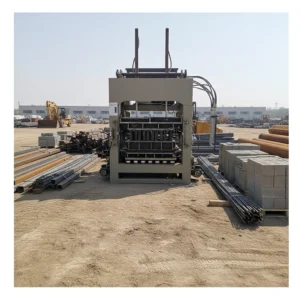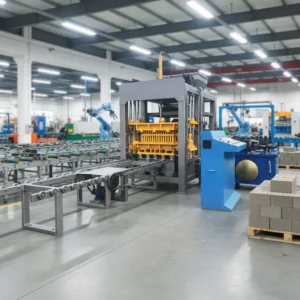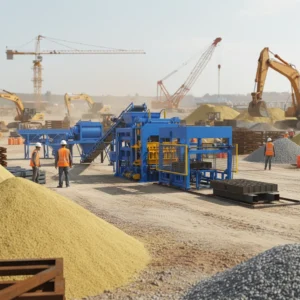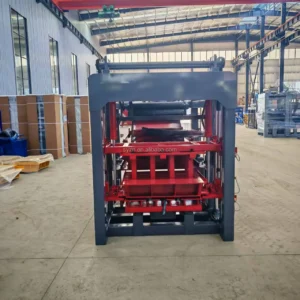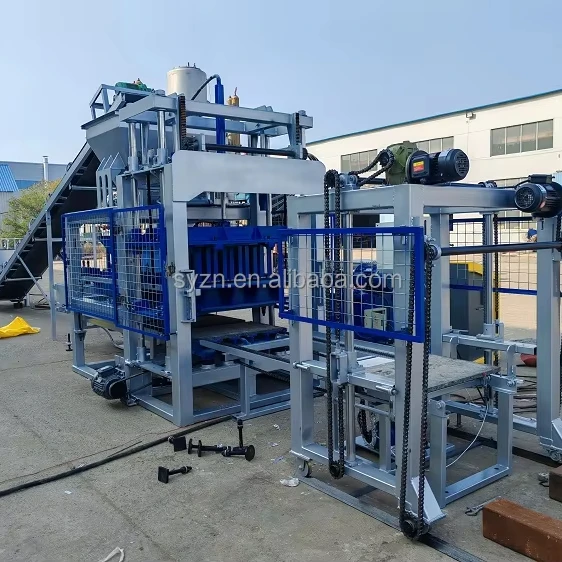
Synchronized Line Rhythm — the QT4-15 block production line turnkey layout maps cycle times across mixer, conveyor, press and stacker so no station sits idle waiting for the next pallet.
Technical Specifications
| Parameter | Value |
|---|---|
| Model | QT4-15 |
| Product Type | Automatic Concrete Block Making Machine |
| Overall Dimensions (L×W×H) | 3900 × 1600 × 2300 mm |
| Molding Cycle | 15–25 s |
| Vibration Force | 40–50 KN |
| Total Power | 24 kW |
| Mixer Model | JQ350 |
| Pallet Size | 850 × 550 × 25 mm |
| Total Weight | 3 T |
| Applied Products | Paver, solid block, hollow block, curbstone |
| Raw Materials | Crushed stones, sand, cement, dust, fly ash |
| Control System | Hydraulic station with vibration |
| Output Capacity (400×200×200 mm hollow, 4 pcs/mould, 15–20 s) | 9,600–13,440 pcs / 8 hr |
| Output Capacity (400×150×200 mm hollow, 6 pcs/mould, 15–20 s) | 14,400–19,200 pcs / 8 hr |
| Output Capacity (240×115×53 mm solid brick, 15–20 s) | 16,200–19,440 pcs / 8 hr |
Application Suitability
| Application | Material or Output |
|---|---|
| Hollow block production for housing projects | Crushed stone, sand, cement and fly ash blended in JQ350 mixer |
| Interlocking paver runs for municipal walkways | Fine aggregate with pigment dosing through the same batching station |
| Solid brick batches for load-bearing walls | Coarse aggregate at shorter cycle settings on the 850×550 mm pallet |
| Curbstone formats for road edge demarcation | Heavier mix designs compacted under full 40–50 KN vibration |
Why "Cycles per Hour" Tells Only Half the Story
A block production line turnkey quotation that quotes the press alone often leaves the buyer discovering on day one that pallets are moved by hand and stacked output sits on the floor. The real throughput of any block line is decided by the slowest transfer point between stations, not by the press’s rated cycle.
I have walked past plants in Europe where a QT4-15 host machine sat idle for half the shift because the upstream batcher could not feed fast enough and the downstream stacker was never specified. The buyer paid for 15-second cycles but ran 30-second ones. [NEED_CITE: Typical bottlenecks in concrete block production lines between press and handling stations] Matching every station to the press rhythm is the only way the rated output becomes the actual output.
How Each Station Connects on the QT4-15 Line
The JQ350 mixer discharges into a belt conveyor sized to match the press’s 15–25 second molding cycle, ensuring the hopper never starves. The host press compacts the mix on 850×550×25 mm pallets fed from a magazine that must hold enough stock to cover curing rack turnover. An automatic stacker collects finished blocks, and a trolley ferries racks to the curing area. Every transfer is timed so the block production line turnkey setup runs without the operator chasing pallets.
Where Line Rhythm Breaks Down
Cycle time on the press is only one variable; the conveyor speed, mixer batch discharge interval and stacker lift cycle must all fall inside the same window. If the mixer takes longer than the press cycle to deliver a fresh batch, the press waits. If the stacker is slower than the press discharge, wet blocks queue on the roller table and risk surface damage. [NEED_CITE: Effects of station mismatch on concrete block line throughput] Specifying these intervals together during the quotation stage prevents the costly retrofits I have seen on sites that bought the press first and asked questions later.
Reading the QT4-15 Numbers That Matter
The 40–50 KN vibration force works with the hydraulic station to consolidate the mix; too little force and hollow blocks crack during de-moulding, too much and the fine aggregate segregates. The 850×550 mm pallet dimension dictates the curing rack slot width and the forklift tine spacing the buyer already has on site. A 15–25 second molding cycle across formats means the mixer must discharge roughly every 20 seconds to keep pace, which is why the JQ350 is paired rather than a smaller pan mixer. The 24 kW total power draw tells the electrician whether a dedicated circuit or a shared bus is needed before the container arrives.
The Cost of Skipping the Line-Level Conversation
Quoting only the host press leaves the buyer to source pallets, stackers and conveyors locally, often in incompatible sizes. Pallet slots on the curing rack end up too narrow for 850×550 mm boards, forcing a reorder. A locally bought stacker may lift too slowly, creating a queue that chips fresh block edges. [NEED_CITE: Hidden costs of unmatched block handling equipment] These issues surface weeks after installation, when the supplier of the press alone has already left the site.
Why This Line Is Specified as One System
The mixer, conveyor, press, stacker and trolley are selected together so transfer points carry the same cycle assumption. Pallet size is locked before the curing rack drawing is released, avoiding dimensional surprises. Voltage, frequency and control language are confirmed before production starts, so the PLC screen reads correctly on day one. Factory tests run the full sequence—batch, convey, press, stack—rather than the press in isolation. Mould drawings cover every format the buyer’s market sells, including interlock and curbstone profiles.
Documentation & Verification
- Line layout showing station spacing and pallet flow path for QT4-15 footprint
- Capacity table stating block format, pieces per mould and cycle for each figure
- Pallet specification sheet matching 850×550×25 mm boards to curing rack slot width
- Hydraulic and electrical schematic confirming 24 kW supply and valve sequence
- Factory test record covering full batch-to-stack run before crate closure
- CE declaration documentation where export market requires machinery directive compliance
Installation, Commissioning & Support
- Foundation pad leveled to 3900×1600 mm press footprint with anchor bolt template provided
- Dedicated 24 kW circuit with correct voltage and frequency confirmed before wiring
- Mixer, conveyor and stacker assembled on-site and belt tension set to press cycle
- First-run parameter dial-in covering vibration duration, hydraulic pressure and feed gate timing
- Operator training on mould change procedure and daily grease points across all stations
- Wear parts list covering hydraulic seals, vibration springs and conveyor belt splices
What to Share Before Quoting the Full Line
Tell us the block formats your market sells and the daily volume each format requires. Provide the raw materials available locally, including aggregate grading and any fly ash or dust proportion. Confirm the curing area dimensions, existing forklift capacity, and the voltage and frequency at the site so the block production line turnkey package arrives ready to run.
Frequently Asked Questions
Q: How is the 8-hour output figure calculated for each block format?
A: Each capacity row in the specification table states the block size, pieces per mould, and cycle time used for the calculation. The 9,600–13,440 pieces figure, for example, assumes 400×200×200 mm hollow blocks at four per mould with a 15–20 second cycle. Changing any one of these variables shifts the result, which is why we always confirm your target format before quoting.
Q: Are the mixer, conveyor, stacker and pallets part of the quotation?
A: Yes, the line configuration includes the JQ350 mixer, belt conveyor, host press, automatic stacker and trolley as one package. Pallet quantity is recommended separately based on your curing area size and the number of racks you plan to circulate during an 8-hour shift.
Q: What happens if station cycle times are not matched?
A: The press waits for the next pallet or the stacker cannot clear finished blocks fast enough, and actual throughput drops below the rated figure. We map every transfer point during the proposal stage so the conveyor discharge, press cycle and stacker lift all fall within the same window.
Q: How many pallets should I order for continuous production?
A: Pallet count depends on curing time and rack capacity. A typical 8-hour shift on the QT4-15 line circulates several hundred 850×550×25 mm boards between press, curing rack and return conveyor. We calculate the exact number once your curing area layout is confirmed.
Q: What plant footprint and utilities does the full line require?
A: The host press alone measures 3900×1600×2300 mm, but the complete line with mixer, conveyor, stacker and curing rack trolley needs a longer bay. A 24 kW power supply at your local voltage and frequency must be available, along with water for the mixer and a level concrete pad with anchor points.