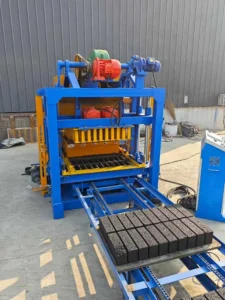
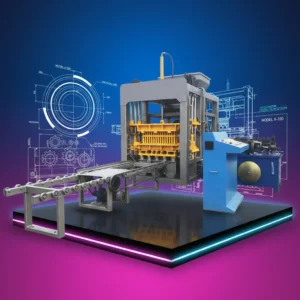
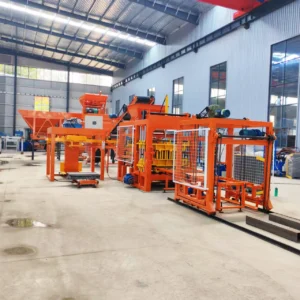
System-Matched Line Design — every station from raw material feeding to stacking is specified against the QT4-15 press cycle so no upstream or downstream bottleneck limits actual output.
Technical Specifications
| Parameter | Value |
|---|---|
| Model | QT4-15 |
| Product Type | Hydraulic Automatic Block Making Machine |
| Control System | PLC, fully automatic computer control |
| Vibration Mode | Multiaxis synchronizer vibration, vertically downward |
| Hydraulic System | High thermal efficiency, low heat generation |
| Mixer System | Multiaxis forced mixer, adaptable to varied raw materials |
| Guide Bearing | Long-period over-length guide bearing for accurate mould movement |
| Rack Construction | High-strength steel, special welding technique |
| Automation Level | Fully automatic |
| Output Capacity | 900–1200 pcs/h (based on 400×200×200mm hollow block, 4 pcs/mould) |
| Output Capacity | 2880–3840 pcs/h (based on 200×100×60mm paver, 16 pcs/mould) |
| Output Capacity | 5930–6720 pcs/h (based on 240×115×53mm solid brick, 28 pcs/mould) |
| Cycle Time | 15–20 s (per format stated above) |
| Mould Formats | Hollow block, solid brick, paving brick, porous brick, multicellular brick |
| Warranty | 1 year for the whole machine (excluding spare parts) |
Application Suitability
| Application | Material or Output |
|---|---|
| Hollow block production | Crushed stone, cement, sand, and fly ash for load-bearing walls |
| Paving brick production | High-density concrete mixes for walkways and parking lots |
| Solid brick production | Fine aggregate and cement for structural masonry units |
| Porous brick production | Lightweight aggregate blends for thermal insulation walls |
What "1200 Pieces per Hour" Leaves Out About Line Capacity
The press cycle means nothing if the mixer cannot feed fast enough or the stacker cannot clear pallets in time.
When buyers evaluate an automatic block making machine production line, the headline number is almost always the press cycle rated in isolation. In practice, the mixer output rate, pallet feed speed, and stacking interval all sit in series with the press. If any one of those stations runs slower, the press sits idle for a portion of every cycle, and daily output drops noticeably below the quoted figure [NEED_CITE: line synchronization principles for concrete block plants]. I have seen projects where the press was correctly sized but the pallet return conveyor was undersized, causing the operator to pause the line every few minutes to clear a jam.
Matching Every Station to the QT4-15 Press Cycle
The QT4-15 cycles every 15–20 seconds depending on block format. For the automatic block making machine production line to sustain that rhythm, the multiaxis forced mixer must deliver a fresh batch to the hopper within the same window, and the pallet feeder must present a clean, cured pallet before the mould descends. The PLC coordinates these intervals so that the press, mixer, and pallet stations run as one continuous loop rather than independent machines waiting on each other.
Where Line Bottlenecks Typically Hide
Bottlenecks rarely appear on the first day of commissioning. They surface once the operator settles into a steady rhythm and a secondary station falls a few seconds behind [NEED_CITE: commissioning observations in block production plants]. A common example is the stacking station: if the automatic stacker takes longer to cube a layer than the press takes to fill the next pallet, the line accumulates a small delay that compounds across an eight-hour shift.
Reading the Specs That Actually Determine Output
Hydraulic pressure and vibration force together set the density and strength of each block, but those values only matter if the raw material feed is consistent. The long-period over-length guide bearing keeps the upper mould aligned with the mould box across thousands of cycles, reducing uneven wear that leads to dimensional drift. The high-strength steel rack with special welding resists vibrating shock over sustained runs, maintaining frame geometry. Voltage and frequency must be confirmed before production so the PLC and hydraulic pump motors run within their rated envelope once the line arrives on site [NEED_CITE: voltage and frequency standards by export market].
The Cost of Specifying Stations in Isolation
When the mixer, press, and handling equipment are sourced from separate suppliers, integration gaps appear at the connection points. The pallet size chosen for the press may not match the curing racks the buyer already owns, forcing a manual re-stack at the end of the line. Voltage mismatches between the PLC and the local grid can delay commissioning by weeks while replacement transformers are shipped [NEED_CITE: typical commissioning delays from electrical mismatch].
Why Sourcing the Full Line from One Supplier Matters
Shandong Shiyue Intelligent Machinery Co., Ltd focuses exclusively on block machinery, so the press, moulds, pallets, and handling equipment are specified as one matched system. The multiaxis forced mixer is selected against the buyer’s actual raw material and target block format, not a catalogue default. Line layout drawings show cycle time at every station, stated per block format, so the buyer can verify capacity before the order is placed. PLC display language and voltage are confirmed in writing before production to avoid delays at commissioning.
Documentation & Verification
- Line layout drawing with cycle time stated per block format at each station
- Machine specification sheet covering press, mixer, and handling equipment
- Factory test record on buyer’s target block format before dispatch
- Hydraulic and electrical schematic matching as-built configuration
- Voltage, frequency, and PLC language confirmation document
- Wear parts and mould list with part numbers for reordering
Installation, Commissioning & Support
- Foundation plan sized to the QT4-15 rack footprint and vibration load
- Power supply specification matching confirmed voltage and frequency
- Assembly sequence for press, mixer, and pallet handling stations
- First-run parameter setting on buyer’s local aggregate and mix design
- Operator training covering PLC interface and mould change procedure
- Wear parts catalogue with hydraulic seals and vibration components listed
What to Include with Your Inquiry
Provide the block formats you intend to produce, along with target daily output for each format and the raw materials available locally. State the voltage and frequency at your site, the PLC display language your operators require, and the dimensions of your existing curing area and forklift capacity so pallet size can be matched from the start.
Frequently Asked Questions
Q: How is line capacity calculated, and which block format does the hourly figure assume?
A: Every capacity figure we quote names the block format, mould cavity count, and cycle time it assumes. For the QT4-15, the 900–1200 pieces per hour figure is based on the 400×200×200mm hollow block with four cavities per mould. A different format changes both the cavity count and cycle time, so the hourly number shifts accordingly.
Q: How do I match the mixer output rate to the press cycle?
A: The multiaxis forced mixer must deliver a full batch to the press hopper within the same 15–20 second window the press uses for one cycle. We calculate the batch volume from the target block format and select a mixer whose discharge rate keeps the hopper topped up without overflow.
Q: What pallet size should I choose based on my curing area?
A: Pallet dimensions must match both the mould area of the QT4-15 and the spacing of your curing racks. We confirm your rack dimensions and forklift capacity before specifying pallet size and material, so pallets move from press to rack to dispatch without manual rehandling.
Q: What electrical details must be confirmed before the line ships?
A: Voltage, frequency, and PLC display language are confirmed in writing before production begins. This ensures the hydraulic pump motor, vibration motor, and control panel all match your site supply, and that operators can read alarms and cycle data in their working language.