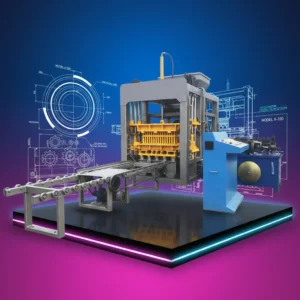
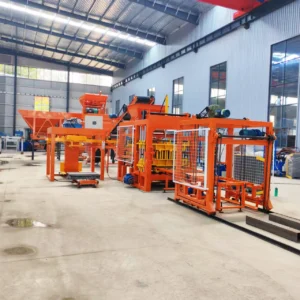
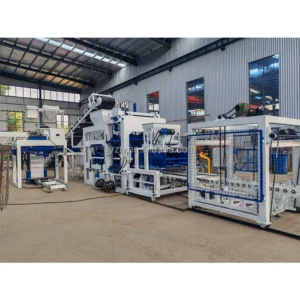
Matched Line Integration — the Qt4-25 is specified alongside its pallet feed, mixer discharge and stacker cycle times so the press never waits for upstream or downstream stations.
Technical Specifications
| Parameter | Value |
|---|---|
| Model | Qt4-25 |
| Product Type | Automatic Concrete Block Making Machine |
| Control System | PLC controlled fully automatic |
| Machine Power | 16.58 kW |
| Molding Cycle | 25 seconds |
| Capacity | 4600 pcs / 8 h (basis not stated in source — confirm block format and mix) |
| Machine Weight | 5000 kg |
| Overall Size | 6400 × 1500 × 2700 mm |
| Pallet Size | 850 × 480 mm |
| Pressure Type | Vibration motor based (non-hydraulic) |
| Vibration System | Large vibration box with vibration motor |
| Motor Brand | Siemens |
| Voltage | Configured to local supply |
| Automation Level | Fully automatic pallet feeding, material feeding, scraping and block stacking |
| Raw Materials | Concrete, sand, cement, fly ash, crushed stone, lime, water |
| Warranty | One year |
Application Suitability
| Application | Material or Output |
|---|---|
| Hollow block production for medium-scale plants | Crushed stone, sand, cement, fly ash blends |
| Solid block manufacturing | Concrete and lime-based mixes |
| Paving block and interlocking brick runs | Fine aggregate with cement binder |
| On-site contractor block supply | Locally sourced sand and crushed stone |
What "4600 Pieces per Shift" Actually Means on the Floor
The figure only holds when the entire automatic block machine production line — mixer, pallet return and stacker — keeps pace with a 25-second press cycle.
I have watched a Qt4-25 sit idle for seconds each cycle because the upstream mixer could not discharge fast enough, and the line output dropped well below the quoted number. When buyers evaluate an automatic block machine production line, the press capacity is only one station in a chain. If the pallet return conveyor lags or the stacker cannot clear cured blocks quickly enough, the bottleneck simply moves down the line [NEED_CITE: typical block line bottleneck analysis].
Synchronizing Every Station Around the 25-Second Cycle
The Qt4-25 automatic block machine production line is built around a single timing reference: the 25-second molding cycle. The PLC coordinates pallet indexing, material feed, vibration and scraper movement so that each station finishes its task just before the press demands the next pallet. When the mixer, pallet feeder and stacker share this clock, the press runs continuously instead of pausing between cycles.
How the Pallet Loop Sets the Real Throughput
Pallets travel from the press to the curing area and back. If the return conveyor cannot deliver a clean pallet within the 25-second window, the press waits. The Qt4-25 line includes an automatic pallet feeder sized to hold enough pallets for uninterrupted runs, and the stacker clears finished blocks at a rate matched to the press output [NEED_CITE: pallet circulation requirements in block plants]. This closed-loop handling is where many quoted capacities fall apart in practice.
Reading the Specs That Decide Daily Output
The 16.58 kW machine power drives both the vibration box and the material feed system. Vibration frequency and amplitude determine how densely the concrete settles in the mould cavity, which in turn sets block strength and demoulding integrity. The 850 × 480 mm pallet size dictates how many blocks fit per cycle; switching to a larger format reduces the number of cavities and therefore the pieces-per-hour figure. The non-hydraulic, vibration-motor pressure system means mould change relies on mechanical adjustment rather than hydraulic clamp release, so changeover time must be factored into format flexibility planning. Siemens motors on the vibration box provide consistent amplitude across shifts, reducing density variation from one batch to the next.
When Line Stations Are Spec’d in Isolation
A buyer who purchases the press, mixer and stacker from three different suppliers often discovers that the mixer discharges in 40-second batches while the press needs material every 25 seconds. The result is a press that idles through a third of its available time. Similarly, a stacker rated for a slower cycle leaves wet blocks sitting on pallets too long, risking surface damage before curing begins [NEED_CITE: equipment mismatch consequences in concrete product lines]. These mismatches do not show up on individual spec sheets — they only appear once the line is running.
Why Specifying the Whole Line Together Matters
Block machinery is our single focus, so the Qt4-25 press, moulds, pallets and handling equipment are specified as one matched system rather than assembled from separate vendors. The configuration is set against the buyer’s actual mix design, local aggregate and target block format, not a catalogue default. Mould design covers the formats the buyer’s market sells, including custom drawings where needed. Automation level is selectable — a buyer can start with semi-automatic pallet handling and add the auto stacker later without replacing the press. Installation support includes operator training so the crew understands the timing relationships between stations from day one.
Documentation & Verification
- Line layout drawing showing Qt4-25 footprint alongside mixer, pallet return and stacker positions
- Capacity calculation sheet stating the exact block format and mix assumed for the 4600-piece figure
- Voltage and PLC display language confirmation signed off before production begins
- Factory test record run on the buyer’s specified block format before dispatch
- Hydraulic and electrical schematic for the pallet feed and stacking circuits
- Wear parts and mould list with part numbers for reordering
Installation, Commissioning & Support
- Foundation pad sized for the 5000 kg Qt4-25 plus dynamic vibration load
- Dedicated power circuit matching the 16.58 kW total draw at confirmed local voltage
- Machine arrives dismantled; reassembly covers vibration box alignment and pallet conveyor tensioning
- First-run commissioning sets PLC timing for 25-second cycle across all stations
- Operator training covers mould change procedure and pallet loop troubleshooting
- Spare vibration motor and scraper blade included for initial maintenance cycle
What to Share Before Requesting a Line Quote
To size the Qt4-25 automatic block machine production line accurately, provide your target block formats with dimensions, expected daily output, and the local aggregate and cement types you plan to use. Include your workshop length, width and clear height so the pallet return and curing rack layout can be drafted. Confirm your site voltage, frequency and preferred PLC display language so the electrical package is built correctly before the machine leaves the factory.
Frequently Asked Questions
Q: Is the 4600-piece capacity valid for every block format the Qt4-25 can produce?
A: No. That figure is calculated on a specific block size and mix that must be confirmed before the quotation is finalized. Larger formats such as 200 mm hollow blocks reduce the number of cavities per mould, lowering pieces per cycle. We provide a capacity calculation for each format you plan to run so you can compare realistic daily outputs.
Q: How do you ensure the mixer keeps up with the 25-second press cycle?
A: We match the mixer batch size and discharge time to the material volume consumed per Qt4-25 cycle. If the mixer takes longer than 25 seconds to discharge, the press idles. Our line proposals include the mixer model and its timed discharge rate so you can verify the upstream station will not become a bottleneck.
Q: Will the 850 × 480 mm pallets work with my existing curing racks and forklift?
A: Pallet dimensions must match both the curing rack slot width and the forklift tine spacing at your plant. We confirm these measurements before production so pallets move smoothly from the Qt4-25 stacker to the curing area without manual repositioning or rack modification.
Q: Can I add the automatic stacker later if I start with manual pallet handling?
A: Yes. The Qt4-25 PLC is pre-wired for stacker integration, so adding the automatic stacking module later requires mechanical mounting and a short PLC program update rather than a full control replacement. This lets you scale automation as production volume grows.
Q: What space does the full line occupy beyond the 6400 × 1500 × 2700 mm press?
A: The mixer, pallet return conveyor, stacker and curing rack transfer all add to the footprint. We supply a line layout drawing showing each station’s position and the minimum clearance needed for pallet circulation and operator access, so you can plan the workshop floor before equipment arrives.