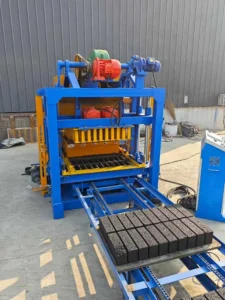
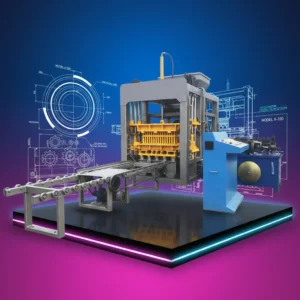
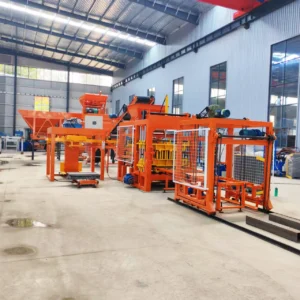
Integrated line engineering — Every station from raw material feeding through stacking is sized against the QT4-16 cycle rate, so the press never idles while upstream or downstream equipment catches up.
Technical Specifications
| Parameter | Value |
|---|---|
| Model | QT4-16 |
| Product Type | Automatic Hydraulic Concrete Block Making Machine |
| Overall Dimension | 7400 × 1950 × 2800 mm |
| Total Mass | 5 T |
| Rated Pressure | 21 MPa |
| Main Vibration Form | Platform Vibration |
| Vibration Frequency | 2800–4500 r/min |
| Vibration Force | 40 KN |
| Pallet Size | 900 × 550 mm |
| Molding Cycle | 15–20 s (basis not stated in source — confirm block format / material / thickness) |
| Demolding Method | Hydraulic |
| Control System | PLC intelligent control with man-machine interface, malfunction diagnosis and remote control function |
| Automation Level | Full Automatic |
| Factory Area | 600 m² |
| Raw Materials | Crushed stone, sand, cement, fly ash, gravel, slag and similar aggregates |
| Key Features | Adjustable vibration frequency, hydraulic demolding, PLC with malfunction diagnosis, remote control capability |
Application Suitability
| Application | Material or Output |
|---|---|
| Hollow block production for residential and commercial walls | Crushed stone, sand, cement and fly ash blends |
| Solid block manufacturing for load-bearing structures | Gravel, sand and cement mixes with local aggregate |
| Paving block and colored paver runs for roads and walkways | Fine aggregate, cement and pigment additives |
| Interlocking brick and kerbstone for landscaping and drainage | Slag, dust, sand and cement combinations |
| On-site production for housing and development projects | Locally sourced aggregate matched to project specifications |
What a 15-Second Cycle Time Actually Means for Your Line
The press cycle is only one node — daily throughput depends on every station around it keeping pace.
Buyers often see a 15–20 second molding cycle on the QT4-16 spec sheet and multiply it into a daily figure, then watch real output fall well short once the line is running. The reason is almost always upstream or downstream: the mixer batch size does not match the hopper draw rate, the pallet feeder jams on warped boards, or the stacking station cannot clear cured blocks fast enough [NEED_CITE: common bottlenecks in block production lines]. When any single station stalls, the press sits idle and that cycle time becomes meaningless. Designing an automatic block machine production line means calculating throughput at every transfer point, not just at the press.
How Raw Material Feeding and Mixing Must Sync with the Press
The QT4-16 draws from a hopper that must stay charged without overflowing, which means the mixer batch size and discharge interval have to align with the press consumption rate. A mixer that discharges too slowly forces the press into a wait state between batches, while one that dumps too quickly risks material segregation in the hopper. Matching the mixer output to the press demand is a core requirement for any automatic block machine production line to sustain its rated cycle.
Pallet Circulation as the Hidden Bottleneck
The 900 × 550 mm pallets cycle through the press, the curing racks and back to the feeder in a closed loop. If the curing rack handling system cannot accept pallets as fast as the press releases them, wet blocks accumulate on the transfer conveyor and begin to deform under their own weight [NEED_CITE: pallet handling impact on block quality]. Sizing the pallet return path and curing rack capacity to the QT4-16 output rate prevents this pile-up and keeps the press running continuously.
Reading the Specs: What Each Number Controls on the Line
The 21 MPa rated hydraulic pressure works together with the 40 KN vibration force to compact the mix into a dense, close-grained block — neither parameter alone determines the outcome, because vibration distributes the material while pressure locks it in place. The adjustable vibration frequency range of 2800–4500 r/min lets the operator tune the energy input to different mix designs; a dry, coarse aggregate blend needs higher frequency to settle, while a wetter fly-ash mix requires less to avoid slumping. The 900 × 550 mm pallet size directly dictates the curing rack dimensions and the forklift tine width needed to move stacked racks — specifying pallets without confirming the existing curing area layout creates a mismatch that surfaces only after the line is installed. PLC control with malfunction diagnosis allows a single operator to monitor the entire automatic block machine production line from the interface and trace stoppages to the exact station.
When Stations Are Mismatched After Arrival
A buyer who sources the QT4-16 press from one supplier and the pallet handling, stacking and curing equipment from separate vendors often discovers timing gaps that no amount of on-site adjustment can fully close. The press completes a cycle and waits for the stacker to clear the previous pallet, losing seconds that compound across a shift into a significant daily shortfall [NEED_CITE: integration risks with multi-vendor block lines]. Pallet dimensions ordered without reference to the curing rack spacing mean boards either do not fit the racks or leave wasted space that reduces rack density.
Why Sourcing the Full Line from One Engineering Team Matters
Block machinery is our single focus, which means the QT4-16 press, its moulds, pallets and every handling station are specified as one matched system rather than assembled from unrelated suppliers. Configuration starts from your actual mix design, local aggregate properties and target block format, not a catalogue default — the vibration frequency and hydraulic pressure are set to produce consistent strength with the materials you can actually source. Mould design covers the specific formats your market sells, including custom drawings when standard options do not fit. Automation level is selectable so you can begin with semi-automatic pallet handling and expand to full automatic stacking and cubing as demand grows. Installation includes on-site commissioning and operator training so the line reaches steady-state operation under your team’s control.
Documentation & Verification
- Line layout drawing showing every station from material intake to stacking with cycle times matched
- Capacity calculation stating the specific block format and mix assumed for each output figure
- Pallet specification confirmed against your curing rack spacing and forklift capacity
- Hydraulic and electrical schematic for local service and troubleshooting
- Voltage, frequency and PLC display language written confirmation before production
- Factory test record run on your block format before the line is dismantled for shipment
Installation, Commissioning & Support
- 600 m² factory area plan with foundation loads for the 5 T QT4-16 press and supporting stations
- Dedicated power circuit sized to the PLC control system and hydraulic pump motor requirements
- Line dismantled into container-load modules with reassembly sequence documented in packing photographs
- On-site commissioning with cycle time verification across your selected block format and mix
- Operator training covering PLC malfunction diagnosis, mould change procedure and daily maintenance points
- Wear parts and mould list supplied with first-order spare recommendations based on your production schedule
Before You Request a Quote
Send us your target block format and daily output requirement so we can calculate which stations the automatic block machine production line needs and at what capacity. Confirm your local aggregate type, available voltage and frequency, and the PLC display language your operators will use. If you already have curing racks or forklifts on site, share their dimensions so pallet size can be matched before the line is designed.
Frequently Asked Questions
Q: How is daily output calculated across the full line, not just the press cycle time?
A: We map every station — mixer discharge, pallet feed, press cycle, stacking and curing rack handling — and calculate the slowest transfer point. Daily output is stated per block format with the mix design assumed, so the figure reflects what the complete line delivers rather than what the QT4-16 alone could theoretically achieve in isolation.
Q: What supporting equipment stations must be included so the press runs without idle gaps?
A: At minimum, the line needs a matched mixer and hopper, a pallet feeder sized to the 900 × 550 mm boards, a transfer system to the curing racks, and a stacking or cubing station. Each is timed to the QT4-16 cycle so no station forces the press into a wait state during continuous production.
Q: How are pallet size and material selected to match the curing area and handling equipment?
A: We confirm your curing rack dimensions, rack spacing and forklift tine width before finalizing the 900 × 550 mm pallet specification. Material — typically bamboo, PVC or steel — is chosen based on your local humidity, expected pallet lifespan and the weight of fully loaded racks your forklift must move.
Q: What voltage, frequency and control language confirmations are needed before the line ships?
A: We need your site voltage and frequency written confirmation, plus the PLC display language your operators will read daily. These are locked before the QT4-16 enters production so the control panel, motor ratings and transformer specifications match your supply on arrival.
Q: How is mould change time factored into realistic line throughput across multiple block formats?
A: Each mould change on the QT4-16 requires the press to stop, the old mould to be unbolted and the new one seated and aligned. We estimate the changeover duration for your specific mould set and deduct that time from the shift when calculating daily output across multiple formats, so the figure accounts for the format switches your schedule actually requires.