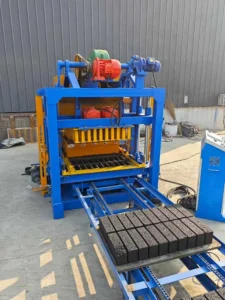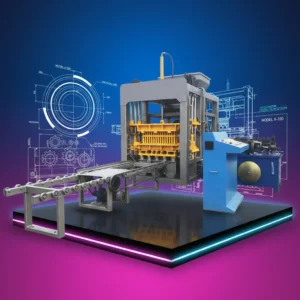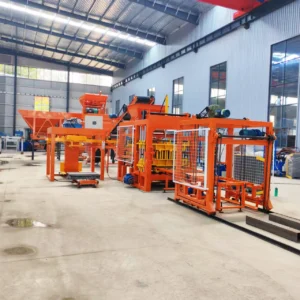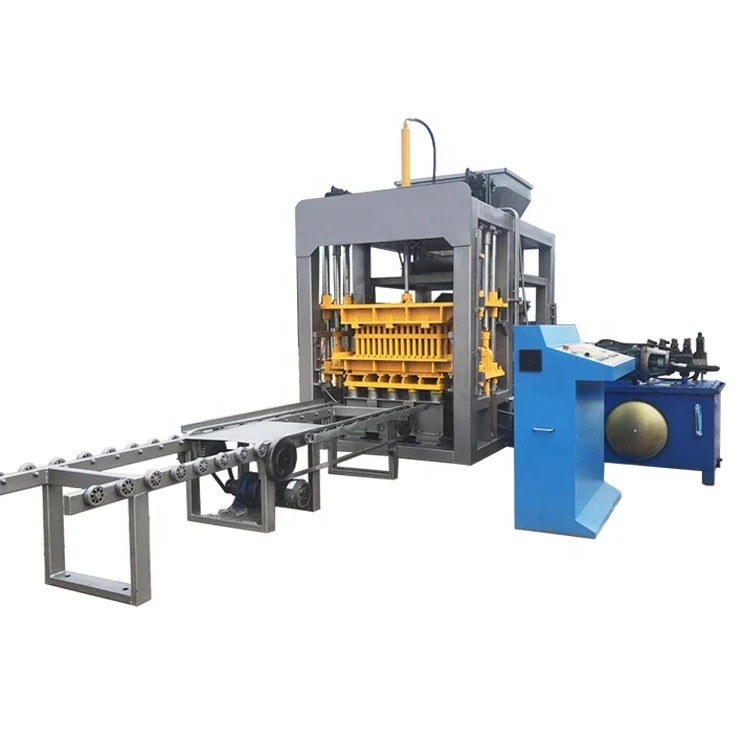
Matched System Engineering — the QT5-15 press is specified alongside raw material feeding, mixing, pallet circulation and stacking so every station sequences to one cycle rather than fighting for floor space and timing.
Technical Specifications
| Parameter | Value |
|---|---|
| Model | QT5-15 |
| Product Type | Automatic Hydraulic Concrete Block Making Machine |
| Rated Power | 26.5 kW |
| Voltage & Frequency | Configurable to buyer’s local supply (confirm before production) |
| Control System | PLC Controller with electric-hydraulic interlocking (display language to be confirmed) |
| Hydraulic Pressure | 16–21 MPa |
| Vibration Force | 45 kN |
| Main Vibration Form | Platform Vibration |
| Molding Cycle | 15–20 seconds (basis not stated in source — confirm block format, material and thickness) |
| Pallet Size | 1100×550 mm |
| Overall Dimensions (L×W×H) | 7400×1950×2800 mm |
| Net Weight | 6000 kg |
| Applied Products | Hollow blocks, solid blocks, porous blocks, paving blocks, interlocking blocks, curbstone, colored pavers |
| Raw Material Compatibility | Crushed stone, sand, cement, fly ash, dust, gravel, slag and other aggregates |
| Theoretical Output — Hollow Block | 7,200–9,600 pcs/day (based on 400×200×200 mm, 5 pcs/mould, 15–20 s cycle) |
| Theoretical Output — Porous Block | 23,000–28,800 pcs/day (based on 240×115×90 mm, 16 pcs/mould, 15–20 s cycle) |
| Theoretical Output — Standard Block | 61,440–70,400 pcs/day (based on 240×115×53 mm, 32 pcs/mould, 15–17 s cycle) |
| Automation Level | Automatic with electric-hydraulic interlocking control |
| Key Features | Platform vibration, PLC-controlled station sequencing, configurable voltage and language, multi-format mould compatibility |
Application Suitability
| Application | Material or Output |
|---|---|
| Hollow block production for residential and commercial walls | Crushed stone, sand, cement and fly ash mixes on 1100×550 mm pallets |
| Paving block and colored paver runs for roads and landscapes | Fine aggregate and pigment blends under 16–21 MPa hydraulic pressure |
| Porous and interlocking brick for municipal drainage projects | Permeable aggregate gradings with extended vibration dwell |
| Kerbstone and solid block for infrastructure contractors | Heavy-mix designs requiring maximum platform vibration at 45 kN |
| On-site plant for housing or development projects | Line footprint arranged around 7400×1950×2800 mm press envelope |
Why the QT5-15 Automatic Block Machine Production Line Must Be Read as a Whole
A press that cycles every 15 seconds is useless if the pallet feeder arrives every 22.
When I spent years running service calls across the Pearl River Delta, the breakdowns were rarely the press itself. More often, a mixer discharged too slowly and the hopper ran dry mid-cycle, or a pallet return conveyor jammed because its motor was sized for a smaller machine. The buyer had purchased a fast press and a slow line. [NEED_CITE: common causes of block plant downtime in field service reports] The QT5-15 automatic block machine production line addresses this by sizing every upstream and downstream station to the same cycle envelope, so the press never waits for material, pallets or stacking clearance.
Station Synchronization Across the Material Path
Raw material feeding, the mixer discharge gate, the pallet magazine and the stacker all receive their trigger signals from the same PLC that governs the press ram. This electric-hydraulic interlocking means a pallet cannot enter the press until the previous one has cleared, and the mixer cannot dump a new batch until the hopper level sensor confirms space. The QT5-15 automatic block machine production line therefore runs as one timed loop instead of several independent timers that drift apart over a shift.
Pallet Circulation and the Curing Bottleneck
The 1100×550 mm pallet dimension is not chosen in isolation. It must match the curing rack spacing the buyer already has, and the fork truck tine width on site. When pallet size is confirmed against those two constraints before production, wet blocks move from press to rack without a manual re-stack. If the pallet is too long for the rack, operators spend every cycle trimming the layout by hand. [NEED_CITE: pallet sizing considerations for concrete block curing areas] The line specification therefore starts with a site survey of rack dimensions and handling equipment before the pallet order is released.
Reading the Numbers Behind 45 kN and 16–21 MPa
Platform vibration at 45 kN compacts the aggregate while hydraulic pressure at 16–21 MPa holds the mould walls rigid during the shake. If pressure is too low for a given mix, the block slumps before the cement hydrates enough to hold shape; if vibration is too high for a fine-sand mix, the material liquefies and bleeds water to the surface. The correct pairing depends on the buyer’s local aggregate grading and cement type, which is why mix design confirmation precedes machine build. A 26.5 kW rated power budget must also cover the mixer, conveyor motors and PLC panel without tripping a shared breaker, so the electrical single-line drawing lists every station’s draw before the panel is wired.
What Happens When Stations Are Specified Separately
A buyer once sourced the press from one supplier and the pallet return system from another. The return conveyor ran on a fixed-speed motor that could not adjust to the press cycle, so pallets piled up at the press exit and operators had to pull them off by hand every few minutes. Over a ten-hour shift that manual intervention added up to lost output and two extra labourers. [NEED_CITE: impact of mismatched station cycle times on daily block output] Sourcing the QT5-15 automatic block machine production line as one package eliminates that interface gap because the PLC code is written and tested with every station connected before the line ships.
Why This Line Is Specified as One Package
Block machinery is our single focus, so the press, mould, pallet and handling equipment are engineered together rather than assembled from unrelated suppliers. Configuration is set against the buyer’s actual mix design, local aggregate and target block format instead of a catalogue default. Mould design covers the formats the buyer’s market sells, including custom drawings when a non-standard kerb or paver profile is needed. Automation level is selectable, allowing a buyer to start with semi-automatic pallet handling and add a stacker later without replacing the press. Installation support includes operator training on the full line, not just the press controls.
Documentation & Verification
- Line layout drawing showing station spacing and pallet path for the 7400×1950×2800 mm press envelope
- Capacity calculation stating the exact block format and cycle time behind each output figure
- Hydraulic and electrical schematics covering every station, not the press alone
- Voltage, frequency and PLC display language confirmation sheet signed before production
- Factory test record run on the buyer’s specified mould and pallet combination
- Wear parts and mould list for the press and all upstream and downstream stations
Installation, Commissioning & Support
- Foundation plan sized to the 6000 kg net weight and 26.5 kW power draw of the full line
- Dedicated circuit specification for the PLC panel and 16–21 MPa hydraulic pump unit
- Dismantling and container loading plan so the 7400 mm frame fits standard 40-foot containers
- On-site commissioning with station-by-station sequence verification before full-speed runs
- Operator training covering PLC fault screens, mould change procedure and pallet magazine loading
- First-year spare parts kit including hydraulic seals, vibration springs and proximity sensors for every station
What to Include in Your Inquiry
Tell us the block formats your market currently sells and the daily volume you need for each. Share the local aggregate types and any existing curing racks or fork trucks so the 1100×550 mm pallet can be confirmed or adjusted. Provide your site voltage and frequency, preferred PLC display language, and the yard dimensions available for the line footprint.
Frequently Asked Questions
Q: How is daily capacity calculated across the full line, and which block format is the figure based on?
A: Each capacity figure in our proposal names the exact block dimensions, pieces per mould and cycle seconds behind it. For example, hollow block output of 7,200–9,600 pcs/day assumes a 400×200×200 mm block, 5 pcs/mould and a 15–20 second cycle. The line layout confirms that feeding, mixing and stacking can sustain that rate without becoming the slowest station.
Q: How do raw material feeding, mixing and pallet feeding stations match the press cycle so it is not left waiting?
A: Every station receives its start signal from the same PLC that controls the press ram. The mixer discharges only when the hopper sensor confirms space, and the pallet magazine releases a pallet only after the previous one clears the press exit. This interlocking prevents the press from idling while upstream or downstream stations catch up.
Q: Which pallet size and material are specified, and how does that account for the curing area and forklift on site?
A: The standard pallet is 1100×550 mm, but we confirm the choice against your existing curing rack spacing and fork truck tine width before production. If your racks are narrower, we adjust pallet length so wet blocks transfer directly from press to rack without manual re-stacking.
Q: What voltage, frequency and PLC language are confirmed before shipment, and who handles commissioning?
A: Voltage and frequency are matched to your local supply and written into the production order. PLC display language is confirmed at the same stage. Our technicians travel to site for commissioning, running each station through its sequence before full-speed production begins, and training your operators on the complete line.
Q: Which wear parts are stocked for the press and supporting stations, and what is the lead time for replacements?
A: The spare parts list covers hydraulic seals, vibration springs, proximity sensors and mould wear plates for the press plus belts, bearings and motors for the mixer and conveyors. We provide the full list with the quotation so you can order a first-year kit alongside the machine, avoiding a line stop while waiting for a single component.