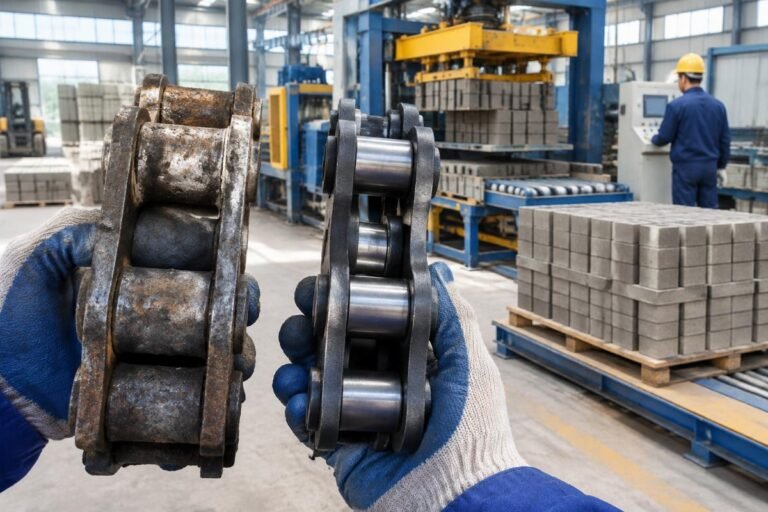
Concrete Block Machine Alignment & Calibration: Factory-Direct Supplier
Most cracked blocks are not caused by bad cement, but by a vibration table that is off by mere millimeters.
Proper alignment and calibration are the root causes of block density uniformity and structural integrity; neglecting millimeter-level tolerances leads to high rejection rates regardless of raw material quality. To achieve consistent production, operators must prioritize vibration table leveling, mold box parallelism, and motor phase synchronization over adjusting mix ratios.
I still recall the urgent email from a client in Monterrey, Mexico. He had just installed a new QT6-15 line and was furious, claiming the machine was scrap metal because every brick emerged with hairline cracks and uneven density. He blamed the cement supplier and the sand quality. When I arrived at his plant, the raw materials were fine. The issue was invisible to the naked eye but catastrophic in operation: the vibration table was not level, and the mold box was tilted by nearly two millimeters. The vibration motors were also out of phase, creating chaotic rather than synchronous force. After spending a day recalibrating the frame and synchronizing the motors, the machine produced perfect, dense blocks. This experience reinforced a critical truth in our industry: precision in Concrete Block Machine Alignment and Calibration is non-negotiable. [NEED_CITE: impact of mechanical alignment on concrete compaction uniformity]

Ignoring these mechanical fundamentals turns a high-capacity production line into a source of waste. Below, we break down the essential protocols for maintaining this precision.
Why Does My Block Machine Produce Cracked Bricks?
Misalignment is the primary culprit behind structural failures, not just material composition.
When a block cracks during ejection or shortly after curing, the immediate assumption is often that the water-cement ratio is wrong or the aggregate is too coarse. While mix design matters, mechanical misalignment creates uneven stress distribution that no amount of chemical adjustment can fix. If the vibration table is not perfectly horizontal, the compaction force is applied asymmetrically. One side of the mold receives intense pressure while the other remains loose. This differential density causes internal stresses that manifest as cracks once the block is released from the mold. [NEED_CITE: relationship between uneven compaction and tensile strength failure in concrete masonry units]
Furthermore, a misaligned mold box increases friction against the guide rods. Instead of sliding smoothly, the mold binds, causing jerky movements during the pressing cycle. This irregular motion disrupts the settling of the concrete mix, leading to voids and weak spots. In my years of troubleshooting installations across Latin America and Africa, I have seen plants replace entire batches of cement only to find the problem persisted until they leveled the machine frame. The solution lies in rigorous Concrete Block Machine Alignment and Calibration checks before blaming the raw materials.

Critical Calibration Points for Vibration Systems
Leveling the table and synchronizing motors are the foundations of consistent block density.
The vibration system is the heart of any block making machine. Its job is to eliminate air voids and pack the aggregate tightly. However, this only works if the force is uniform and directed vertically. Two key factors determine this: the horizontal level of the table and the phase sequence of the vibration motors.
First, the vibration table must be leveled with extreme precision. Using a high-accuracy spirit level, check the frame in both longitudinal and transverse directions. Any deviation causes the concrete to shift toward the lower side during vibration, resulting in blocks that are denser on one end and porous on the other. For machines like the QT series, the tolerance should be minimal to ensure even force distribution. [NEED_CITE: ISO standards for vibration equipment installation and leveling tolerances]
Second, the vibration motors must be synchronized. Most automatic lines use dual vibration motors. If their electrical phases are not matched, they will vibrate out of sync, canceling each other’s force or creating lateral shaking instead of vertical compaction. This not only reduces efficiency but also accelerates wear on bearings and structural welds. Verifying the phase sequence ensures that both motors reach their peak force simultaneously, delivering the maximum compaction energy to the mold. Proper Concrete Block Machine Alignment and Calibration of the vibration system prevents premature motor burnout and ensures every block meets density specifications.

Mold Box Alignment: Ensuring Dimensional Accuracy
Checking verticality and parallelism tolerances prevents dimensional errors and rapid wear.
The mold box is where the concrete takes shape. If it is not aligned correctly, the resulting blocks will have inconsistent dimensions, making them unsuitable for interlocking applications or standard construction. More importantly, misalignment causes excessive friction between the mold and the machine’s guide columns.
To check alignment, use dial indicators to measure the verticality of the mold box sides. The mold must move strictly up and down without any lateral tilt. Parallelism between the top and bottom plates is equally critical. If the plates are not parallel, the hydraulic pressure will be uneven, leading to blocks that are thicker on one side. This uneven pressure also strains the hydraulic cylinders and can cause seal failures. [NEED_CITE: mechanical tolerance standards for precast concrete mold manufacturing]
In a high-volume paver production facility in East Africa, we encountered an issue with uneven color distribution on the surface of the blocks. The mix was consistent, but the surface finish varied. Upon inspection, we found that the mold box had drifted out of parallelism after thousands of cycles. Recalibrating the mold alignment restored the uniform surface finish. Regular checks of mold box verticality and parallelism are a vital part of Concrete Block Machine Alignment and Calibration, ensuring that the machine produces dimensionally accurate products without excessive wear on moving parts.

Routine Maintenance Schedule for Long-Term Precision
Daily checks prevent minor shifts from becoming major production failures.
Precision is not a one-time setup; it is a continuous requirement. Vibrations, thermal expansion, and daily operational loads can gradually shift components out of alignment. A structured maintenance schedule helps catch these shifts before they affect product quality.
Daily tasks should include visual inspections of the mold box movement and listening for unusual noises from the vibration motors. Operators should check that the mold rises and falls smoothly without binding. Weekly, use a spirit level to verify the horizontal status of the vibration table. Monthly, inspect the tightness of anchor bolts and check the phase synchronization of the motors. Quarterly, a more thorough calibration involving dial indicators for mold parallelism and hydraulic pressure tests should be performed. [NEED_CITE: recommended maintenance intervals for heavy industrial concrete machinery]
This proactive approach minimizes downtime. Instead of stopping production to fix a major breakdown, small adjustments keep the machine running optimally. Many plant managers overlook these routine checks, focusing only on output volume. However, neglecting them leads to higher rejection rates and increased spare parts consumption. Integrating these checks into the daily routine ensures that Concrete Block Machine Alignment and Calibration remains within specification, protecting the investment and ensuring consistent ROI.

Troubleshooting Common Alignment Failures
Diagnosing uneven density and motor issues requires a systematic approach.
When problems arise, a systematic diagnosis saves time and resources. Start by observing the block quality. If blocks are cracked, check the vibration table level first. If the density is uneven, inspect the mold box parallelism and the vibration motor synchronization. If the machine vibrates excessively or makes loud noises, check the motor phase sequence and bearing condition.
A common issue in retrofitted lines is motor burnout. This often stems from incorrect phase wiring during installation. If the motors are not synchronized, they work against each other, drawing excessive current and overheating. Verifying the electrical phase sequence resolves this issue quickly. Another frequent problem is uneven wear on guide rods. This indicates that the mold box is not moving vertically. Realigning the mold using dial indicators corrects this trajectory.
Understanding these relationships allows operators to troubleshoot effectively. Instead of guessing, they can target the specific mechanical component responsible for the defect. This knowledge is central to effective Concrete Block Machine Alignment and Calibration, turning potential disasters into manageable maintenance tasks.

Conclusion
Precision alignment is the silent guardian of block quality and machine longevity.
Neglecting the mechanical fundamentals of your production line leads to wasted materials and frustrated customers. By prioritizing vibration table leveling, mold box parallelism, and motor synchronization, you ensure that every block meets the highest standards of density and dimension. Regular maintenance and systematic troubleshooting keep your operation efficient and profitable. Mastering Concrete Block Machine Alignment and Calibration is not just about fixing machines; it is about building a reputation for quality that lasts.