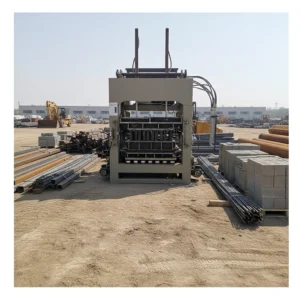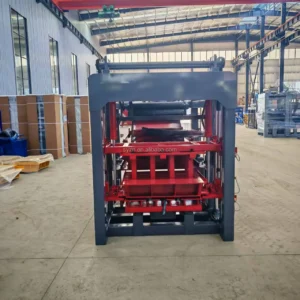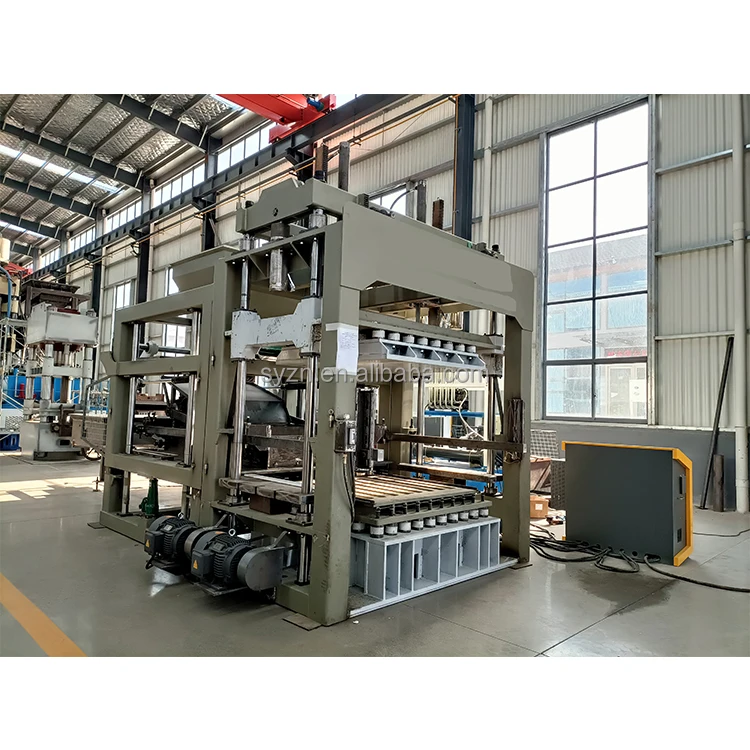
Technical Specifications
| Parameter | Value |
|---|---|
| Model | QT8-15 |
| Product Type | Hydraulic Block Making Machine |
| Overall Dimensions (L×W×H) | 8300 × 1860 × 3000 mm |
| Rated Pressure | 21 MPa |
| Main Vibration Form | Platform Vibration |
| Vibration Frequency | 2800–4500 r/min |
| Vibration Force | 45 kN |
| Pallet Size | 950 × 900 mm |
| Molding Cycle | 15–20 s (basis to be confirmed by block format and material) |
| Overall Power | 55.5 kW |
| Total Mass | 8 T |
| Demolding Method | Hydraulic |
| Factory Area Required | 300 m² |
| Raw Materials | Crushed stone, sand, cement, fly ash, gravel, slag |
| Applied Products | Hollow blocks, solid blocks, pavers, interlocking blocks, curbstone, colored pavers |
Application Suitability
| Application | Material or Output |
|---|---|
| Hollow block production for residential walls | Crushed stone and cement with fly ash filler |
| Solid block manufacturing for load-bearing structures | Gravel, sand, and cement blends |
| Paving brick runs for municipal sidewalks | Fine sand and cement with color pigment |
| Interlocking block runs for retaining walls | Coarse aggregate and cement at low slump |
| Curbstone production for road edging | High-strength gravel mix with extended vibration |
| Colored paver runs for landscape projects | Cement, fine aggregate, and oxide pigment |
What Quoted Cycle Times Leave Out About a Complete Block Production Line Equipment Setup
A press cycle is only as fast as the slowest station feeding or clearing it.
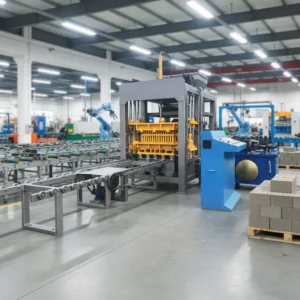
When I first started laying out lines, I watched a QT8-15 installation where the pallet return conveyor took two extra seconds per cycle compared with the press timing. That plant lost a noticeable share of its expected shift output just waiting for pallets to circle back. The quoted molding cycle meant nothing because the block production line equipment around it was not matched. Buyers often focus on the press itself and overlook how raw material feeding, mixing, pallet circulation, stacking, and curing all have to hit the same rhythm [NEED_CITE: line synchronization principles for concrete block plants].
How Raw Material Feeding and Mixing Must Keep Pace
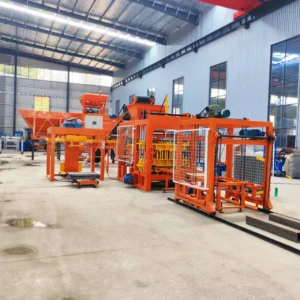
A 15–20 second molding cycle demands a steady supply of consistent mix arriving at the press hopper without pause. If the batch mixer discharges slower than the press consumes, the hopper level drops and the operator either slows the press or produces underfilled blocks. The turnkey block plant concept only works when the mixer capacity, conveyor speed, and feeding rate are all calculated against the press cycle, not chosen independently from a catalogue.
Pallet Circulation and Curing Rack Alignment
The 950 × 900 mm pallet format on this machine was selected to align with standard curing rack dimensions and common forklift tine widths. When pallets move from the press to the stacking station and then into the curing area, every transfer point must accept that same size without manual adjustment. A mismatch between pallet size and curing rack spacing means workers rearrange blocks by hand, which defeats the purpose of an automatic block production line equipment setup [NEED_CITE: pallet and curing rack compatibility standards in concrete block manufacturing].
Reading the Numbers That Actually Matter on Site
The 21 MPa rated pressure working together with 45 kN vibration force at up to 4500 r/min determines block density and green strength at demolding. Higher vibration frequency compacts finer aggregates more effectively, while hydraulic pressure locks that compaction in place before the block leaves the mould. The 8 T total machine mass provides the inertia needed to absorb platform vibration without transmitting it into the factory floor, which protects adjacent stations and keeps the mixer and conveyor frames stable. Overall power of 55.5 kW covers the entire press station including the hydraulic pump, vibration motor, and pallet pusher, so electrical planning must account for the full draw rather than just the main motor rating.
The Cost of Treating Each Station as a Separate Purchase
When the mixer, conveyor, press, and stacker are sourced from different suppliers with no single party responsible for cycle time alignment, the gaps show up on the first day of production. A pallet conveyor that runs slightly slower than the press creates a queue. A stacker that cannot lift at the rate the press delivers forces the operator to pause the entire turnkey block plant. These mismatches are not visible in individual quotations, and they are expensive to fix once concrete has already been poured on the factory floor [NEED_CITE: integration risks in multi-supplier block plant setups].
Why Sourcing the Full Line From One Supplier Matters Here
The QT8-15 is specified as part of a complete block production line equipment package rather than sold as a standalone press. Machine, mould, pallet, and handling systems are configured together so that cycle times match across every station. The pallet size, curing rack layout, and forklift requirements are confirmed against the buyer’s existing site conditions before production begins. Voltage, frequency, and PLC display language are locked in during the order stage so commissioning is not delayed by electrical mismatches. Factory testing runs the entire line together, not just the press alone, which catches timing gaps before the equipment ships.
Documentation & Verification
- Line layout drawing showing every station from feeder to stacker with cycle time annotations
- Capacity calculation sheet stating the exact block format and mix design assumed
- Pallet specification matched to the buyer’s curing rack and forklift dimensions
- Hydraulic and electrical schematic for integration with existing plant utilities
- Factory test record running the full line through a timed production sequence before dispatch
Installation, Commissioning & Support
- Foundation plan sized for the 8 T machine mass and 8300 mm overall length
- Dedicated 55.5 kW power circuit with voltage and frequency confirmed before wiring
- Pallet conveyor aligned and timed against the 15–20 second press cycle on site
- Operator training covering mould change, pallet handling, and daily maintenance routines
- Wear parts list covering hydraulic seals and vibration mounts with reorder intervals
What We Need to Configure Your Line
Share your target block format, daily output requirement, and the raw materials available at your site so the mixer and feeding system can be sized correctly. Confirm your existing pallet size, curing area dimensions, and forklift capacity so the pallet circulation and stacking stations align. Provide your local voltage, frequency, and preferred control language so electrical panels and PLC displays are built to match before the line leaves the factory.
Frequently Asked Questions
Q: How is daily output calculated when the line includes mixing, pallet feeding, stacking, and curing?
A: Daily output is calculated from the slowest station in the line, not the press alone. The mixer discharge rate, pallet conveyor speed, and stacking cycle are each measured against the 15–20 second molding cycle, and the final figure states which block format and mix design it assumes.
Q: What pallet size does the QT8-15 require, and how does it match my curing racks?
A: The QT8-15 uses a 950 × 900 mm pallet. Before production, we confirm your existing curing rack spacing and forklift tine width so pallets transfer directly from the press to the curing area without manual rearrangement or size adaptation on site.
Q: Which upstream equipment must match the press cycle to avoid bottlenecks?
A: The batch mixer discharge rate, raw material feeding conveyor, and pallet return conveyor must all complete their tasks within the 15–20 second press window. Each station is timed during the line layout phase to ensure none of them force the press to idle between cycles.
Q: How is the 300 m² factory area divided among production zones?
A: The 300 m² covers the press station, raw material storage, pallet circulation path, stacking area, and curing zone. The exact division depends on your block format, curing duration, and whether stacking is manual or automatic, which is confirmed during the layout stage.