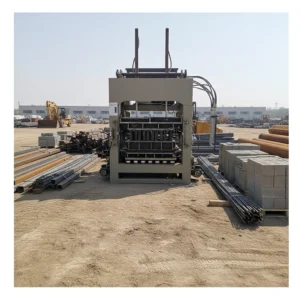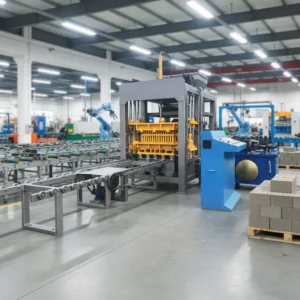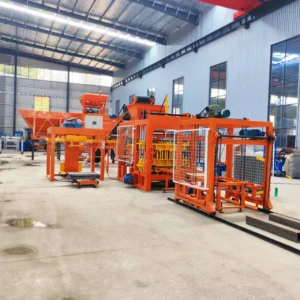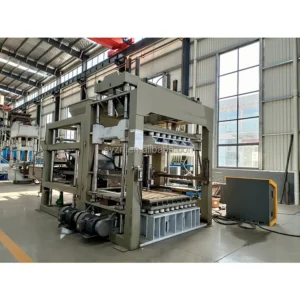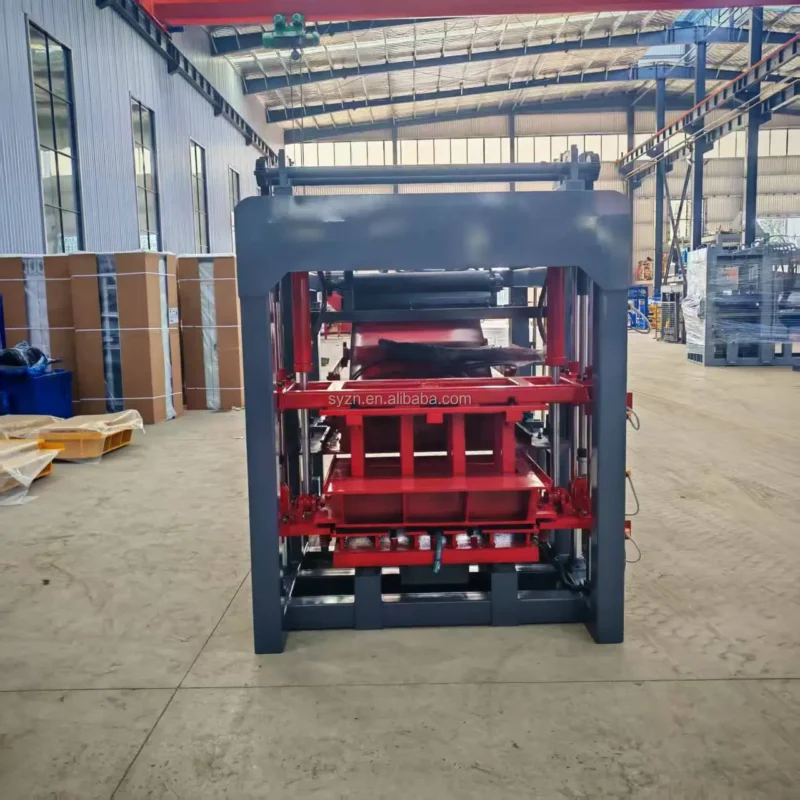
Matched System Design — every upstream feeder, mixer, and downstream pallet handler is timed to the QT4-15A press cycle so no station sits idle during a production run.
Technical Specifications
| Parameter | Value |
|---|---|
| Model | QT4-15A |
| Product Type | Fully Automatic Concrete Block Making Machine |
| Overall Dimensions (L×W×H) | 4100 × 1600 × 2600 mm |
| Rated Pressure | 16–21 MPa |
| Main Vibration Form | Platform Vibration |
| Vibration Frequency | 4200 r/min |
| Vibration Force | 55 kN |
| Pallet Size | 880 × 550 mm |
| Molding Cycle | 25–30 s (basis not stated in source — confirm block format / material / thickness) |
| Overall Power | 18.45 kW |
| Demolding Method | Hydraulic |
| Total Mass | 4 T |
| Factory Area | 300 m² |
| Applied Products | Concrete blocks, hollow/solid blocks, pavers, interlocking blocks, curbstone |
| Raw Material | Crushed stone, sand, cement, dust, fly ash, gravel, slag |
| Control System | PLC |
| Automation Level | Fully Automatic |
| Warranty | 1 year (whole machine, excluding spare parts) |
Application Suitability
| Application | Material or Output |
|---|---|
| Hollow block production for commercial walls | Crushed stone, sand, cement, fly ash |
| Solid block manufacturing for load-bearing structures | Gravel, sand, cement blends |
| Interlocking paver production for walkways and driveways | Fine aggregate, cement, pigment |
| Curbstone and kerb forming | Coarse aggregate, cement, slag |
| Porous permeable block for municipal projects | Graded aggregate, cement, dust |
Why the Block Production Line Equipment Must Be Sized as One System, Not One Press
A block press that outpaces its own pallet feeder is simply an expensive machine waiting for work.
I spent years assembling lines on the shop floor in Linyi, and the most frustrating calls always come from buyers who purchased a high-speed press only to discover their mixer delivers half the volume the hopper demands per cycle. The press then idles, the pallet queue empties, and the quoted daily output never materializes. When evaluating block production line equipment, the press is only one node; the mixer discharge rate, the pallet return conveyor speed, and the stacker lift timing all have to align within the same 25-30 second window this machine operates in. [NEED_CITE: production line synchronization principles in block manufacturing]
How the Press Cycle Dictates Every Upstream Decision
The QT4-15A completes a molding cycle in the 25-30 second range, which means the mixer must deliver a fresh batch to the hopper, the pallet feeder must index a new board into position, and the wet block stacker must clear the finished pallet — all before the next press stroke begins. A turnkey block making system built around this rhythm eliminates the micro-stoppages that silently erode daily volume. If any single station lags, the press absorbs the delay, and the gap compounds across a ten-hour shift.
Pallet Circulation as the Invisible Bottleneck
With an 880 × 550 mm pallet footprint, the return conveyor must carry enough boards to keep the press fed while a full rack of freshly pressed blocks travels to the curing area. Undersizing the pallet pool means the press waits for boards to come back from curing, which is a problem no amount of press speed can solve. We specify pallet quantity and return conveyor length against the buyer’s actual curing distance and forklift rotation schedule, not against a generic template. [NEED_CITE: pallet circulation calculations in concrete block plants]
Reading the Specs That Actually Govern Line Output
The 55 kN vibration force and 4200 r/min frequency work together with the 16–21 MPa hydraulic pressure to compact the mix into a dense, consistent block before demolding. This pressure-vibration balance determines whether a hollow block holds its shape off the pallet or slumps at the web. The 18.45 kW total power rating tells you the electrical supply must support simultaneous motor starts across the press, mixer, and conveyor drives without voltage sag. Buyers often focus on cycle time alone, but the rated pressure range is what lets the same machine platform produce a lightweight hollow block and a high-density paver simply by adjusting the mix and the pressure setpoint. Factory area of 300 m² must accommodate the press envelope, raw material bays, curing racks, and forklift travel lanes — a layout constraint that should be confirmed before the line ships.
What Happens When Line Stations Are Specified in Isolation
I have watched a block plant in West Africa stall because the buyer ordered the press from one supplier and the mixer from another, each quoting capacity independently. The mixer ran at a rate suited to a smaller press, and the QT4-15A spent nearly a third of each shift waiting for material. No single machine was at fault — the mismatch was in the line design. This kind of hidden idle time is invisible in a quotation that lists only the press. [NEED_CITE: common causes of production line throughput loss in block plants]
Why Buyers Source the Complete Line from One Responsibility Point
Block machinery is our single focus, so the press, mould, pallet, and handling equipment are specified as one matched system rather than assembled from disconnected suppliers. We set the configuration against your actual mix design and local aggregate, not a catalogue default that assumes materials you cannot source. Mould design covers the formats your market actually sells, with custom drawings available when standard formats do not fit. Automation level is selectable, so a buyer can start with the semi-automatic pallet handling arrangement and add the automatic stacker and cubing system later as volume grows. Installation includes on-site commissioning with operator training so the crew understands the timing relationships between stations from day one.
Documentation & Verification
- Line layout and capacity calculation stating the exact block format assumed for daily output
- Hydraulic and electrical schematic with confirmed voltage, frequency, and PLC display language
- Factory test record run on your specified mix design before container loading
- Pallet specification sheet matching your existing curing rack dimensions and forklift capacity
- Mould drawing and format list for every block type in your initial production plan
- Operation and maintenance manual with wear parts and mould replacement intervals
Installation, Commissioning & Support
- Foundation plan scaled to the 4100 × 1600 mm press footprint and 4 T operating mass
- Dedicated electrical circuit sized for the 18.45 kW total load with voltage and frequency confirmed before production
- Machine dismantled into press frame, hydraulic unit, and control cabinet for 40HQ container loading
- First-run parameter setting covering vibration frequency, hydraulic pressure, and molding cycle per block format
- Operator training on PLC interface, mould change procedure, and pallet feed synchronization
- Wear parts list covering hydraulic seals, vibration springs, and mould liner plates with reorder part numbers
What We Need to Size Your Line Correctly
Send us the block formats you plan to produce and the target daily volume for each, along with the aggregate and cement types available locally. We also need your workshop dimensions, existing curing rack layout, and the voltage and frequency at your site so the PLC and motor configuration match your supply from the first day of commissioning.
Frequently Asked Questions
Q: How do I ensure the mixer output matches the QT4-15A press cycle so the machine is never starved of material?
A: We calculate the mixer batch volume against the press hopper demand per 25-30 second cycle and specify a mixer discharge rate that stays ahead of consumption. The goal is a small buffer in the hopper at all times, never an empty one waiting for the next batch to finish mixing.
Q: What pallet handling and stacking equipment should be included to avoid manual labor after the press?
A: The line can include an automatic pallet feeder on the infeed side and a wet block stacker on the outfeed, so boards cycle without hand labor. The stacker lifts and cubes the freshly pressed blocks onto curing racks matched to your forklift capacity.
Q: Can the line be configured in phases — starting with the press and adding automatic stacking later?
A: Yes. The QT4-15A platform supports a semi-automatic start with manual pallet handling, and the automatic stacker and cubing system can be added when production volume justifies the investment. The PLC control accommodates the upgrade without a full system replacement.
Q: How is the 300 m² factory area divided between the press, curing racks, and raw material storage?
A: The press and its immediate conveyors occupy the central zone, with raw material bays on one side and curing rack lanes on the other. We provide a scaled line layout showing forklift travel paths so the space is verified against your actual building dimensions before shipment.
Q: What upstream batching accuracy is required to maintain block-to-block strength consistency on this line?
A: Cement and aggregate weigh batching must stay within tight tolerances per batch so that every pallet of blocks receives the same mix proportion. Inconsistent batching shows up as variable block strength, which no amount of press vibration or hydraulic pressure can correct downstream.