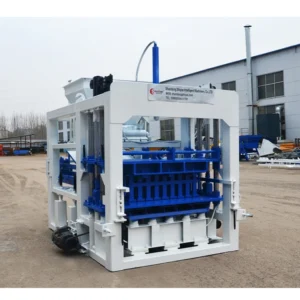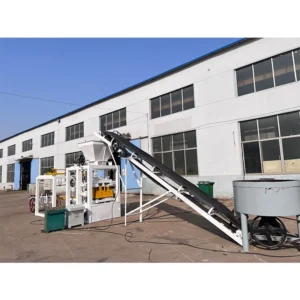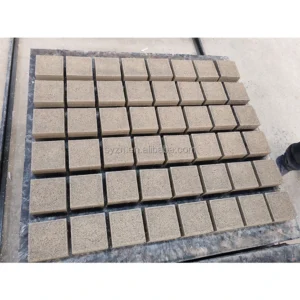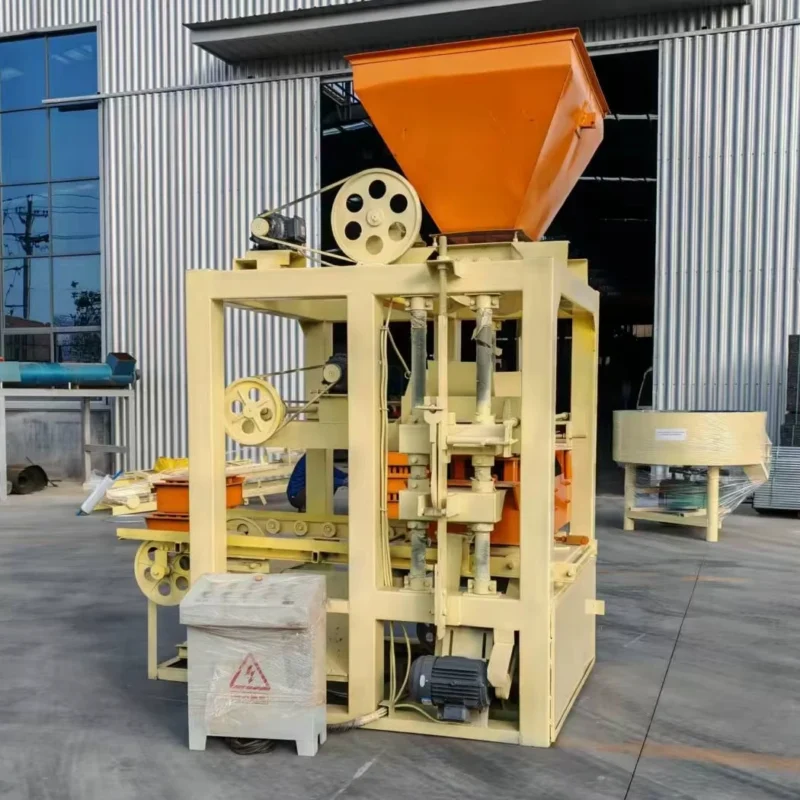
Matched Line System — the QTJ4-24 semi-automatic block making machine production line is specified so material feeding, mixing, and pallet flow are balanced to the 24–26 s molding cycle, preventing the press from standing idle between stations.
Technical Specifications
| Parameter | Value |
|---|---|
| Product Type | Semi-Automatic Cement Block Making Machine |
| Model | QTJ4-24 |
| Overall Dimensions (L×W×H) | 3600 × 1700 × 2560 mm |
| Pallet Size | 850 × 450 mm |
| Molding Cycle | 24–26 s (basis not stated in source — confirm block format) |
| Overall Power | 11.95 kW |
| Vibration Force | 45 kN |
| Total Mass | 2 T |
| Vibration Configuration | 2 × 3 kW lower vibrators + 2 × 1.5 kW upper vibrators |
| Mold Lifting Reducer | 350-type |
| Material Distribution | Full-automatic spiral |
| Control System | PLC (source value — verify against manufacturer catalog) |
| Molding Method | Mechanical |
| Automation Level | Semi-automatic |
| Raw Materials | Cement, sand, stone |
| Voltage & Frequency | Configurable (to be confirmed before order) |
| Mould Formats | Hollow block, solid block, interlocking brick, paving brick (mould list to confirm) |
| Warranty | 1 year for whole machine, excluding spare parts |
Application Suitability
| Application | Material or Output |
|---|---|
| Small block plant producing hollow blocks for local housing | Cement, crushed stone, sand mix |
| On-site contractor block production for building projects | Locally sourced aggregate with cement binder |
| Building material distributor adding solid blocks to inventory | Standard sand and gravel blends |
| Interlocking brick and paving block runs for municipal supply | Fine aggregate with cement |
What the Cycle Time Figure Does Not Tell You About Daily Output
A molding cycle quoted without the block format it assumes is not a capacity figure — it is an incomplete measurement.
When I first started quoting the QTJ4-24 to overseas buyers, the 24–26 second cycle looked attractive on paper. But a hollow block and a thin paving brick pull very different volumes from that same cycle. If the quotation does not state which format the cycle time was measured against, the daily pallet count can fall far below what the buyer budgeted for. The semi-automatic block making machine production line must define throughput per format, not just per cycle, before the line layout is finalized [NEED_CITE: block format assumptions in capacity quotations].
Upstream Feeding Must Keep Pace With the Spiral Distributor
The full-automatic spiral material distribution on the QTJ4-24 moves mixed material into the mold box at a fixed rate. If the upstream mixer discharges slower than the spiral consumes it, the mold fills unevenly and block density varies across the pallet. The semi-automatic block making machine production line is configured so mixer batch size and discharge interval are calculated against the spiral feed rate, keeping the press supplied without material backing up in the hopper.
Downstream Pallet Flow Defines the Real Bottleneck
A 24–26 second cycle means a loaded pallet leaves the press roughly every half minute. In a semi-automatic setup, operators must pull the finished pallet, place it on a curing rack, and return an empty pallet to the press table. If the curing yard is too far or the pallet return path is not planned, the press sits idle while the operator walks. Line layout must show pallet flow distance, rack spacing, and return route so the cycle is not broken by manual handling delays [NEED_CITE: pallet handling impact on semi-automatic block line throughput].
How Vibration Force and Reducer Sizing Affect Shift-Length Runs
The QTJ4-24 delivers 45 kN of vibration force through four vibrators — two 3 kW units below and two 1.5 kW units above. This dual-level configuration compacts the mix from both directions, which matters when local aggregate is coarse or contains fines. The 350-type mold lifting reducer is sized for repeated mold changes across a full shift; undersized reducers in this class tend to develop backlash after continuous use, causing uneven mold seating and block height variation. For plants running two shifts, reducer service intervals should be planned around actual mold change frequency rather than calendar months.
The Cost of Skipping Line Integration
Buyers who purchase the press alone and source mixers, pallets, and racks separately often find that station cycle times do not align. A mixer that batches every ninety seconds starves a press cycling every twenty-five. Pallets ordered in a different size than the 850 × 450 mm spec do not seat correctly on the press table, causing vibration energy to dissipate into the frame rather than the block [NEED_CITE: mismatched pallet dimensions and vibration efficiency]. These problems surface on the first production day, not in the quotation.
Why Specify the Entire Line From One Source
Block machinery is our single focus, so the QTJ4-24 press, mold, pallet, and handling equipment are specified as one matched system. Configuration is set against the buyer’s actual mix design and local aggregate, not a catalog default. We provide mold design for the specific formats the buyer’s market demands, including custom drawings when standard formats do not match local dimensions. Automation level is selectable — a buyer can start with the semi-automatic block making machine production line and add automatic stacking later. Installation support includes operator training so the crew understands cycle dependencies between stations.
Documentation & Verification
- Line layout drawing showing station spacing and pallet flow path for the QTJ4-24 configuration
- Capacity calculation stating the block format and mix assumed for the 24–26 s cycle
- Pallet specification sheet matched to the 850 × 450 mm press table and buyer curing area
- Voltage, frequency, and PLC display language written confirmation before production starts
- Factory test record on buyer’s specified block format before dispatch
Installation, Commissioning & Support
- Foundation pad sized to the 3600 × 1700 mm footprint with vibration isolation for the 45 kN force output
- Dedicated power circuit for the 11.95 kW total draw with voltage confirmed to local supply before wiring
- Press and mixer delivered in dismantled state for container loading, reassembled on-site with alignment checks
- First-run parameter setting for vibration timing and spiral feed rate against buyer’s actual aggregate sample
- Operator training covering mold change procedure using the 350-type reducer and pallet return workflow
- Wear parts list for vibrators and spiral flighting with recommended reorder quantities
Before You Request a Quote
To size the semi-automatic block making machine production line correctly, share the block formats your market requires, the target daily output per format, and a sample of your local sand and stone aggregate. Confirm your site voltage and frequency, the language needed for the PLC display, and the dimensions of your existing curing yard and forklift capacity so pallet specification matches what you already have on the ground.
Frequently Asked Questions
Q: How is realistic daily output calculated when the cycle time is quoted without a block format?
A: We calculate output per format by multiplying the cycle time by the number of cavities for that specific mold, then subtracting pallet exchange and mold change intervals across a shift. The quotation lists daily output separately for each block type the buyer intends to produce, so capacity planning reflects the actual product mix rather than a single best-case figure.
Q: Which supporting stations must match the press cycle so it never waits?
A: The mixer discharge rate, spiral material feed speed, and pallet return time must all complete within the 24–26 second window. If any station takes longer, the press idles. We map each station’s cycle in the line layout drawing so the buyer can see where the bottleneck falls before equipment is shipped.
Q: What pallet size and material does the line require, and does it fit my curing yard?
A: The QTJ4-24 uses 850 × 450 mm pallets. Material choice — bamboo, steel, or composite — depends on your curing environment and forklift type. We confirm pallet spec against your existing rack spacing and handling equipment so pallets move from press to curing yard without modification.
Q: How is raw material feeding configured to keep up with the spiral distribution rate?
A: We match the mixer batch volume and discharge gate size to the spiral’s consumption rate per cycle. If local aggregate is slow-flowing due to moisture or fines, we adjust hopper angle and add vibration assist to prevent material bridging above the spiral inlet.
Q: What does the line layout look like for a semi-automatic setup?
A: A typical semi-automatic line places the mixer and feed hopper upstream, the press at center, and pallet racks on both sides for loading and curing removal. Floor space depends on curing capacity needed for daily output. We provide a scaled layout drawing with your chosen configuration before order confirmation.