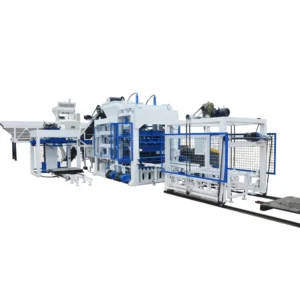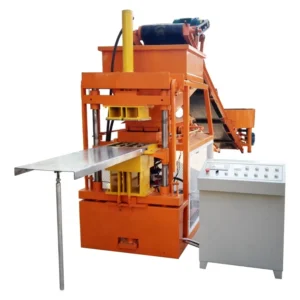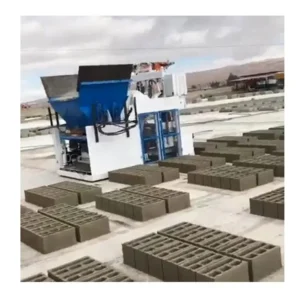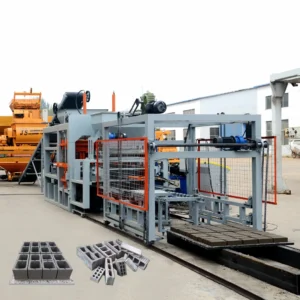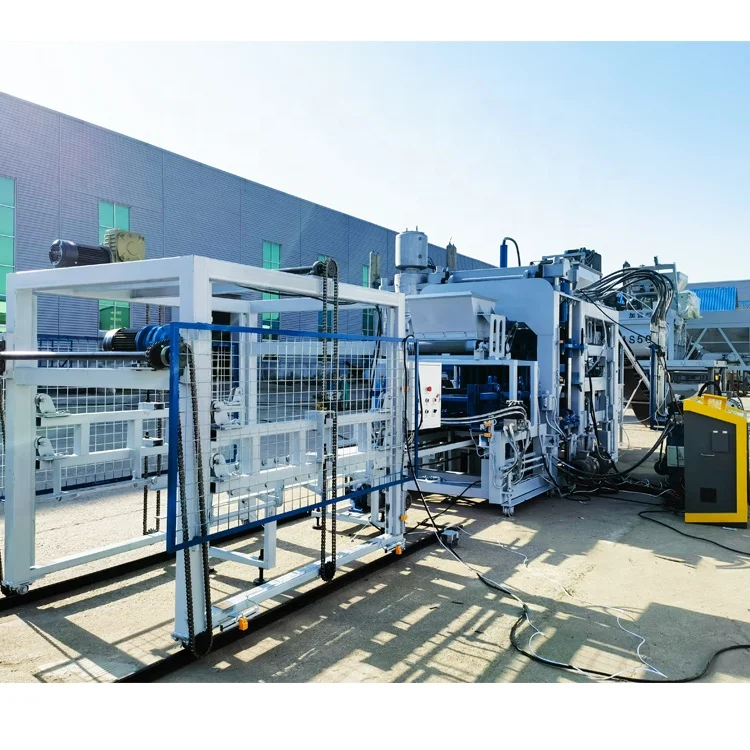
System-Matched Line Design — Mixer discharge, pallet feed and stacking rates are sized to the QT8-15 cycle so the press never waits for upstream or downstream stations.
Technical Specifications
| Parameter | Value |
|---|---|
| Product Type | Hydraulic Concrete Block Making Machine |
| Model | QT8-15 |
| Overall Dimensions (L×W×H) | 8300×1860×3000 mm |
| Rated Hydraulic Pressure | 21 MPa |
| Vibration Form | Platform Vibration |
| Vibration Frequency | 2800–4500 r/min |
| Vibration Force | 45 kN |
| Pallet Size | 950×900 mm |
| Molding Cycle | 15–20 s (basis not stated in source — confirm block format and material) |
| Overall Power | 55.5 kW |
| Total Mass | 8 T |
| Demolding Method | Hydraulic |
| Recommended Factory Area | 300 m² |
| Applied Products | Hollow blocks, solid blocks, pavers, interlocking blocks, kerbstones, colored pavers |
| Raw Materials | Crushed stone, sand, cement, fly ash, gravel, slag |
| Control System | Configurable — PLC brand and display language to be confirmed before production |
| Automation Level | Selectable from semi-automatic pallet handling to fully automatic stacking and cubing |
| Voltage & Frequency | Configurable — to be confirmed against buyer site supply |
| Warranty | 1 year (whole machine, excluding spare parts) |
| Container Loading | 1×40HQ (basic equipment) |
Application Suitability
| Application | Material or Output |
|---|---|
| Hollow block production for structural walls | Crushed stone, sand, cement, fly ash blends |
| Solid block production for load-bearing partitions | Gravel, sand, cement mixes |
| Paving brick manufacturing for driveways and walkways | Fine aggregate, cement, pigment for colored pavers |
| Interlocking block production for retaining walls | Crushed stone, sand, cement |
| Kerbstone production for road and curb applications | Coarse aggregate, sand, cement |
Why the Quoted Cycle Rate Rarely Survives Contact with the Rest of the Line
A hydraulic block making machine production line only holds its rated cycle when every upstream and downstream station is matched to the press timing.
Buyers often receive a cycle figure for the QT8-15 in isolation — 15 to 20 seconds per mould — and project daily output from that number alone. On site, the mixer cannot discharge a fresh batch before the press finishes its current cycle, or the pallet feeder jams because the stacking station has not cleared the previous pallet. The press sits idle, and actual output drops well below the quoted rate. [NEED_CITE: line balancing principles in concrete block production] When the entire hydraulic block making machine production line is specified as one system rather than assembled from separate quotes, those gaps close before the equipment ships.
Matching Mixer Discharge to the Press Cycle
The QT8-15 completes a moulding cycle every 15 to 20 seconds, which sets the tempo for the entire hydraulic block making machine production line. If the mixer takes longer to deliver a homogeneous batch than the press needs to consume one, the hopper runs dry and the operator watches the press idle. Mixer capacity, discharge gate size and conveyor belt speed must all be calculated against the press cycle and the specific block format being run, because a hollow block draws a different volume per cycle than a paving brick.
Pallet Flow and Curing Rack Coordination
Every cycle pushes a loaded 950×900 mm pallet onto the wet-side conveyor. If the stacking station cannot index and lift fast enough, pallets queue on the line and eventually back up to the press. Downstream, the curing rack system must accept pallets at the same rate the stacker releases them. This coordination is where most line bottlenecks appear, and it is the reason pallet handling configuration must be settled before the QT8-15 enters production. [NEED_CITE: pallet handling and curing logistics in block plants]
Reading the Specifications in Context
Platform vibration at 2800–4500 r/min combined with 21 MPa hydraulic pressure determines how densely the mix is compacted inside the mould cavity. Higher vibration frequency works well for fine-aggregate paver mixes, while lower frequency paired with full hydraulic pressure suits coarse hollow block mixes. The 45 kN vibration force must be evaluated alongside the buyer’s actual aggregate gradation — a specification sheet number means little without that context. Overall power draw of 55.5 kW affects transformer sizing and cable runs from the main panel; buyers operating in regions with unstable grid supply should confirm voltage and frequency before the electrical cabinet is wired. The 8 T machine mass and 8300×1860×3000 mm footprint set the foundation requirements and bay spacing inside the 300 m² recommended factory area.
What Happens When Stations Are Specified Separately
When the mixer, pallet feeder and stacker are sourced from different suppliers, each unit arrives with its own cycle logic and control interface. The QT8-15 may be ready to press, but the pallet feeder runs on a different signal protocol, or the stacker lift speed was chosen for a lighter pallet than the 950×900 mm boards this line uses. Commissioning stretches from days into weeks as technicians rewrite PLC routines on site. [NEED_CITE: integration challenges in multi-vendor block production lines] The cost is not just the delay — it is the output lost while the line is being reconciled.
Why Specify the Full Line from One Source
Block machinery is the single focus here, so the QT8-15 press, its mould, pallets and handling equipment are specified as one matched system. Configuration starts from the buyer’s actual mix design and local aggregate rather than a catalogue default. Mould design covers the block formats the buyer’s market actually sells, with custom drawings available. Automation level is selectable — a buyer can begin with semi-automatic pallet handling and add stacking and cubing later without replacing the press. Installation support includes operator training so the crew understands cycle dependencies from day one.
Documentation & Verification
- Line layout drawing showing station spacing and pallet flow path for the QT8-15 footprint
- Capacity calculation sheet stating the block format assumed for each output figure
- Pallet specification confirming size, material and thickness against buyer curing racks
- Hydraulic and electrical schematics with confirmed voltage and PLC display language
- Factory test record on the buyer’s target block format before dispatch
- Operation and maintenance manual with wear parts and mould replacement list
Installation, Commissioning & Support
- Foundation plan sized for the 8 T mass and 8300×1860 mm footprint of the QT8-15
- Dedicated electrical circuit rated for 55.5 kW draw with confirmed voltage and frequency
- Machine dismantled into 40HQ container loading with reassembly supervised on site
- PLC display language and control parameters set and verified during commissioning
- Operator training covering mould change procedure, pallet feed and stacking sequence
- Wear parts list and first replacement schedule for hydraulic seals and vibration components
Preparing Your Line Inquiry
Share the block formats your market sells, the daily output you need for each format, and the raw materials available locally. Include your existing curing area dimensions, forklift capacity and site voltage supply so the pallet and electrical configuration can be matched before production begins.
Frequently Asked Questions
Q: How is daily output calculated and which block format is assumed?
A: Output figures are based on the 15–20 second moulding cycle applied to a specific block format and mix. Because a hollow block and a paving brick consume different volumes and may require different cycle settings, each capacity number must state the format it assumes. We provide a written calculation per format so you can compare quoted output against your actual production target.
Q: Which supporting stations are included in the line quotation?
A: The base quotation covers the QT8-15 press. Raw material feeding, mixing, pallet feeding, automatic stacking and curing rack handling are configured based on the buyer’s automation preference and site layout. Each station is sized to the press cycle so no point in the hydraulic block making machine production line becomes the bottleneck. Optional and included items are listed separately.
Q: How must pallet size and material match the curing area?
A: The QT8-15 uses 950×900 mm pallets. The material — timber, bamboo or composite — and board thickness must suit the curing rack spacing and the forklift tine width already on site. A mismatch means pallets cannot be racked or moved efficiently, slowing the entire line. We confirm pallet specification against your existing handling equipment before production.
Q: What electrical details must be confirmed before production starts?
A: Voltage, frequency and PLC display language must be agreed in writing. The 55.5 kW overall power draw determines cable sizing and circuit protection. If the site supply differs from the machine configuration, commissioning is delayed until transformers or panels are replaced. We request a copy of the site electrical specification before wiring the control cabinet.
Q: How is the press cycle balanced against upstream and downstream stations?
A: The 15–20 second moulding cycle sets the line tempo. Mixer batch size and discharge speed, pallet feeder indexing rate, and stacker lift speed are all calculated against that cycle for the chosen block format. If any station runs slower, the press idles and actual output falls. Line layout documentation shows the calculated throughput at each station so the balance is visible before equipment ships.