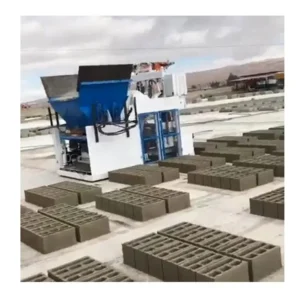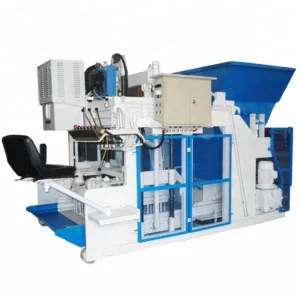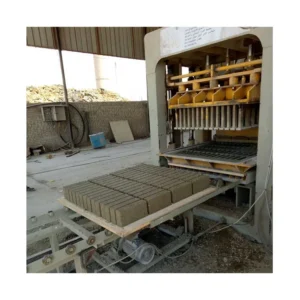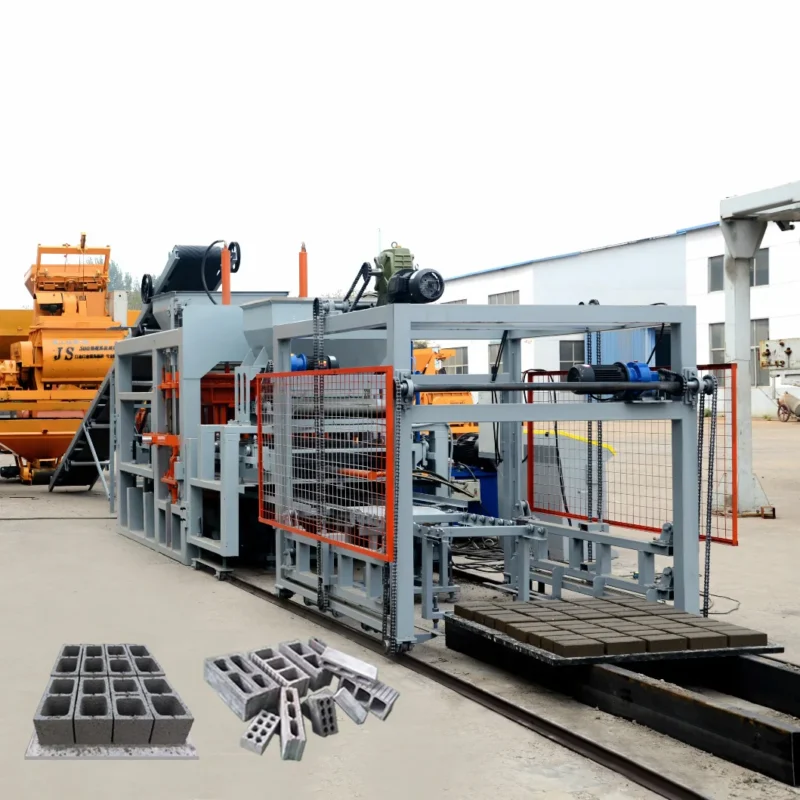
Matched Station Cadence — host press, pallet feeder, block conveyor and hydraulic station are timed to one cycle so no point in the line waits on another.
Technical Specifications
| Parameter | Value |
|---|---|
| Model | QT8-15 |
| Product Type | Automatic Concrete Block Making Machine |
| Overall Dimensions (L×W×H) | 8300 x 1860 x 3000 mm |
| Rated Pressure | 21 MPa |
| Vibration Form | Platform Vibration |
| Vibration Frequency | 2800–4500 RPM |
| Pallet Size | 950 x 900 mm |
| Moulding Cycle | 15–25 s (basis to be confirmed with block format and material) |
| Overall Power | 37 kW |
| Control System | PLC with touch screen HMI |
| Automation Level | Automatic (pallet feeder, host machine, block conveyor, hydraulic station, PLC controller) |
| Block Comprehensive Strength | up to 15 MPa |
| Operation Mode | Manual or automatic selectable |
| Voltage & Frequency | Configurable to site requirement (to be confirmed) |
| Output Capacity | Dependent on block format, material and thickness (basis to be confirmed) |
Application Suitability
| Application | Material or Output |
|---|---|
| Hollow block production | Crushed stone, sand, cement and water mixed for structural masonry units |
| Solid block production | Dense aggregate mix for load-bearing and partition walls |
| Paving block production | Fine aggregate face mix with standard backing for pedestrian and vehicular surfaces |
| On-site contractor production | Locally sourced aggregate for housing and infrastructure project blocks |
| Format expansion for existing plants | Interlocking and kerbstone formats added via mould change on the same pallet size |
What the 15–25 Second Cycle Hides From Your Daily Tally
A press cycle quoted in isolation tells you nothing about what reaches the curing rack at the end of the shift.
The moulding cycle of the QT8-15 is 15–25 s, but that figure only covers the host press. Raw material feeding, mixing, pallet return, block stripping and conveyor travel all sit outside that window. If the mixer takes 45 s per batch and the press expects a fresh charge every 20 s, the press stands idle and the whole line slows to the mixer’s pace. I have stood on plant floors where a fast press was starved by a slow upstream station and a full shift’s output ended up half the brochure promise [NEED_CITE: cycle matching across stations in concrete block production]. An automatic block machine production line only delivers its nameplate rhythm when every station is timed to the same beat.
Stations That Move Together or Not At All
The QT8-15 line is composed of the pallet feeder, host machine, block conveyor, hydraulic station and PLC controller. Each of these is on one control network so the pallet advance, vibration dwell, demould and conveyor step are sequenced from a single PLC cycle. When the operator switches from hollow block to paving block, the cycle parameters for every station shift together rather than requiring separate adjustments at each unit.
Where the Line Ends and Your Scope Begins
What sits outside the quoted line matters as much as what is inside. Raw material batching, curing rack handling, stacking and cubing are not part of the QT8-15 package as standard. If the curing yard uses a forklift sized for a different pallet dimension, every wet block has to be double-handled before it can be stored. I have seen plants where the conveyor dropped blocks onto a transfer table that led nowhere because the curing rack pitch had never been measured [NEED_CITE: pallet and curing area compatibility in block plants]. Planning the automatic block machine production line means drawing the boundary from the aggregate silo all the way to the cured stack.
Pressure, Vibration and Pallet Geometry in Plain Terms
The 21 MPa rated pressure works together with platform vibration at 2800–4500 RPM to compact the mix inside the mould cavity. Pressure alone would leave air voids; vibration alone would not consolidate the face. Both applied at the same moment give the block its density and its surface finish. The pallet size of 950 x 900 mm defines the maximum mould footprint and therefore the block count per cycle — a wider block format fills fewer cavities per pallet, so cycle time alone does not predict daily volume. The independent hydraulic station sits away from the main vibration zone, which keeps pressure stable cycle after cycle instead of drifting as seals warm up. Overall power draw of 37 kW must be supported by a dedicated circuit with the correct voltage and frequency confirmed before the machine leaves the factory.
The Cost of Stations That Do Not Talk to Each Other
When the pallet feeder and the conveyor are sourced from separate suppliers, their timing is set by hand and drifts as belts stretch. Operators end up compensating by slowing the host press, which defeats the reason for buying an automatic machine in the first place. A pallet that arrives a half-second late forces the press to skip a cycle; a conveyor that steps too early drags a wet block and ruins the face. These faults do not show up on the factory test floor where the line runs in a straight loop — they appear after weeks of production when belt tension and hydraulic oil temperature change [NEED_CITE: station timing drift in multi-supplier block lines].
Why Source the Whole Line From One Configuration
The QT8-15 is specified as a matched set rather than a press surrounded by unrelated equipment. Pallet feeder timing, conveyor speed and hydraulic response are all set against the same moulding cycle so the stations hand off without pause. The PLC controller coordinates the sequence and allows manual override without rewiring, which matters during mould change and first-article inspection. Line layout and capacity calculation are prepared against the buyer’s stated block format and local aggregate, not against a catalogue default. Voltage, frequency and HMI language are confirmed before production begins, not discovered when the container opens.
Documentation & Verification
- Line layout drawing showing every station from pallet feeder to block conveyor with cycle times per format
- Machine specification sheet listing rated pressure, vibration frequency and pallet size as built
- Hydraulic and electrical schematic matching the installed PLC and valve configuration
- Factory test record run on the buyer’s stated block format before dispatch
- Voltage, frequency and PLC display language confirmation signed off before production
Installation, Commissioning & Support
- Foundation plan sized to the 8300 x 1860 mm footprint with anchor bolt positions marked
- Dedicated 37 kW circuit with the agreed voltage and frequency before the line is powered
- Hydraulic station filled to the specified oil grade and bled through all cylinders on first start
- PLC touch screen loaded with the confirmed language and cycle profiles for each block format
- Operator training covering manual and automatic modes, mould change sequence and daily checks
- Wear parts list with part numbers for pallets, mould liners and hydraulic seals for first reorder
What to Have Ready Before You Send an Inquiry
A meaningful proposal for the QT8-15 needs the target block format with dimensions, the daily output you are planning against, and the aggregate and cement types available at your site. Please also confirm the local voltage and frequency, the PLC language your operators will need, and the curing area layout including pallet size already in use if you are adding to an existing plant.
Frequently Asked Questions
Q: Which stations are included in the QT8-15 line and which remain my responsibility?
A: The line covers the pallet feeder, host machine, block conveyor, hydraulic station and PLC controller. Raw material batching and mixing, curing rack handling, stacking and cubing sit outside the standard package. We state this boundary in the line layout so you know exactly which stations to plan for on your side before the machine arrives.
Q: How does the 15–25 s cycle translate to realistic daily output?
A: The cycle range depends on block format, wall thickness and mix design. A hollow block typically runs at the longer end of the range while a thinner paving block can run faster. We prepare a capacity calculation that states the assumed block format so the daily figure you plan against matches what the line will actually produce on your material.
Q: Will the 950 x 900 mm pallet match my existing curing racks and forklift?
A: That depends on your current curing rack pitch and fork tine spacing. If the pallet does not match, wet blocks have to be re-stacked by hand before curing. We ask for your rack and forklift details at inquiry stage so pallet size and material can be confirmed against what you already have on site.
Q: Can I add an automatic stacker to the QT8-15 line later?
A: The PLC controller coordinates pallet feeder, press and conveyor from one program, which leaves a logical connection point for a downstream stacker. Adding one later requires the conveyor discharge height and block pattern to be agreed up front so the mechanical and electrical interfaces are already in place when you are ready to expand.
Q: What utility requirements must my site meet before the line arrives?
A: The line draws 37 kW total and needs a dedicated circuit at the confirmed voltage and frequency. The hydraulic station requires the specified oil grade, and the foundation must match the 8300 x 1860 mm footprint drawing. We supply a utility checklist with the installation documents so your electrician and civil team can prepare before the container is opened.