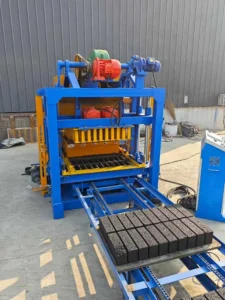
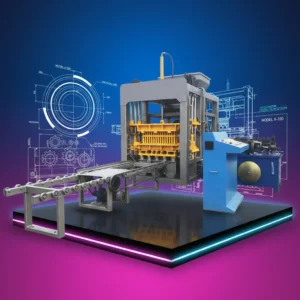
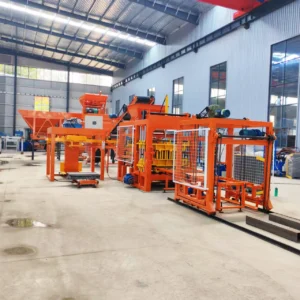
Complete Matched Line Configuration — The QT6-15 press is specified alongside its raw material feeding, mixing, pallet handling, and stacking systems as one coordinated unit, eliminating the station-level bottlenecks that strand standalone presses.
Technical Specifications
| Parameter | Value |
|---|---|
| Product Type | Automatic Concrete Block Making Machine |
| Model | QT6-15 |
| Machine Power | 31.25kW |
| Hydraulic Pressure | 16-21 MPa |
| Main Vibration Form | Platform Vibration |
| Pallet Size | 850*680mm |
| Overall Size | 710015003000mm |
| Machine Weight | 8500KGS |
| Molding Cycle | 15-20 seconds (basis not stated in source — confirm block format / material / thickness) |
| Voltage | Configurable to local grid standards |
| Control System | PLC intelligent control with malfunction diagnosis and remote function |
| Theoretical Productivity (Hollow Block) | 8640 pcs/day based on 400200200mm, 6 pcs/mould, 16-20s cycle |
| Theoretical Productivity (Standard Block) | 54400 pcs/day based on 24011553mm, 30 pcs/mould, 14-17s cycle |
Application Suitability
| Application | Material or Output |
|---|---|
| Hollow Block Production | Crushed stone, sand, cement, fly ash |
| Solid Block Manufacturing | Gravel, slag, cement, dust |
| Paver and Interlocking Block | Sand, cement, colored aggregates |
| Curbstone Production | High-density concrete mixes |
| Porous Block Manufacturing | Lightweight aggregates, cement, fly ash |
Why the Line Cycle Matters More Than the Press Speed
A fast press standing idle while the mixer finishes a batch is still a slow line.
In the field, I have seen plants where the automatic concrete block making machine production line was quoted based on a 15-second cycle, but the raw material feeder and mixer were sized for a 25-second reality. The daily output fell far short of the brochure figure because the press spent half its shift waiting for the next batch of wet mix or the next pallet to arrive. When supporting equipment is treated as an afterthought, the investment in a high-speed press is effectively wasted [NEED_CITE: industrial line balancing principles for concrete plants]. The complete QT6-15 automatic block production line with supporting equipment integration is designed to prevent this specific failure mode.
Synchronizing the Feed, Mix, and Press Stations
The QT6-15 operates on a platform vibration system that requires a consistent flow of material to maintain its cycle rate. If the mixer discharge or the pallet feeder lags, the hydraulic pressure and vibration sequence must pause, breaking the rhythm of the entire automatic concrete block making machine production line. We specify the raw material feeding and mixing capacity to match the press’s maximum throughput, ensuring the 16-21 MPa hydraulic system is never left waiting for a charge. This synchronization is the core focus when planning a complete block production setup.
How Pallet Handling Defines Daily Capacity
The 850*680mm pallet size is a fixed parameter of the QT6-15, but how those pallets move through the curing area determines the real daily output. In many plants, the press produces blocks faster than the manual labor can move them to the curing racks, creating a bottleneck that the PLC intelligent control cannot fix. By including automatic stacking and curing rack handling in the line quotation, we ensure the pallet cycle matches the press cycle [NEED_CITE: material handling constraints in block manufacturing]. This prevents the "output stacked by hand" scenario that limits capacity.
Interpreting the QT6-15 Specifications for Your Plant
The 31.25kW power rating and platform vibration form are engineered for high-density concrete products like curbstone and interlocking pavers. The hydraulic pressure range of 16-21 MPa is critical for achieving the block strength required in load-bearing walls, especially when using local aggregates like fly ash or slag. Furthermore, the PLC system includes a malfunction diagnosis function, which is essential for maintaining consistency across long shifts. When configuring an automatic concrete block making machine production line, these parameters must be verified against your specific mix design and target block format to ensure the vibration force and pressure are correctly matched.
The Hidden Cost of Mismatched Voltage and Control
I have spent weeks on sites waiting for transformers because the voltage and frequency were not confirmed before the machine left the factory. A 31.25kW motor configured for the wrong voltage will either fail to start or burn out within days. Additionally, if the PLC display language is not set to the local operator’s preference, the malfunction diagnosis system becomes a source of confusion rather than a tool for uptime. These commissioning delays are entirely avoidable if the electrical parameters are documented and verified during the ordering process [NEED_CITE: electrical standards and commissioning delays in machinery exports].
Why This Line Configuration Works
We specify the machine, mould, pallet, and handling equipment as one matched system rather than assembling them from separate suppliers. The configuration is set against your actual mix design and local aggregate, not a catalogue default. We provide a line layout and capacity calculation that states the block format assumed, so the daily output is a realistic figure. The automation level is selectable, allowing a buyer to start with semi-automatic pallet handling and upgrade the stacking system later. Every supporting station is cycle-verified against the QT6-15 press to ensure continuous production.
Documentation & Verification
- Line layout and capacity calculation stating the block format assumed.
- Machine specification sheet with voltage and control language confirmation.
- Pallet specification matched to curing area dimensions and forklift rating.
- Hydraulic and electrical schematic for local maintenance teams.
- Factory test record on your target block format before dispatch.
Installation, Commissioning & Support
- Foundation requirements based on the 710015003000mm footprint and 8500KGS weight.
- Electrical verification for the 31.25kW load and local voltage frequency.
- PLC logic and display language setup during the commissioning phase.
- Operator training on the malfunction diagnosis and remote control functions.
- Mould and hydraulic wear parts list for initial stock planning.
Preparing Your Project Details
To provide an accurate line configuration, we need to know your target block formats and the daily output you require for each. Please share the details of your local raw materials, specifically the type of aggregate and cement available. We also require your site’s grid parameters, including voltage, frequency, and the preferred language for the control panel interface.
Frequently Asked Questions
Q: How is daily output calculated across the full line?
A: Daily output is calculated by matching the QT6-15 cycle rate (15-20s) with the capacity of the mixer, pallet feeder, and stacker. We provide a capacity calculation that states the specific block format and cycle time assumed, ensuring the figure reflects a balanced line rather than just the press’s theoretical speed.
Q: Are pallet handling and stacking included in the quotation?
A: Yes, the 850*680mm pallet feeding, automatic stacking, and curing rack handling are specified as part of the complete line. This ensures that the movement of pallets does not become a bottleneck that limits the press’s actual daily production capacity.
Q: How is raw material feeding matched to the press?
A: We size the raw material feeding and mixing stations to provide a continuous supply of concrete that matches the 16-21 MPa hydraulic pressure and vibration cycle of the QT6-15. This prevents the press from standing idle while waiting for the next batch of material.
Q: What electrical details are confirmed before shipment?
A: We document the exact voltage, frequency, and PLC display language required for your site. This confirmation ensures the 31.25kW motor and control system are ready for immediate commissioning upon arrival, avoiding delays caused by incompatible grid connections.
Q: How is pallet size selected for my site?
A: The 850*680mm pallet size is verified against your existing curing area dimensions and forklift capacity. This ensures that the automatic stacking system integrates smoothly with your current handling equipment and site layout.