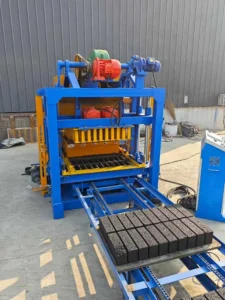
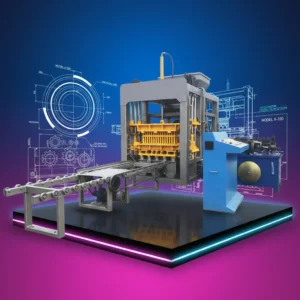
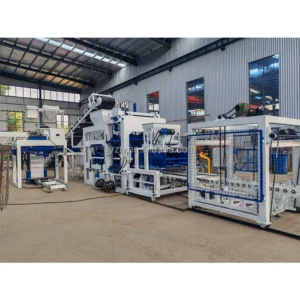
Line-Matched Engineering — The QT6-15 press is specified alongside its mixer, pallet feed, stacker and curing handling so every station runs at the same tempo, avoiding the common bottleneck where upstream or downstream equipment leaves the block machine waiting.
Technical Specifications
| Parameter | Value |
|---|---|
| Product Type | Automatic Hydraulic Block Making Machine |
| Model | QT6-15 |
| Rated Power | 31.25 kW |
| Control System | PLC (Siemens electronics) with remote diagnostics |
| Overall Dimensions (L×W×H) | 7100 × 1500 × 3000 mm |
| Pallet Size | 850 × 680 mm |
| Rated Hydraulic Pressure | 21 MPa |
| Vibration Force | 60 kN |
| Motor Brand | Siemens |
| Mould Manufacturing | Wire cutting + carburizing heat treatment |
| Stacking Method | Automatic stacker for loaded pallets |
| Automation Level | Automatic, with manual pallet handling option |
| Voltage & Frequency | To be confirmed per site supply |
| PLC Display Language | To be confirmed before commissioning |
| Warranty | 1 year (excluding wear parts) |
Application Suitability
| Application | Material or Output |
|---|---|
| Hollow block production for masonry walls | Crushed stone, sand, cement, water |
| Solid block for structural and infill use | Aggregate blends with local sand or gravel |
| Color paving brick for roads and plazas | Pigmented concrete mixes with fine aggregate |
| Interlocking paver ("S" shape and others) | High-density concrete with graded stone dust |
| Grass block and curbstone for landscaping | Porous or standard mixes depending on format |
What "Automatic" Means When the Rest of the Line Cannot Keep Up
A block press is only as fast as the slowest station feeding or clearing it.
I learned this the hard way on a QT6-15 line a few years back in Shandong. The press cycle was dialed in perfectly, but the mixer discharge rate could not match the press demand during solid block runs, so the hopper ran dry every third cycle. The automatic block making machine production line spent half the shift idle, and the buyer blamed the press. [NEED_CITE: line synchronization requirements for concrete block plants] Since then, I calculate every station’s throughput against the buyer’s target block format before any quotation goes out, because an isolated press specification tells you almost nothing about real daily output.
Upstream Feeding and Mixing Must Match the Press Cadence
The QT6-15 cycles through a full mould of hollow blocks in a matter of seconds, and the mixer must deliver a fresh batch to the press hopper before the next cycle begins. If the mixer is undersized or the belt conveyor runs too slowly, the press waits — and waiting presses do not produce blocks. When we plan an automatic block making machine production line, the mixer capacity and discharge time are calculated against the press cycle for every block format the buyer intends to run, not just the largest one.
Downstream Stacking and Curing Cannot Be an Afterthought
The automatic stacker lifts loaded pallets onto curing racks, keeping the pallet return loop clear so the next cycle can begin without delay. If the stacker cycle is slower than the press, pallets queue up at the press exit and force the operator to intervene manually. We specify stacker lift speed and rack capacity alongside the press output, and we confirm that the pallet size of 850 × 680 mm fits the buyer’s existing curing yard spacing and forklift tine width. [NEED_CITE: pallet circulation and curing rack planning for block production lines]
Pressure, Vibration and Mix Design Determine Block Strength Together
The 21 MPa hydraulic pressure and 60 kN vibration force on the QT6-15 are not standalone figures — they must be matched to the buyer’s local aggregate gradation and cement ratio to deliver consistent density across every block format. A mix that works for hollow blocks may not compact well for thin interlocking pavers without adjusting vibration duration or pressure dwell time. We set these parameters during factory testing using the buyer’s actual material samples wherever possible, rather than relying on a catalogue default.
When Pallet Size and Mould Change Are Overlooked
A pallet size chosen without checking the curing area dimensions means the buyer may need to reconfigure the entire yard or buy a different forklift before the line can run. Similarly, if the mould change procedure is not factored into shift planning, a format switch can consume most of a morning, negating the flexibility the buyer paid for. On the QT6-15, the mould mounting system allows format changes, but the time required depends on operator familiarity and whether the moulds are pre-staged on the shop floor. [NEED_CITE: mould change best practices for hydraulic block machines]
Line-Matched Supply from a Single Source
Shiyue focuses exclusively on block machinery, so the press, moulds, pallets and handling equipment are specified as one coordinated system rather than assembled from unrelated suppliers. The line layout drawing shows every station with its capacity stated against the buyer’s chosen block format. Voltage, frequency and PLC display language are confirmed in writing before production begins, and the factory test covers the full line dry run — not the press in isolation. Installation support includes operator training on mould changes, stacker operation and daily maintenance routines.
Documentation & Verification
- Line layout drawing with station-by-station capacity matched to your target block format
- Hydraulic and electrical schematics for the QT6-15 press and connected stations
- Pallet specification sheet confirming 850 × 680 mm dimensions and load rating
- Voltage, frequency and PLC language confirmation signed before production
- Factory test record covering full-line dry run across your selected mould formats
- Mould drawing and format list with wire cutting and carburizing treatment details
Installation, Commissioning & Support
- Foundation plan based on the 7100 × 1500 mm press footprint and 10 t operating weight
- Dedicated power circuit sized for the 31.25 kW rated load plus mixer and stacker draw
- Machine arrives in assembly-ready state; on-site bolt-up and alignment included
- PLC parameters set to your confirmed voltage, frequency and display language
- Operator training covers mould change, stacker reset and daily hydraulic checks
- Wear parts list with lead times for hydraulic seals, vibration springs and mould liners
Planning Your Line Starts with Your Block Format
To size the QT6-15 within a complete automatic block making machine production line, we need to know which block formats your market sells, the daily volume you target per format, and the aggregate materials available locally. Share your curing yard dimensions and existing forklift specifications so we can match pallet handling correctly. Confirm your site voltage and frequency early, and tell us whether the PLC interface needs to run in a specific language for your operators.
Frequently Asked Questions
Q: How is line capacity calculated when the press, mixer and stacker have different cycle times?
A: We calculate each station’s cycle independently against your target block format, then set the line tempo to the slowest station. The mixer discharge, press cycle and stacker lift are all stated per format in the layout drawing, so you see exactly where the bottleneck sits before you commit.
Q: What happens to feeding and stacking when I change mould formats mid-shift?
A: A format change alters the press cycle time and the number of blocks per pallet. The mixer feed rate and stacker lift pattern must be adjusted in the PLC accordingly. We pre-load these parameter sets during commissioning so the operator selects the new format with one menu change rather than manual recalibration.
Q: How do I match the 850 × 680 mm pallet to my existing curing yard and forklift?
A: We need your curing rack spacing, yard aisle width and forklift tine dimensions before finalizing the pallet spec. If your existing equipment does not match, we adjust the pallet size or recommend rack modifications so the line integrates without a second equipment purchase.
Q: Which stations can I add later when moving from semi-automatic to fully automatic?
A: The QT6-15 supports an automatic stacker and pallet return system that can be added after the initial press installation. Cubing and wrapping stations can also be integrated downstream once production volume justifies the investment, using the same PLC platform already installed on the press.
Q: What documentation covers the entire line beyond just the press?
A: You receive a line layout drawing, station-by-station capacity sheet, hydraulic and electrical schematics, pallet specification, mould drawings, factory test record for the full line, and an operation manual covering all connected equipment. CE declaration is provided where applicable to your export market.