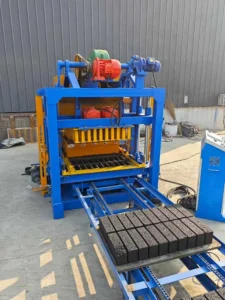
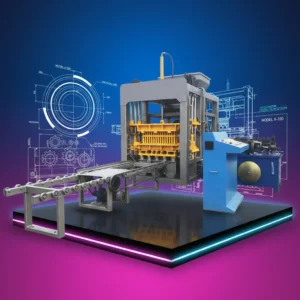
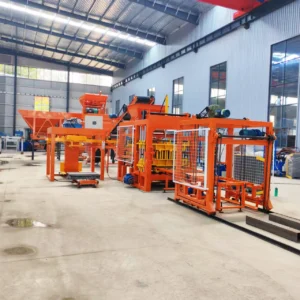
Line Synchronization — every station from silo to stacker is timed to the QT6-15 press cycle, so the automatic block machine production line never starves for material or piles up unhandled pallets.
Technical Specifications
| Parameter | Value |
|---|---|
| Product Type | Automatic Concrete Block Making Machine |
| Model | QT6-15 |
| Molding Way | Vibration and hydraulic pressing |
| Rated Pressure | 21 MPa |
| Molding Cycle | 15s-20s (basis not stated in source — confirm block format / material / thickness) |
| Pallet Size | 900 x 700 mm |
| Main Machine Weight | 6,000 kg |
| Control System | PLC with customizable display language |
| Voltage & Frequency | Customizable to local grid standards |
| Output Capacity (Hollow Block 400x200x200mm) | 1,440 pcs/h, 11,520 pcs/8h |
| Output Capacity (Paving Brick 200x100x60mm) | 5,040 pcs/h, 40,320 pcs/8h |
| Output Capacity (Solid Brick 240x115x53mm) | 7,680 pcs/h, 61,440 pcs/8h |
| Line Configuration Options | Simple line or fully automatic line |
| Mould Change System | Interchangeable moulds with quick-change mechanism |
| Warranty | 1 year (excluding wear parts) |
Application Suitability
| Application | Material or Output |
|---|---|
| Hollow block production for residential and commercial wall systems | Concrete mix with cement, sand, and crushed stone |
| Paving brick manufacturing for roads, parking lots, and walkways | High-density mix with stone powder and fly ash |
| Solid brick output for load-bearing structures and partitions | Cement and sand blend with slag or quarry dust |
| Kerbstone and curb production for municipal infrastructure | Heavy-duty aggregate mix with reinforced vibration |
What "11,520 Blocks per Shift" Actually Requires Upstream
A press never hits its quoted output unless the mixer, conveyor, and pallet feeder are timed to match its cycle.
When I planned a block plant outside Bogotá, the contractor bought a press rated for a 15-second cycle but paired it with a mixer that took 90 seconds per batch. The press sat idle half the day. That gap between catalogue numbers and real throughput is where most plant owners lose money. The QT6-15 automatic block machine production line addresses this by specifying the mixer batch time, belt conveyor length, and pallet loading speed as one interlocked system rather than leaving each station to be sourced separately [NEED_CITE: block plant throughput loss from unmatched station cycle times].
Feeding and Mixing Stations Sized to the Press Cycle
The JS500 mixer in the simple line configuration delivers a batch volume that aligns with the QT6-15 hopper capacity and molding cycle. In the fully automatic configuration, the batching machine, cement scale, and screw conveyor from the silo feed raw materials into the mixer at a rate that keeps the press hopper topped up without overflow. The 8-meter belt conveyor bridges the mixer discharge to the press feed hopper at a speed matched to the 15-to-20-second cycle window.
Pallet Handling as Part of the Line, Not an Afterthought
The pallet loader and pallet separator in the full automatic configuration are set to the 900 x 700 mm pallet size so that cured pallets return to the press on a continuous loop. The automatic stacker at the downstream end lifts freshly pressed blocks off the pallet before the pallet circles back to the loader. This closed loop is what keeps the automatic block machine production line running at rated output — without it, a worker has to pull each pallet by hand, and the press cycle stretches well beyond its designed interval [NEED_CITE: pallet recirculation requirements in concrete block plants].
Reading the Numbers That Matter
The 21 MPa rated pressure, combined with the vibration force, determines the density and compressive strength of the finished block — pressure alone is not enough if the vibration frequency does not consolidate the aggregate in the mould cavity. The 900 x 700 mm pallet size defines how many blocks press per cycle and must match the curing rack spacing and the forklift tine width already on site. The interchangeable mould system means the same press can produce hollow blocks, paving bricks, and solid bricks, but the mould change time and the hydraulic trolley alignment must be factored into the daily schedule so format switching does not consume a full shift.
The Cost of Skipping Line Integration
Buying a press and adding mixers, conveyors, and stackers from different suppliers often results in a voltage mismatch between the PLC and the motor starters, or a pallet size that the curing rack cannot accept. One plant owner I worked with in Medellín received his press with 380V wiring but his mixer ran on 220V, delaying commissioning by weeks while transformers were sourced locally [NEED_CITE: voltage mismatch delays in industrial equipment commissioning]. These are not equipment failures — they are integration failures that a matched line specification prevents.
Why Source the Full Line from One Specification
The QT6-15 is configured as the center of a line, not sold as a standalone press, so every upstream and downstream station is documented in one layout drawing. The pallet size, curing rack handling, and stacking equipment appear in the quotation rather than surfacing as hidden extras after shipment. Voltage, frequency, and PLC display language are confirmed before production starts, avoiding commissioning delays. The line configuration is scalable — a buyer can begin with the simple line and add pallet separators, batching machines, and silo systems later without replacing the press. Moulds are designed to the formats the buyer’s market actually sells, including custom drawings when standard formats do not match local demand.
Documentation & Verification
- Line layout drawing showing station spacing and pallet flow path for the QT6-15
- Capacity calculation sheet stating the block format assumed for each output figure
- Hydraulic and electrical schematics matching the confirmed voltage and frequency
- Factory test record run with the buyer’s specified mould and pallet size
- Pallet specification sheet with dimensions and load rating for curing rack compatibility
Installation, Commissioning & Support
- Foundation plan based on the QT6-15 main machine weight of 6,000 kg and vibration isolation requirements
- Dedicated power circuit sized for the press motor, mixer, and conveyor combined load
- On-site assembly of the stationary line with station alignment and belt tensioning
- First-run parameter setting of the PLC for the buyer’s confirmed voltage and control language
- Operator training on mould change procedure and daily hydraulic system checks
- Wear parts list covering hydraulic seals, vibration springs, and mould liner plates
What We Need to Build Your Line Quote
To configure the QT6-15 automatic block machine production line for your plant, share the block formats your market sells, your target daily output per format, the raw materials available locally with sample gradation, and the dimensions of your curing area. Confirm your site voltage, frequency, and preferred PLC display language so we can lock the electrical specification before production begins.
Frequently Asked Questions
Q: How do I know whether the simple line or the full automatic line fits my output target?
A: The simple line with the JS500 mixer and 8-meter belt conveyor suits lower-volume plants where pallet handling can still be partly manual. The full automatic line adds the batching machine, pallet loader, and stacker to remove labor from the material feed and output end, which becomes necessary once daily volume reaches a level where manual pallet movement creates a bottleneck.
Q: What happens if the mixer batch time does not match the press molding cycle?
A: The mixer must deliver a full batch to the press hopper before the hopper empties. If the batch time is longer than the press consumption rate, the press idles and real output drops below the quoted cycle rate. The line configuration matches mixer capacity to the QT6-15 cycle so the hopper stays full continuously.
Q: Is pallet feeding and stacking included in the quotation or purchased separately?
A: In the full automatic configuration, the pallet loader, pallet separator, and automatic stacker are part of the line quotation. In the simple line, the automatic stacker is included while pallet return may involve manual handling. Every pallet-related station is listed explicitly so there are no missing links after installation.
Q: Can the line be expanded from simple to fully automatic later without changing the press?
A: The QT6-15 press accepts the same pallet size and control signals in both configurations. Adding a cement silo, batching machine, and pallet separator later connects to the existing PLC without replacing the press, allowing a phased investment that grows with production demand.
Q: How is the 900 x 700 mm pallet size chosen to match my site?
A: The pallet size determines how many blocks are pressed per cycle and must align with the curing rack dimensions and the forklift already on site. We confirm rack spacing and forklift tine width before finalizing the pallet specification so cured blocks move from rack to truck without rehandling.