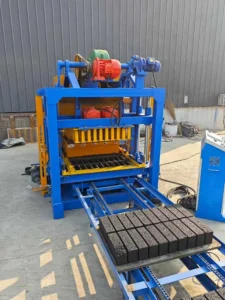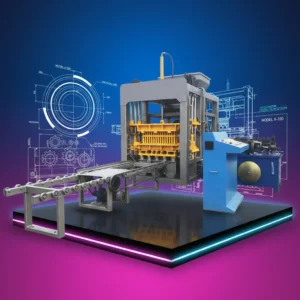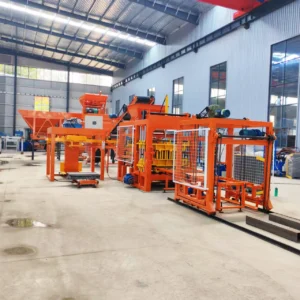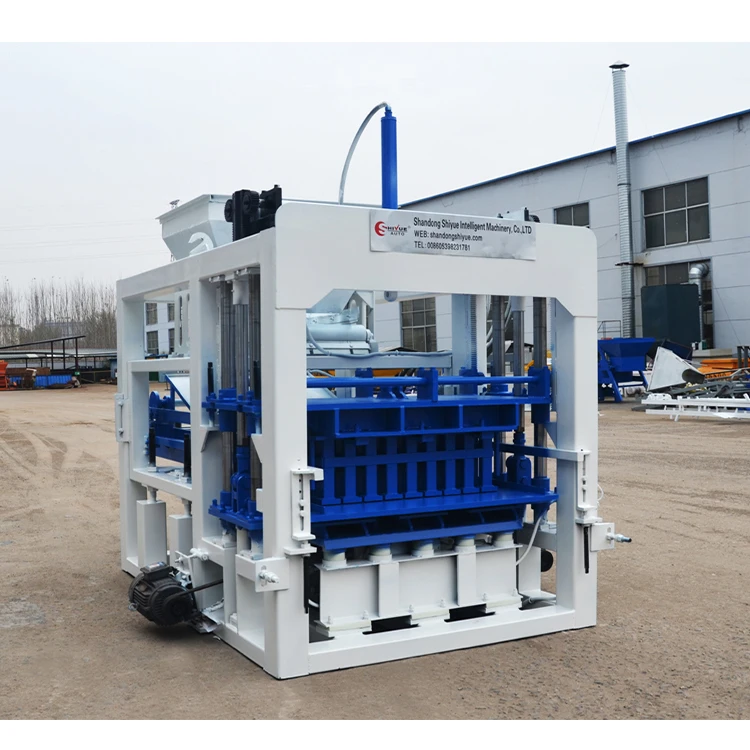
Matched Line Integration — The QT5-15 is specified as a coordinated block production line where raw material feeding, mixing, pallet circulation, and stacking stations are timed to the press cycle so the host never idles waiting for upstream or downstream input.
Technical Specifications
| Parameter | Value |
|---|---|
| Model | QT5-15 |
| Product Type | Interlocking Brick Making Machine |
| Overall Dimensions (L×W×H) | 7400×1950×2800 mm |
| Vibration Frequency | 0–60 Hz |
| Vibration Form | Platform Vibration |
| Moulding Mode | Automatic loading, vibration moulding |
| Pallet Size | 1100×550 mm |
| Molding Cycle | 15–20 s |
| Overall Power | 32 kW |
| Vibration Force | 80 kN |
| Total Mass | 5000 kg |
| Demolding Method | Hydraulic |
| Recommended Factory Area | 1000 m² |
| Control System | PLC with touch screen interface |
| Hydraulic System | Independent integrated hydraulic station |
| Output Capacity (Hollow block 400×200×200 mm) | 900–1200 pcs/h, 7200–9600 pcs/8 hr (basis: 5 pcs/mould, 15–20 s cycle) |
| Output Capacity (Solid brick 240×115×53 mm) | 5760–7680 pcs/h, 46080–61440 pcs/8 hr (basis: 32 pcs/mould, 15–20 s cycle) |
| Output Capacity (Rectangular brick 200×100×60 mm) | 3600–4500 pcs/h, 28800–36000 pcs/8 hr (basis: 25 pcs/mould, 20–25 s cycle) |
| Raw Materials | Fly ash (up to 70%), slag, gangue, sand, crushed stone, cement, water |
| Block Compressive Strength | >15 MPa |
| Line Components | Pallet feed machine, block making machine, storage hopper, conveyor, hydraulic unit, PLC cabinet |
| Warranty | 1 year (excluding spare parts) |
Application Suitability
| Application | Material or Output |
|---|---|
| Hollow block production for structural walls | Crushed stone, sand, cement (400×200×200 mm and 400×150×200 mm formats) |
| Interlocking brick manufacturing for housing projects | Fly ash (up to 70%), slag, cement with platform vibration compaction |
| Paving brick production for roads and walkways | Sand, crushed stone, cement (rectangular 200×100×60 mm and zigzag 225×112.5×60 mm) |
| Solid brick production for masonry infill | Sand, cement, industrial residue (240×115×53 mm format) |
| Building material plant adding multi-format capability | Mould change on a single host with matching pallet and handling equipment |
Why "Cycle Time" Means Nothing Without Line Synchronization
A QT5-15 interlocking brick making machine production line only delivers its stated cycle time when every upstream and downstream station is timed to the press.
Quotations often list cycles per hour against a single block format without showing how material arrives at the hopper, how fast the mixer discharges, or how pallets circulate back to the feed station. I once configured an interlocking brick line for a project in Chile where the press was rated for a 15–20 second cycle, but the pan mixer discharged in batches too slow for continuous running — the host sat idle nearly half the shift waiting for material. [NEED_CITE: mixer discharge rate versus press cycle matching in block production]. When the mixer was replaced with a twin-shaft unit sized to the press throughput, actual daily output came close to the original estimate. This QT5-15 interlocking brick making machine production line avoids that trap by specifying the storage hopper, conveyor, pallet feed machine, and hydraulic unit as one matched system rather than sourcing each station independently.
Matching Every Station to the Press Rhythm
The QT5-15 interlocking brick making machine production line connects raw material intake to cured block output through sequenced stations. The storage hopper feeds the press on demand, the pallet feed machine delivers a fresh pallet before each press cycle begins, and the PLC touch screen interface coordinates vibration, material loading, and hydraulic demolding so that no station waits on another.
Where Bottlenecks Actually Form
In most block plants, the bottleneck is not the press itself — it is pallet return speed or mixer discharge rate. The independent integrated hydraulic station on this QT5-15 line is isolated from host vibration and dust, which protects valve response times across long shifts. When hydraulic response slows, demolding extends the cycle and the pallet queue backs up. [NEED_CITE: hydraulic station isolation from vibration sources in block machinery]. Specifying the hydraulic unit within the line rather than sourcing it separately keeps response time consistent with the 15–20 second molding target.
What the Core Specifications Mean on the Shop Floor
The 80 kN vibration force at 0–60 Hz platform vibration is matched to the mould format and the buyer’s mix design — higher frequency works for fine sand mixes producing pavers, while lower frequency with longer duration suits coarse aggregate hollow blocks. The 1100×550 mm pallet size must align with the curing rack spacing and the forklift tine width already on site; specifying pallets without confirming curing area dimensions leads to double handling. The 32 kW overall power draw determines the transformer and dedicated circuit requirement before the machine arrives. Block compressive strength above 15 MPa is achievable when vibration force, hydraulic pressure, and mix water content are balanced — any one of those out of range produces weak or cracked output regardless of cycle speed.
The Cost of Treating the Press as a Standalone Purchase
When the press arrives without pallet handling, stacking, or curing rack specifications, the buyer is left stacking wet blocks by hand — output that should leave the line on pallets ends up on the floor. Mismatched pallet sizes mean the forklift cannot move loaded pallets to curing racks, creating a secondary bottleneck that no amount of press speed can solve. [NEED_CITE: pallet handling as a production bottleneck in small and medium block plants]. Voltage and PLC display language left unconfirmed before production delay commissioning by weeks while control panels are reprogrammed or transformers are sourced locally.
Why Sourcing the Full Line Matters Here
Block machinery is a single focus, so the QT5-15 press, moulds, pallets, and handling equipment are specified as one matched system. Configuration starts from the buyer’s actual mix design and local aggregate rather than a catalogue default. Mould design covers the formats the buyer’s market sells, including custom drawings for interlocking profiles. Automation level is selectable — a buyer can start with manual pallet handling and add automatic stacking later. Installation and commissioning include operator training so the line runs at rated rhythm from the first shift.
Documentation & Verification
- Line layout drawing showing station spacing and pallet circulation path for the 1000 m² recommended area
- Capacity calculation table stating block format and cycle time assumption for each output figure
- Hydraulic and electrical schematic for local maintenance and troubleshooting planning
- Pallet specification sheet matched to buyer’s curing rack dimensions and forklift tine width
- Voltage, frequency, and PLC display language confirmation form signed before production begins
- Factory test record run on buyer’s target block format before dispatch
Installation, Commissioning & Support
- Foundation must support 5000 kg total mass across the 7400×1950 mm footprint with vibration isolation
- Dedicated 32 kW circuit with confirmed voltage and frequency matching the PLC cabinet rating
- Machine arrives with hydraulic station and hopper assembled; pallet feed and conveyor bolted on site
- PLC touch screen parameters set to buyer’s block format and molding cycle during commissioning
- Operator training covers mould change sequence, hydraulic pressure adjustment, and fault code reading
- Wear parts list provided for hydraulic seals, vibration springs, and mould liners specific to this model
What We Need to Configure Your Line
To size the supporting stations correctly, please share the block formats your market demands, the raw materials available locally including aggregate grading, and your target daily output per format. We also need your existing curing area dimensions, forklift specifications, and site voltage and frequency so the QT5-15 interlocking brick making machine production line is configured before it ships.
Frequently Asked Questions
Q: How do line stations synchronize so the QT5-15 press cycle is not interrupted by upstream or downstream delays?
A: The PLC controls pallet feeding, material discharge from the hopper, vibration timing, and hydraulic demolding as a single sequence. Each station’s response time is calculated against the 15–20 second molding cycle so the press never idles. If the mixer or conveyor is undersized, the PLC will flag a queue fault rather than let the press run dry.
Q: What supporting equipment is included — and what is the buyer responsible for sourcing locally?
A: The line package covers the pallet feed machine, storage hopper, conveyor, hydraulic unit, and PLC control cabinet alongside the QT5-15 press. Buyers typically source the raw material mixer, curing racks, and forklift locally. We specify pallet size and curing rack spacing so local purchases integrate without modification.
Q: How is pallet size and material confirmed against the buyer’s curing rack system and forklift?
A: We request the buyer’s curing rack bay width, rack height, and forklift tine spacing before production. The 1100×550 mm pallet is standard for this line, but material — bamboo, steel, or composite — is selected based on curing temperature, humidity, and expected pallet lifespan. Mismatched pallets cause double handling and slow the entire line.
Q: Can the automation level be upgraded later — for example from manual stacking to automatic cubing?
A: Yes. The line is designed so a buyer can start with manual pallet stacking and add an automatic stacker and cubing station later without replacing the press or PLC cabinet. The control system reserves I/O channels for downstream automation, and the pallet return conveyor can be extended to feed a cubing station when the upgrade is ready.