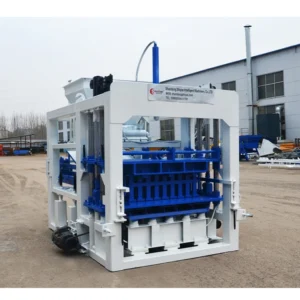
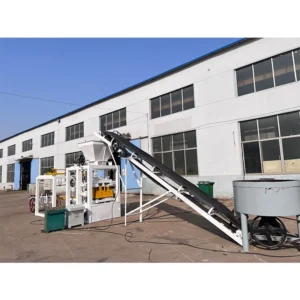
Balanced Line Integration — The QT5-15 block press is specified as the centre of a coordinated production line where raw material feeding, mixing, pallet circulation, stacking and curing rack handling are matched to its 15–25s moulding cycle so no station waits on another.
Technical Specifications
| Parameter | Value |
|---|---|
| Model | QT5-15 |
| Product Type | Automatic Concrete Block Making Machine |
| Overall Dimensions (L×W×H) | 7400×1950×2800mm |
| Rated Pressure | 21MPa |
| Main Vibration Form | Platform Vibration |
| Vibration Frequency | 2800~4500 r/min |
| Pallet Size | 1100×550mm |
| Molding Cycle | 15-25s |
| Overall Power | 26.5kW |
| Demolding Method | Hydraulic |
| Applied Products | Concrete blocks, hollow/solid blocks, pavers, interlocking blocks, curbstone, colored pavers |
| Raw Material | Crushed stone, sand, cement, dust, fly ash, gravel, slag, and other raw materials |
| Output Capacity (Hollow brick 400×200×200mm) | 1800 pcs/h (based on 5 pcs/mold, 16-20s cycle) |
| Output Capacity (Hollow block 400×150×200mm) | 1300 pcs/h (based on 6 pcs/mold, 15-20s cycle) |
| Output Capacity (S paver 225×112.5×60mm) | 3700 pcs/h (based on 16 pcs/mold, 15-20s cycle) |
| Voltage & Frequency | To be confirmed with buyer’s local grid (basis not stated in source) |
| Control System | To be confirmed: PLC brand and display language (basis not stated in source) |
| Net Weight | To be verified against manufacturer catalog (basis not stated in source) |
| Automation Level | Automatic (exact scope of pallet feeding, stacking, cubing to be confirmed) |
| Mould Change Time | To be confirmed per format change (basis not stated in source) |
| Stacking Method | To be confirmed: manual or automatic (basis not stated in source) |
Application Suitability
| Application | Material or Output |
|---|---|
| Block and paver production plants | Full range: hollow blocks, solid blocks, paving blocks, interlocking bricks from crushed stone, sand, cement, fly ash |
| Construction contractors producing blocks on-site | Hollow and solid blocks from locally sourced aggregate and cement for project-specific output |
| Concrete product manufacturers adding formats | Switching between curbstone, colored pavers and standard blocks using the same pallet size |
| Development and housing project contractors | High-volume hollow block production from gravel, slag and cement for residential wall construction |
What the Quoted Cycle Time Actually Means for Your Line
A 15–25 second moulding cycle only holds when every upstream and downstream station delivers on time.
I once stood on a site in West Africa watching a block press sit idle for four seconds every cycle because the pallet feeder from a different supplier could not keep pace. The press was rated for a certain output, but the actual daily throughput fell far short because nobody had checked the station-to-station timing before shipping. When planning an automatic block making machine production line, the press cycle must be verified against the mixer discharge rate, the pallet return conveyor speed, and the stacking interval. If any one of these is slower than the press, the entire line bottlenecks at that point [NEED_CITE: line balancing principles in concrete block production].
Station Timing from Raw Material Intake to Curing Rack
The QT5-15 completes a moulding cycle in 15–25 seconds depending on block format. That means the mixer must discharge a fresh batch to the hopper within that window, the pallet feeder must place a clean pallet on the vibration table, and the wet block stacker must clear the finished pallet before the next stroke. In a balanced automatic block making machine production line, each of these stations is specified with a cycle time slightly faster than the press so the press never waits.
Pallet Circulation as the Hidden Bottleneck
Pallet size on this model is 1100×550mm. That dimension determines the curing rack spacing, the forklift fork width, and the return conveyor length. If the pallet material is too flexible, blocks crack during transport to the curing area. If the return conveyor is undersized, pallets pile up at the press exit and the operator starts stacking wet blocks by hand — which defeats the purpose of investing in an automatic line. The pallet specification must be confirmed against the buyer’s existing curing area footprint and material handling equipment before the line is built [NEED_CITE: pallet material selection for concrete block curing].
Platform Vibration and Hydraulic Pressure Matched to Local Aggregate
The QT5-15 uses platform vibration at 2800–4500 r/min combined with 21 MPa rated hydraulic pressure. These two forces work together: vibration settles the mix into the mould cavity while hydraulic pressure compacts it to target density. The correct balance depends on the buyer’s local aggregate — a coarse crushed stone mix requires different vibration frequency and pressure settings than a fine fly ash blend. Configuration is set against the actual mix design the buyer will run, not a catalogue default.
The Cost of Skipping Line Integration Checks
When supporting stations are sourced separately and the timing is never verified, the consequences appear on the first day of production. Blocks stack up on the conveyor because the stacker is too slow. The mixer runs dry because its batch size does not match the press hopper capacity. Pallets arrive at the curing rack warped because the return conveyor lacks alignment guides. These problems are not press failures — they are integration failures that no amount of on-site adjustment can fully correct once the line is bolted down [NEED_CITE: common integration failures in block production lines].
Why Specifying the Full Line Here Matters
Block machinery is our single focus, so the QT5-15 is quoted as part of a matched system — press, mould, pallet and handling stations specified together. The configuration is set against the buyer’s actual mix design, local aggregate and target block format rather than a default catalogue entry. Mould design covers the formats the buyer’s market sells, including custom drawings when needed. The automation level is selectable, allowing a buyer to start with pallet feeding and stacking and add cubing later. Installation and commissioning include operator training so the line runs at stated capacity from the first shift.
Documentation & Verification
- Line layout showing station-by-station cycle time for the QT5-15 configuration
- Capacity calculation stating the block format assumed for each throughput figure
- Pallet specification matched to buyer’s curing rack and forklift dimensions
- Hydraulic and electrical schematic with confirmed voltage and control language
- Mould drawing and format list for every block type in the quotation
- Factory test record on buyer’s specified mix before dispatch
Installation, Commissioning & Support
- Foundation plan based on QT5-15 overall dimensions of 7400×1950×2800mm and dynamic vibration loads
- Dedicated power circuit sized for 26.5kW overall draw at confirmed local voltage and frequency
- Machine dismantled for container loading with reassembly sequence documented per station
- First-run parameter setting for vibration frequency, hydraulic pressure and cycle time per block format
- Operator training covering mould change procedure, pallet feeder adjustment and daily maintenance checks
- Wear parts and mould list with recommended reorder intervals for the buyer’s production volume
Before You Request a Quote
To size the QT5-15 line correctly, we need to know the block formats you plan to produce and the daily output target per format. Share your local raw material source and typical mix proportions so the vibration and pressure settings can be matched before production. Confirm your site voltage, frequency and preferred PLC display language, along with the dimensions of your existing curing area and forklift capacity, so pallet and handling stations are specified to fit.
Frequently Asked Questions
Q: How is the daily output of the QT5-15 line calculated when multiple block formats are produced in one shift?
A: Each format has its own cycle time — for example, 16–20 seconds for 400×200×200mm hollow bricks at 5 pieces per mould, and 15–17 seconds for S pavers at 16 pieces per mould. Daily output is calculated per format against the planned shift length, with format change time deducted. A mixed-format shift plan is provided with the quotation so you can see realistic throughput before committing.
Q: Which supporting stations are included in the quotation and which are optional?
A: The standard quotation covers the QT5-15 press, moulds, pallet specification and pallet feeder. Raw material mixer, automatic stacker, curing rack handler and cubing system are configurable additions. The proposal states clearly which stations are included and which are optional, with cycle time for each station shown so you can see where the line balances.
Q: How do we confirm that pallet size and material match our existing curing area and forklift?
A: The 1100×550mm pallet is the starting point. Before production, we request your curing rack dimensions, rack spacing and forklift fork width. Pallet material — wood, bamboo or composite — is then selected against your curing environment and handling method. This confirmation happens in writing before the line enters manufacturing.
Q: What is the cycle time at each station, and how is the line balanced?
A: Every station in the QT5-15 line — mixer discharge, pallet feeding, press stroke, block stacking and pallet return — is specified with a target cycle time. The press cycle of 15–25 seconds sets the pace, and upstream and downstream stations are configured to complete their tasks within that window. The line layout document shows these timings station by station.
Q: Can the automation level start at pallet feeding and stacking and be upgraded later?
A: Yes. The QT5-15 can be configured with manual or semi-automatic pallet handling at the start, with the mechanical and electrical interfaces for automatic stacking and cubing already in place. When you are ready to add those stations, they integrate into the existing line without replacing the press or modifying the foundation.