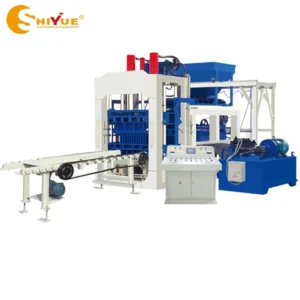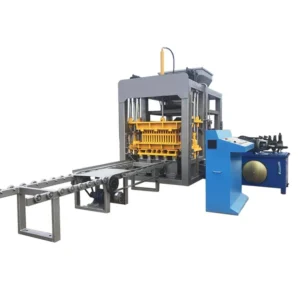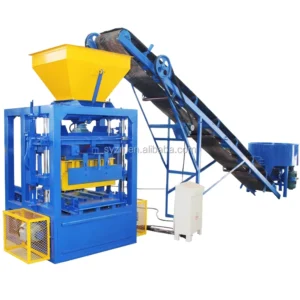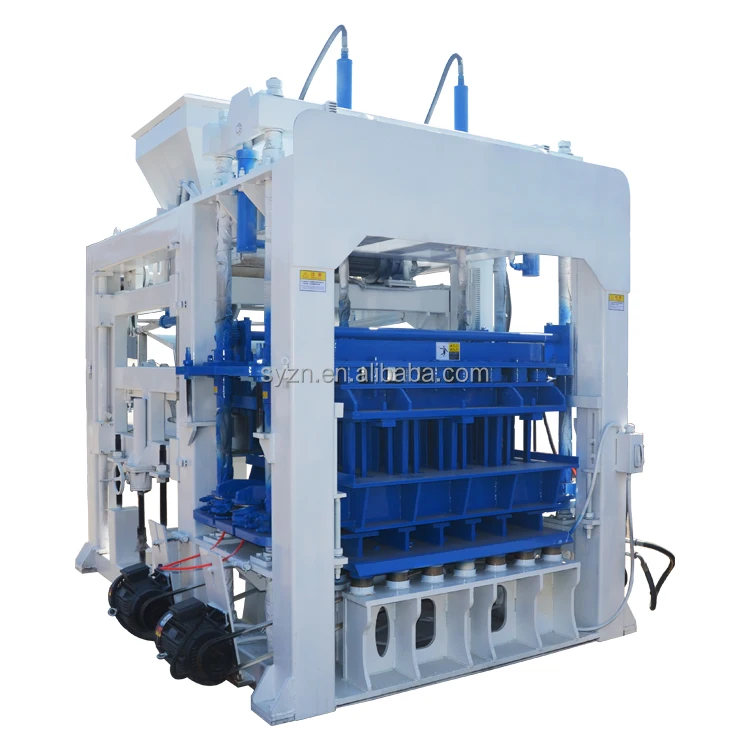
Matched System Integration — Every supporting station from material feeding to automatic stacking is specified as one coordinated line, ensuring the press never waits for upstream or downstream equipment.
Technical Specifications
| Parameter | Value |
|---|---|
| Model | QT12-15 |
| Product Type | Large Scale Stationary Automatic Block Making Machine |
| Control System | PLC aptitude control with human-machine interface dialogue system |
| Vibration System | Vertically synchronous vibration, frequency conversion and braking, synthetic output compounded with double vibration sources |
| Feeding System | Semi-closed screen reticular rotational feeding unit, forced feeding with evenness and even speed |
| Hydraulic System | Special hydraulic loading unit, computer control flow pressure |
| Structure | Super-strong steel structure with imported original parts |
| Output – Hollow Block 400×200×200 mm | 2160–2880 pcs/hour (basis: 12 pcs/mould, molding cycle 15–20s) |
| Output – Hollow Block 400×150×200 mm | 2520–3360 pcs/hour (basis: 14 pcs/mould, molding cycle 15–20s) |
| Output – Solid Brick 240×115×53 mm | 9360–12480 pcs/hour (basis: 52 pcs/mould, molding cycle 15–20s) |
| Output – Rectangular Paver 200×100×60 mm | 5040–6300 pcs/hour (basis: 35 pcs/mould, molding cycle 20–25s) |
| Output – Zigzag Brick 225×112.5×60 mm | 3888–4860 pcs/hour (basis: 27 pcs/mould, molding cycle 20–25s) |
| Automation Level | Automatic mass production |
| CE Compliance | Documentation available (basis to be confirmed) |
Application Suitability
| Application | Material or Output |
|---|---|
| Large scale hollow block production | Crushed stone, cement, sand, fly ash aggregate blends |
| High-volume solid brick manufacturing | Cement-bound aggregate mixes with fine sand gradation |
| Paving block and rectangular paver plants | Dense aggregate blends requiring high vibration compaction |
| Interlocking and zigzag brick facilities | Standard concrete mix with colour oxide additions |
| Concrete product manufacturers expanding format range | Multiple mould configurations on a single press platform |
Why "Pieces per Hour" Tells Only Half the Story for an Automatic Block Making Machine Production Line
A cycle time without the supporting equipment context is just a number on paper.
In my years visiting block plants across Southeast Asia, I have watched high-capacity presses sit idle because the mixer could not deliver fresh batch material fast enough or the pallet return system lagged behind the press cycle. One project in Indonesia involved a large-format press whose rated output assumed a specific hollow block, yet the actual daily production fell noticeably short once format changes and pallet logistics were factored in [NEED_CITE: line synchronization impact on actual block plant throughput]. When planning an automatic block making machine production line, the honest question is how every station connects — raw material feeding, mixing, pallet feeding, stacking, and curing rack handling — so the press operates at full capacity without forced idle time.
How Raw Material Feeding and Mixing Keep the QT12-15 Press Fed
The automatic block making machine production line begins well before the press itself. The semi-closed screen reticular rotational feeding unit on the QT12-15 delivers material into the mould box with even distribution and consistent speed, but that unit depends entirely on the mixer and conveyor upstream maintaining a steady supply. If the batching plant cycles slower than the press molding cycle of 15–20 seconds per format, the vibration table sits waiting and the quoted output becomes theoretical. Line layout must map each station’s cycle against the press requirement so no single link becomes the bottleneck.
Where Pallet Handling and Automatic Stacking Connect to Press Throughput
Every press cycle deposits a freshly formed layer of blocks onto a pallet, and that pallet must move to the curing rack before the next cycle begins. The QT12-15 produces 12 hollow blocks per mould in rapid succession, meaning pallet circulation speed must match that rhythm precisely. Automatic stacking and curing rack handling stations are specified to receive, transport, and return pallets within the press cycle window [NEED_CITE: pallet circulation requirements for high-output block lines]. When pallet size and material are chosen without regard to the curing area layout and the forklift already on site, the entire downstream flow slows to manual handling pace.
What the Specifications Mean on the Factory Floor
The vertically synchronous vibration system with frequency conversion and double vibration sources is designed to compact the concrete mix uniformly across the full mould area, which directly influences block density and demoulding strength. Hydraulic flow pressure is managed through computer control, adjusting to the resistance the mix presents at different stages of compaction. The PLC aptitude control with human-machine interface allows operators to monitor cycle parameters and perform signal analysis without needing external diagnostic tools. For plants running multiple formats — from 400×200×200 mm hollow blocks down to 200×100×60 mm paving units — the super-strong steel structure absorbs the compaction forces repeatedly over long production shifts.
The Cost of Overlooking Line Synchronization Before Commissioning
When supporting equipment is treated as an afterthought, the press arrives on site and immediately exposes every upstream and downstream gap. A mixer sized for a smaller plant forces the QT12-15 into a start-stop rhythm that accelerates wear on the vibration system and hydraulic components. Pallets specified for a different curing rack dimension require manual repositioning, negating the automatic stacking investment. Voltage and frequency confirmed too late delay commissioning by weeks while transformers are sourced locally [NEED_CITE: voltage mismatch delays in industrial equipment installation]. These are not equipment failures — they are planning failures that surface only after concrete is poured on the foundation.
Why Buyers Plan Their Complete Line Here
Block machinery is the single focus of this operation, so the QT12-15 press, its moulds, pallets, and all supporting handling equipment are specified as one matched system rather than assembled from separate suppliers. Configuration is set against the buyer’s actual mix design, local aggregate characteristics, and target block format rather than a catalogue default. Mould design covers the formats the buyer’s market actually sells, including custom drawings when standard options do not fit. The automation level is selectable, allowing a plant to begin with semi-automatic pallet handling and upgrade stations as production volume justifies it. Installation support includes operator training and documentation for long-term maintenance scheduling.
Documentation & Verification
- Line layout drawing showing station spacing and pallet flow path for the QT12-15 configuration
- Capacity calculation sheet stating the block format and mould configuration assumed per output tier
- Hydraulic and electrical schematic matching the supplied control system language
- Factory test record run on the buyer’s specified aggregate blend before dispatch
- Pallet specification matched to curing rack dimensions and forklift capacity
- Packing photographs and customs documentation support for container loading
Installation, Commissioning & Support
- Foundation plan specifying load points and slab thickness required for the super-strong steel structure
- Dedicated power circuit sized for the QT12-15 hydraulic and vibration system draw
- Voltage and frequency confirmation recorded before production to match local grid supply
- PLC display language set to operator preference during control panel configuration
- On-site commissioning with parameter tuning for the buyer’s specific mix design
- Wear parts list covering vibration table components, hydraulic seals, and mould liners
What We Need to Plan Your Line Accurately
To size the supporting equipment around the QT12-15, we need your target block formats with daily output requirements, the local aggregate and cement types available, and the curing area dimensions you have on site. Voltage and frequency at your facility determine the motor and control configuration before manufacturing starts. If you have existing mixers, conveyors, or forklifts that will remain in the line, share their specifications so the new stations connect without creating flow mismatches.
Frequently Asked Questions
Q: How do the raw material feeding, mixing, and pallet feeding stations synchronize with the QT12-15 press cycle time?
A: Each station’s cycle is mapped against the press molding time of 15–20 seconds per format. The mixer batch size, conveyor speed, and pallet return loop are all calculated so material and pallets arrive before the press completes its current cycle. This prevents forced idle time that would otherwise reduce the automatic block making machine production line output below the rated capacity for any given block format.
Q: What supporting equipment is included in the line configuration versus quoted separately?
A: The standard configuration scope covers raw material feeding, mixing, pallet feeding, automatic stacking, and curing rack handling as integrated stations. Each item is listed individually in the quotation so buyers see exactly what is supplied. Equipment outside this scope — such as raw material silos or curing area covers — is identified clearly so there are no hidden gaps when the plant begins operation.
Q: How is the line layout designed for my site conditions and total plant footprint?
A: The layout drawing positions each station — from aggregate bins through the QT12-15 press to the curing rack area — based on your available floor space and ceiling height. Pallet circulation paths are routed to avoid forklift traffic conflicts. The total footprint includes the press footprint, supporting equipment zones, and the curing rack area calculated for the daily output volume and the curing duration your mix requires.
Q: What is the realistic daily output for my target block format accounting for mould changes?
A: Daily output is calculated per format using the mould configuration and cycle time specific to that block size. Mould change duration is factored into the shift plan based on how many format switches your production schedule requires. The capacity calculation sheet provided with your quotation shows output per format separately, not a single blended figure that hides the assumptions behind it.
Q: How do pallet size and material specifications integrate with my existing handling system?
A: Pallet dimensions are matched to the curing rack spacing and the forklift tine width already on site. Material selection considers the pallet weight your return system can handle and the surface finish required for clean block release. Confirming these details before production ensures the QT12-15 line connects to your existing infrastructure without requiring equipment modifications after arrival.