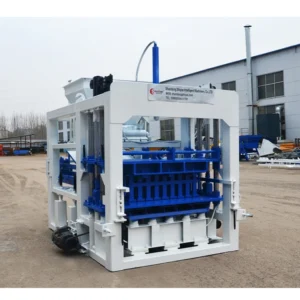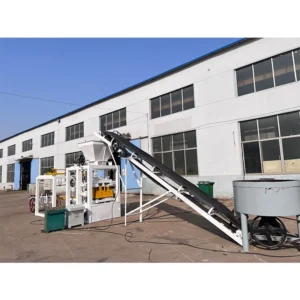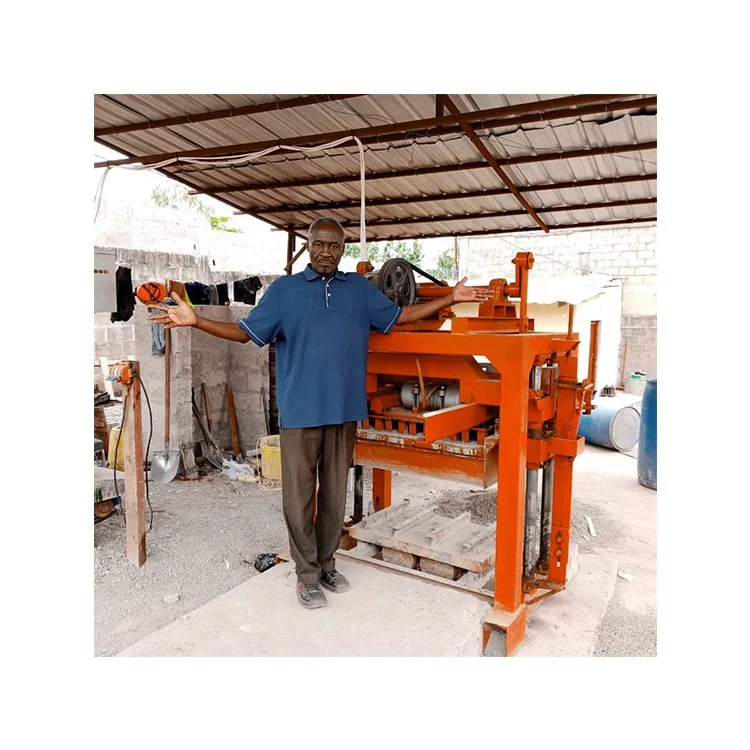
Matched System Sizing — every station around the press is calculated against the 40-second molding cycle so mixer output, pallet feed, and curing rack handling stay synchronized.
Technical Specifications
| Parameter | Value |
|---|---|
| Model | QTJ4-40 |
| Product Type | Semi-Automatic Concrete Block Making Machine |
| Overall Dimensions (L×W×H) | 1350 × 1460 × 1800 mm |
| Rated Power | 10.4 kW |
| Molding Cycle | 40 s |
| Output Capacity (Hollow 400×200×200 mm) | 4 pcs/mould, 360 pcs/h, 2880 pcs/day |
| Output Capacity (Hollow 400×150×200 mm) | 5 pcs/mould, 450 pcs/h, 3600 pcs/day |
| Output Capacity (Solid 225×112.5×60 mm) | 9 pcs/mould, 800 pcs/h, 6400 pcs/day |
| General Output Capacity | 2000–2500 pcs/8h (basis not stated in source) |
| Net Weight | 1.2 T |
| Pallet Size | 850 × 450 × 20 mm |
| Pallet Material Option | Fiber glass (optional) or wooden pallet (local alternative) |
| Vibration System | Bed mould vertical vibration with upper mould compression vibration |
| Mould Format Capability | Hollow, solid, paver (8", 6", 5", 4") |
| Automation Level | Semi-automatic |
| Voltage | Configurable to buyer’s local supply |
| Raw Material Compatibility | Concrete, sand, cement, fly ash, lime, gypsum |
| Supporting Equipment Required | Mixer, host machine, block mould, pallets |
Application Suitability
| Application | Material or Output |
|---|---|
| Small to medium block plant | Hollow blocks from crushed stone, sand, and cement |
| Contractor on-site production | Solid blocks from locally available aggregate and cement |
| First-time entrepreneur plant | Paving blocks and kerbstones from fly ash or sand mixes |
| Format expansion on existing line | Multiple hollow and solid sizes on a single press station |
What "Pieces per Day" Hides When the Line Is Unbalanced
The press cycle is only one station — if the mixer or pallet handler cannot keep pace, the quoted output never materializes.
I have watched a Semi-Automatic Block Making Machine production line sit idle because the upstream pan mixer was sized for a slower press, leaving the operator waiting for the next batch every third cycle. The reverse happens too: a high-capacity mixer feeding a small press means wet concrete sits in the hopper losing workability. Downstream, if pallets are not returned to the feed station fast enough, the press stops. [NEED_CITE: synchronization requirements for concrete block production lines]
Stations Upstream of the Press
A Semi-Automatic Block Making Machine production line begins at raw material intake. The mixer must deliver a homogeneous batch within the 40-second window so the press hopper never runs dry. For the QTJ4-40, a mixer with a batch volume matching roughly one to two mould cycles keeps material fresh and prevents slump loss. Pallet feeding, whether manual or gravity-assisted, must align with the press ejection stroke so the operator is not the pacing constraint.
Stations Downstream and the Curing Loop
Once the block leaves the press on its 850 × 450 mm pallet, it enters the curing zone. The pallet circulation rate must account for the total pallet count in the loop — press, curing racks, and return path. If the curing rack capacity holds only two hours of production, the line halts while racks are cleared. Curing rack dimensions and forklift tine spacing must match the pallet footprint chosen at the quotation stage, not after arrival. [NEED_CITE: pallet circulation planning for stationary block plants]
Reading the Numbers That Matter
Vibration and compression work together on this machine: bed mould vertical vibration settles the aggregate while upper mould compression vibration densifies the face. The 10.4 kW rated power drives both the vibration motors and the hydraulic system. Pallet size at 850 × 450 × 20 mm dictates the mould cavity layout — a 400 × 200 × 200 mm hollow block fits four per mould, while a 225 × 112.5 × 60 mm solid block fits nine. Cycle time stays at 40 seconds across formats, but daily output shifts dramatically with the mould installed. Net weight of 1.2 T and overall dimensions of 1350 × 1460 × 1800 mm mean the press can be positioned on a compact slab without heavy foundation work.
The Cost of Skipping Line Synchronization
When a buyer focuses on the press alone and sources the mixer and pallets separately, mismatched capacities surface on day one. A mixer too small forces the press into intermittent stops that reduce actual output below any quoted figure. Pallets ordered in the wrong thickness jam the feed rails. Wooden pallets from a local supplier may warp after repeated wet curing cycles, causing uneven block height. These failures are rarely blamed on line design — they are blamed on the machine. [NEED_CITE: common commissioning delays in block production startups]
Why Procure the Line Here
Block machinery is the single focus of this facility, so the press, moulds, pallets, and handling equipment are specified as one matched set rather than assembled from separate vendors. Configuration starts from the buyer’s actual mix design and local aggregate, not a catalogue default. Mould formats are selected against the products the buyer’s market actually sells, including custom drawings when standard sizes do not fit. The semi-automatic station can later integrate automatic pallet feeding and stacking as line throughput grows. Voltage, frequency, and control language are confirmed before production begins, avoiding the commissioning delays that come from discovering a mismatch after arrival. Installation support and operator training are included so the line reaches steady output quickly.
Documentation & Verification
- Line layout with capacity calculation stating the block format assumed for each figure
- Pallet specification confirming size, material, and curing rack compatibility
- Voltage and control language confirmation sheet signed before production
- Factory test record showing cycle time and output for the buyer’s chosen mould
- Hydraulic and electrical schematic for local maintenance reference
- Packing photographs and customs documentation support
Installation, Commissioning & Support
- Compact 1350 × 1460 mm footprint fits a standard concrete slab without heavy piling
- 10.4 kW supply requires a dedicated breaker and confirmed voltage and frequency match
- Machine ships partially assembled; vibration table and upper mould frame bolt on at site
- First-run commissioning includes cycle timing and block density verification per mould
- Operator training covers mould change, pallet feed rhythm, and daily vibration motor checks
- Wear parts list identifies hydraulic seals and vibration springs for local stock planning
Before You Send an Inquiry
A complete line quotation requires your target block format and daily volume, local raw material type and source, site dimensions including curing yard area, and your existing forklift and rack specifications. Confirm local voltage, phase, and frequency early. Note which upstream and downstream equipment you already have so the proposal covers only the gaps.
Frequently Asked Questions
Q: How do I verify the daily output for my specific block format?
A: Request a capacity calculation document that states the mould configuration, pallet size, and cycle time assumed. The QTJ4-40 delivers four 400×200×200 mm hollow blocks per 40-second cycle, but your format and mix may differ. A factory test on your chosen mould before shipment provides the verified figure.
Q: What mixer capacity should match this press station?
A: The mixer must deliver one full batch within roughly one to two press cycles to keep the hopper charged without material sitting too long. For the QTJ4-40, this typically means a pan mixer rated for the volume of two mould charges, adjusted for your specific mix density and moisture content.
Q: How should I choose pallets to fit my curing setup?
A: The standard 850×450×20 mm pallet must align with your curing rack slot spacing and forklift tine width. Confirm rack dimensions and handling equipment before finalizing the pallet specification. Fiber glass pallets resist warping in wet curing environments better than untreated timber alternatives.
Q: Can this semi-automatic station be upgraded later?
A: The configuration allows future integration of automatic pallet feeding and stacking as production volume grows. The press itself remains the same; upstream and downstream stations are added around it. Plan the line layout with enough floor space for future automation modules from the start.