
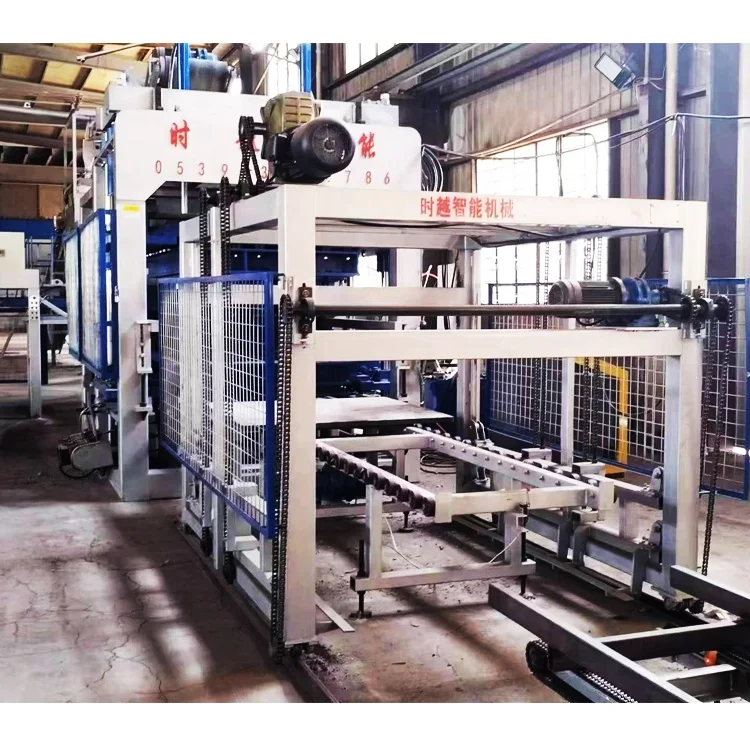
Matched Line Integration — every supporting station from the mixer to the stacker is timed against the QT15-15 press cycle, so the line runs as one coordinated system rather than a collection of isolated machines.
Technical Specifications
| Parameter | Value |
|---|---|
| Model | QT15-15 |
| Product Type | Stationary Concrete Block Making Machine |
| Overall Dimensions (L×W×H) | 9350×2520×2950 mm |
| Net Weight | 15 T |
| Rated Power | 45.7 kW |
| Voltage & Frequency | 380V or according to buyer needs (frequency to be confirmed) |
| Control System | PLC (brand/model to be confirmed) |
| Hydraulic Pressure | 21 MPa |
| Vibration System | Four external vibration motors |
| Pallet Size | 1350×850×40 mm |
| Upper Mould Synchronization | Dual-side synchronous gear, four-point stabilization |
| Material Feeder | European design with turning arm cylinder |
| Vibration Damping | Airbag system with adjustable air pressure |
| Output Capacity | 3600 pcs/h based on 400×200×200 mm hollow block, 15 pcs/mould |
| Daily Output | 28800 pcs/day based on 400×200×200 mm hollow block (shift hours basis not stated) |
| Mould Format | Hollow block, solid block, standard brick, interlocking paver (specific list to be confirmed) |
| Standards | ISO 9001:2008, CE |
| Warranty | 1 year |
Application Suitability
| Application | Material or Output |
|---|---|
| Hollow concrete block production | Crushed stone, sand, cement and fly ash mixes for building construction |
| Solid concrete block production | Dense aggregate blends for load-bearing walls and foundations |
| Standard clay-format brick production | Fine aggregate and cement mixes at 240×115×53 mm format |
| Interlocking paver production | High-strength concrete mixes for roads, walkways and landscaping |
| On-site construction block production | Locally sourced aggregates for project contractors producing at the build site |
What a "Stationary Block Making Machine Production Line" Really Means Beyond the Press
A press is only as productive as the slowest station feeding or clearing it.
Buyers often receive a quotation that highlights the QT15-15 cycle time and mould cavity count, then discover on the first production day that the mixer cannot deliver a fresh batch before the press finishes the previous one. The pallet feeder arrives a fraction of a second late, or the stacking station falls behind and forces the operator to pause the press manually. Over an eight-hour shift, these micro-interruptions compound into a daily output that sits well below the quoted figure. I have watched a high-capacity stationary block making machine production line lose nearly half its theoretical output because the raw material feed and the press were never timed against each other during the planning stage [NEED_CITE: common causes of output shortfall in block production lines]. The remedy is not a faster press — it is a line where every station’s cycle is calculated and confirmed before the first machine ships.
Synchronising the Upstream Feed to the Press Rhythm
The European-design material feeder on this line uses a turning-arm cylinder to spread concrete evenly across the mould box before the press closes. This matters because uneven fill forces the PLC to extend the feed stroke, adding seconds to every cycle. When the feeder is matched to the QT15-15 rhythm, the stationary block making machine production line recovers its full cycle rate without operator intervention.
Downstream Pallet Circulation and Stacking Alignment
Once the press releases a cured block on its pallet, that pallet must travel to the stacking station and return empty before the next cycle begins. If the conveyor speed or the stacker lift time drifts beyond the press cycle window, the press sits idle. On this line, the pallet return loop is sized so that an empty pallet reaches the press loading position within the same interval the QT15-15 needs to complete vibration and demoulding, keeping the stationary block making machine production line running without buffer gaps [NEED_CITE: pallet circulation design in high-output block plants].
Reading the Specifications Behind the Output Numbers
The QT15-15 is rated at 21 MPa hydraulic pressure combined with four external vibration motors, and that pairing directly determines block density. Higher vibration amplitude compacts the aggregate more tightly, but only if the hydraulic head holds the mould firmly against the pallet during the vibration window — otherwise the energy dissipates into the frame. The dual-side synchronous gear with four-point stabilization on the upper mould keeps the head parallel to the 1350×850 mm pallet surface, so pressure distributes evenly across all mould cavities. The airbag vibration damping system lets the operator adjust air pressure to change amplitude for different formats — a hollow block needs a different vibration profile than a dense interlocking paver — without swapping mechanical components. On the electrical side, the 45.7 kW rated power must be matched to the site supply; running a 380V machine on a 415V grid without transformer correction shortens motor winding life noticeably [NEED_CITE: voltage tolerance limits for industrial vibration motors].
The Hidden Cost of Skipping the Line-Level Calculation
When a buyer purchases the QT15-15 as a standalone press and sources the mixer, pallet conveyor and stacker separately, each supplier optimises for their own equipment. The mixer supplier quotes batch capacity without knowing the press cycle time. The conveyor builder assumes a pallet weight that does not account for wet concrete on the return trip. The result is a line that technically runs but never reaches its nameplate output, and the buyer spends weeks adjusting speeds and adding manual labour to compensate [NEED_CITE: integration risks when block line stations are sourced from multiple suppliers]. These costs never appear on the original quotation but show up in overtime wages and missed delivery deadlines.
Why Specifying the Full Line Here Changes the Outcome
Block machinery is the single focus at this facility, so the QT15-15 press, its moulds, pallets and every handling station are specified as one matched system rather than assembled from separate catalogues. The line layout is drawn against the buyer’s actual mix design and local aggregate, not a generic template. Mould design covers the formats the buyer’s market actually sells, with custom drawings available for non-standard shapes. Automation level is selectable, so a buyer can start with semi-automatic pallet handling and add automatic stacking later without replacing the press. Factory testing runs the complete line through a full production cycle before dismantling for shipment, so cycle-time alignment is verified before the machines leave the floor.
Documentation & Verification
- Line layout drawing with cycle time stated per station against the QT15-15 press cycle
- Capacity calculation naming block format, mould cavity count and shift hours for each output figure
- Pallet specification matched to buyer’s curing area dimensions and forklift capacity
- Voltage, frequency and PLC display language confirmed in writing before production
- Factory test record covering a full production run on buyer’s target block format
- Hydraulic and electrical schematic for on-site maintenance reference
Installation, Commissioning & Support
- Foundation plan sized to the 9350×2520 mm footprint and 15 T operating weight of the QT15-15
- Dedicated power circuit rated for 45.7 kW plus upstream mixer and conveyor loads
- Machine shipped in dismantled state with labelled assembly sequence for on-site reassembly
- First-run commissioning includes cycle time verification at every station in the line
- Operator training covers mould change procedure, PLC parameter adjustment and daily lubrication points
- Wear parts list with hydraulic seals and vibration motor brushes identified by part number
What to Share When Requesting a Line Quotation
Provide the target block format and daily output you need to hit, along with the raw materials you can source locally and their typical gradation. Share your site voltage, frequency and preferred PLC display language so the electrical package is locked before production starts. If you already have pallets, a forklift or a curing area in place, send the dimensions — the line can be configured around your existing equipment rather than forcing you to replace it.
Frequently Asked Questions
Q: How is the daily output figure calculated for this line?
A: The 28800 pcs/day figure is based on the 400×200×200 mm hollow block at 15 cavities per mould. The shift length behind this calculation is not stated in the source documentation, so we confirm shift hours and actual working minutes with each buyer before finalising the capacity sheet.
Q: Which supporting stations are included in the line quotation?
A: The quotation covers the QT15-15 press, material feeder, pallet feeder and the return conveyor. Mixer capacity, automatic stacker and curing rack handler are quoted as line items the buyer can include or defer. Each station’s cycle time is stated so the buyer sees exactly where the press could be left waiting.
Q: How do cycle times at each station stay aligned?
A: Every station from raw material feed to pallet return is timed against the QT15-15 press cycle during the layout phase. The PLC coordinates feed, vibration, demoulding and pallet travel so that no single station extends beyond the press interval. If a buyer changes block format, the cycle table is recalculated before the new mould ships.
Q: Can the line use my existing pallets and curing racks?
A: Yes. The 1350×850×40 mm pallet is the standard size for this press, but the conveyor width, stacker lift height and curing rack spacing can be configured around the pallets and forklift you already operate. This avoids the cost and delay of replacing downstream handling equipment.


