
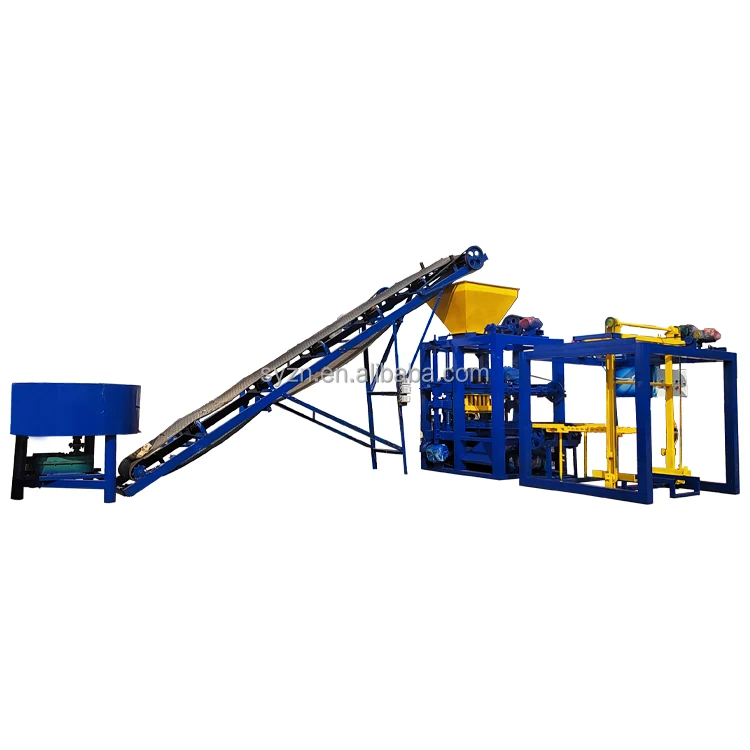
Single Focus Block Line Integration — every feeding, mixing and pallet station is timed against the QTJ4-24 press cycle so the machine never sits idle waiting for upstream or downstream equipment.
Technical Specifications
| Parameter | Value |
|---|---|
| Model | QTJ4-24 |
| Product Type | Stationary Block Making Machine |
| Overall Dimensions (L×W×H) | 3600 × 1700 × 2560 mm |
| Pallet Size | 850 × 450 mm |
| Molding Cycle | 24–26 s |
| Overall Power | 11.95 kW |
| Vibration Force | 45 kN |
| Vibration Configuration | 2 × 3 kW lower + 2 × 1.5 kW upper vibrators |
| Total Mass | 2 T |
| Molding Method | Mechanical |
| Reducer Type (Mold Lifting) | 350-type |
| Automation Level | Semi-automatic with full-automatic spiral material distribution |
| Raw Materials | Cement, sand, stone |
| Output Capacity | (basis to be confirmed by block format and mix design) |
| Voltage & Frequency | (to be confirmed before production) |
| Control System | (to be confirmed before production) |
| Warranty | 1 year for the whole machine, excluding spare parts |
Application Suitability
| Application | Material or Output |
|---|---|
| Hollow block production | Cement, sand, crushed stone aggregate |
| Solid brick forming | Cement, sand, fine stone blend |
| Paving block manufacturing | Cement, coarse sand, stone chips |
| Interlocking brick production | Cement, sand, graded stone |
| Small-scale block plant startup | Local aggregate with cement binder |
Why "Cycles per Hour" Means Nothing Without the Rest of the Line
A stationary block making machine production line only performs as well as its slowest upstream or downstream station. When the mixer cannot discharge fast enough, or pallets are not returned in time, a 24–26 second press cycle stretches into 40 seconds of dead air per mold, and the daily count falls far short of expectation.
I once spent two weeks on a site where the host press was rated for an impressive hourly cycle figure, yet the belt conveyor feeding the mixer was undersized for the batch weight. Every third cycle the hopper ran dry and the operator had to wait. That kind of mismatch is invisible on a spec sheet but obvious by the second day of production [NEED_CITE: common line bottleneck causes in small block plants]. The QTJ4-24 must therefore be quoted not as an isolated press but as the centerpiece of a synchronized stationary block making machine production line where every station from raw material infeed to wet block stacking is calculated against the same cycle clock.
Matching Every Station to the 24–26 Second Press Heartbeat
The QTJ4-24 completes a molding cycle every 24–26 seconds, which sets the rhythm for the entire stationary block making machine production line. The mixer must deliver a fresh batch within that window, the spiral material distributor must fill the mold box before vibration begins, and the pallet feeder must present a clean pallet the instant the press head lifts. If any one of these stations lags, the press sits idle and the shift output drops. Line layout documentation should therefore state the assumed block format so the buyer can verify the cycle against the exact product they intend to sell.
What Happens When Pallet Return Falls Behind
Wet blocks on 850 × 450 mm pallets must travel to the curing area and the empty pallets must return to the press before the next cycle. On a compact site the curing rack distance is short, yet the return conveyor still needs a drive rating and belt speed matched to the press tempo. When the return leg is specified as an afterthought, pallets pile up at the rack entrance and the press operator is forced to hand-carry empties back. Specifying the pallet circulation loop at quotation stage prevents this [NEED_CITE: pallet handling integration in semi-automatic block lines].
Reading the Specs That Actually Matter on Site
The 45 kN vibration force is generated by two 3 kW lower vibrators and two 1.5 kW upper vibrators. This dual-level arrangement compacts the mix from both directions, which is essential when the local aggregate contains a high percentage of fine sand that tends to segregate under single-direction vibration. The 350-type reducer on the mold lifting mechanism is sized to handle repeated vertical travel across thousands of cycles per shift, reducing the frequency of gear-related stoppages during format changeovers. Total connected power of 11.95 kW covers the press itself; the mixer, conveyor motors and stacking station will add to the overall electrical load, so the site transformer and cable sizing must account for the complete stationary block making machine production line, not just the press plate.
The Hidden Cost of Quoting the Press Alone
Leaving pallet handling, stacking and curing rack design out of the quotation forces the buyer to source these items locally, often in mismatched sizes. A pallet dimension that does not fit the curing racks already on site means new racks or new pallets, either of which erases the price advantage of buying the press directly. Voltage and control language left unconfirmed until the machine arrives can delay commissioning by weeks while replacement contactors and translated PLC screens are shipped overseas [NEED_CITE: typical commissioning delays from unconfirmed electrical specs]. These are not theoretical risks; they appear on nearly every site visit where the line was assembled from separate quotations.
Why the Line Is Specified as One Package Here
Shiyue Intelligent Machinery keeps block machinery as a single focus, so the QTJ4-24 press, its molds, pallets and handling equipment are specified as one matched system rather than assembled from separate suppliers. Configuration is set against the buyer’s actual mix design and local aggregate, not a catalogue default. Molds are designed for the formats the buyer’s market actually sells, and the automation level is selectable so a plant can start semi-automatic and add stacking or cubing later. Installation support includes operator training so the crew understands why each station’s timing matters, not just how to press start.
Documentation & Verification
- Line layout drawing with capacity calculated per the specific block format you intend to produce.
- Machine specification sheet listing vibration force, cycle time and overall power for the QTJ4-24.
- Pallet specification matched to your curing rack dimensions and forklift tine spacing.
- Hydraulic and electrical schematic showing station-to-station timing for the full line.
- Voltage, frequency and control language confirmation locked before production starts.
- Factory test record on your target block format before dispatch.
Installation, Commissioning & Support
- Foundation plan sized to the 3600 × 1700 mm press envelope plus conveyor runs.
- Dedicated electrical circuit sized for 11.95 kW press load plus mixer and handling motors.
- Press arrives dismantled for container loading; reassembly supervised on site.
- First-run parameter setting for vibration duration and mold lift speed against your mix.
- Operator training covering mold change procedure and daily grease points on the 350-type reducer.
- Wear parts list with part numbers for vibrators, mold liners and conveyor belt clips.
What to Include in Your Inquiry
To size the line correctly around the QTJ4-24, share your target block format and daily output goal, the local aggregate type you plan to use, and the dimensions of your available production floor. Confirm the site voltage and frequency along with the preferred PLC display language. If you already own pallets, forklifts or curing racks, send their dimensions so the stationary block making machine production line can be designed around what you have rather than forcing new purchases.
Frequently Asked Questions
Q: How is the daily output of this line calculated, and which block format is assumed?
A: Output is calculated per block format, not as a single cycles-per-hour figure. The molding cycle of 24–26 seconds is the base pace, but daily count depends on the number of cavities per mold and the format being run. We state capacity for each format you plan to produce so the projection matches your actual product mix, not a catalogue default.
Q: What supporting equipment is included in the quotation versus what I source myself?
A: The quotation covers the QTJ4-24 press, spiral material distributor, pallet feeder and the mold set. Raw material mixing, belt conveyors, stacking and curing rack handling can be added as matched stations or omitted if you already have compatible equipment. We specify each item clearly so nothing is left ambiguous.
Q: How do I confirm my existing pallets work with the 850 × 450 mm pallet size?
A: Send the dimensions of your curing racks and the tine spacing of your forklift. The 850 × 450 mm pallet must seat properly in the rack slots and be liftable by your existing forks. If there is a mismatch, we adjust the pallet spec before production rather than discovering the problem on arrival.
Q: What voltage, frequency and control language will the line be configured for?
A: These are confirmed and locked before production begins. Provide your site voltage, frequency and the language your operators read, and the control panel, motor ratings and PLC display will match. This prevents the commissioning delays that occur when electrical details are left to default settings.
Q: How long does a mold change take, and how does that affect daily scheduling?
A: The 350-type reducer is designed for repeated lifting during mold swaps. Realistic changeover time depends on crew familiarity; trained operators complete a swap in a window short enough to allow multiple format runs within a single shift. We include a documented procedure and train your team during commissioning.


