
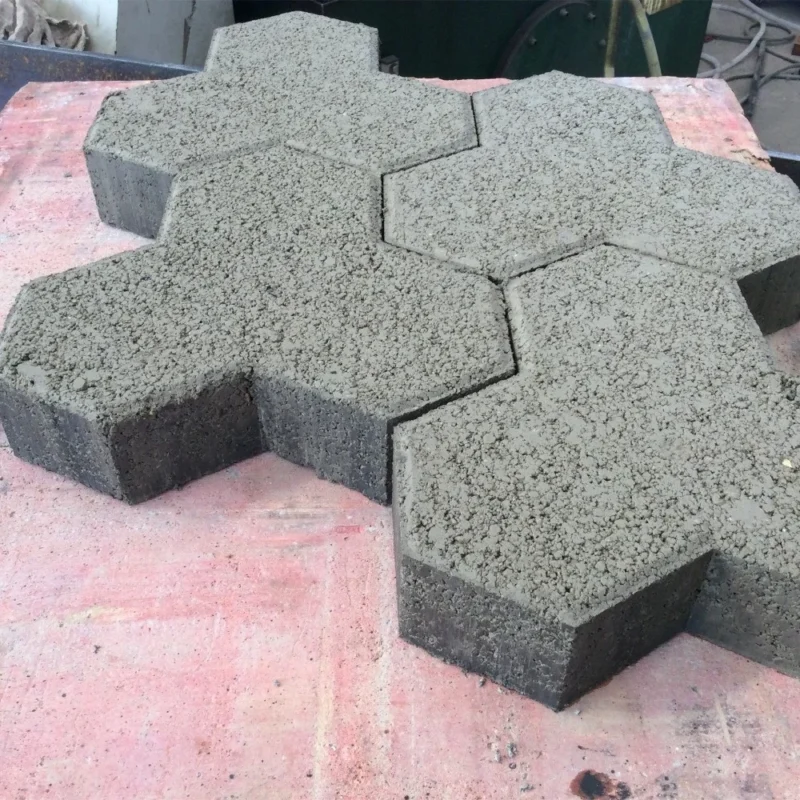
Integrated line configuration — The QTF3-20 stationary block machine production line is engineered as a single matched system where the hydraulic press, mixer discharge, pallet feeder, and stacking stations share a coordinated cycle rhythm.
Technical Specifications
| Parameter | Value |
|---|---|
| Model | QTF3-20 |
| Product Type | Stationary Hydraulic Block Making Machine |
| Main Vibration Form | Platform vibration combined with hydraulic pressure |
| Cycle Time | 20 seconds (basis not stated in source — confirm block format and material) |
| Vibrating Frequency | 4600 rolls/minute |
| Motors Power | 14.25 kW (rated or peak not specified) |
| Pallet Size | 680 × 530 mm |
| Drive System | Hydraulic drive compression molding |
| Raw Materials | Crushed stone, sand, cement, fly ash, cinder, slag, gangue, gravel, perlite, industrial wastes |
| Standards | CE, ISO 9001 |
Application Suitability
| Application | Material or Output |
|---|---|
| Hollow and solid wall block production | Crushed stone, sand, cement, fly ash blends |
| Paving stone manufacturing with face mix | Fine aggregates with colored surface layer |
| Kerbstone and edger production | Coarse aggregate and cement mixes |
| Interlocking and grass block formatting | Varied aggregate sizes with hydraulic compression |
| Landscaping and slope block fabrication | Lightweight aggregates including perlite and cinder |
Why "20 Seconds per Cycle" Can Mislead a Plant Planner
The cycle time only matters when every upstream and downstream station keeps pace.
When I first commissioned block lines in East Africa, I watched a press sit idle for six seconds every cycle because the pallet feeder could not return fast enough. The quoted cycle became irrelevant the moment the line was running. On a stationary block machine production line, the 20-second figure must be read against mixer discharge intervals, pallet travel distance, and stacking speed — not treated as a standalone output claim. [NEED_CITE: line synchronization requirements in concrete block manufacturing]
Matching the Press Rhythm to the Mixing Station
The QTF3-20 completes a pressing cycle at 4600 rolls/minute vibration frequency, meaning the mixer must deliver a consistent batch within that same window. If the mixer discharges too slowly, the press waits and the quoted cycle time stretches. If it discharges too quickly, material sits in the hopper losing workability. This is why the stationary block machine production line must be planned as connected stations rather than isolated machines.
Pallet Return Speed and Curing Area Layout
The 680 × 530 mm pallet must travel from the press to the curing rack and back within the production rhythm. When the curing area is undersized or the forklift cannot turn in the available aisle width, pallets pile up at the stacking station and the entire line slows. Every stationary block machine production line we configure accounts for the buyer’s actual floor plan and existing handling equipment. [NEED_CITE: pallet circulation and curing rack planning in block plants]
Reading the Hydraulic and Vibration Specifications Together
The hydraulic drive compression molding system works in tandem with platform vibration at 4600 rolls/minute. Hydraulic pressure compacts the mix from above while vibration rearranges particles from below — both forces must match the buyer’s aggregate gradation and cement ratio. A mix with high fly ash content behaves differently under vibration than one using clean crushed stone, so the pressure and frequency settings need adjustment per material. The 14.25 kW motor package must sustain both systems simultaneously without voltage drop during peak draw.
The Cost of Ignoring Line Integration
Buyers who select a press based solely on its cycle time often discover that pallet handling, stacking, and curing were never part of the quotation. Output ends up stacked by hand beside the machine, and the labor cost erases the automation advantage they thought they were buying. On other projects, pallets sized without checking the curing rack dimensions force the buyer to rebuild the entire curing area after installation. [NEED_CITE: hidden costs of unmatched block line components]
Why Source the Full Line from One Configuration Point
Block machinery is our single focus, which means the QTF3-20 press, its moulds, pallets, and all handling equipment are specified together rather than assembled from separate suppliers. We set the configuration against your actual mix design and local aggregate, not a catalogue default. Mould design covers the formats your market actually sells, including custom drawings when standard options do not fit. Automation level is selectable so you can begin with semi-automatic pallet handling and add automatic stacking later. Every line leaves our facility only after a full test run with material matching the buyer’s specification.
Documentation & Verification
- Line layout drawing with capacity calculation stating the block format assumed
- Machine specification sheet with hydraulic and electrical schematics
- Pallet specification matched to your curing area and forklift capacity
- Factory test record using your target mix design before dispatch
- Mould drawing and format list covering all planned block types
- Voltage, frequency, and PLC display language confirmation document
Installation, Commissioning & Support
- Foundation plan sized for the 14.25 kW motor package and hydraulic station footprint
- Dedicated power circuit verified against local voltage and frequency before connection
- Press and pallet system assembled on-site with alignment checked against curing rack positions
- First production run supervised with pressure and vibration tuned to your aggregate blend
- Operator training covering mould change procedure and daily maintenance checkpoints
- Wear parts list with reorder intervals for hydraulic seals and vibration platform components
Before You Send an Inquiry
Tell us the block formats your market sells and the daily volume you need per format. Share your local aggregate type and any industrial waste materials you plan to incorporate. Let us know your workshop dimensions, existing forklift capacity, and the voltage and frequency at your site so the stationary block machine production line arrives ready to commission.
Frequently Asked Questions
Q: How do you ensure each station on the line keeps pace with the QTF3-20 press?
A: We calculate the cycle rhythm across every station — mixer discharge, pallet feed, press cycle, stacking, and return — and specify each component so no single point creates a bottleneck. The 20-second press cycle only becomes real output when upstream and downstream equipment match it.
Q: What block format is the 20-second cycle time based on?
A: The source does not state the block format or material basis for that figure. We provide a capacity calculation that names the exact format, mix, and thickness assumed so you can evaluate real daily output against your production target.
Q: How does the 680 × 530 mm pallet size affect my curing area layout?
A: Pallet dimensions determine rack spacing, forklift aisle width, and total curing area needed. We confirm your existing rack and forklift specifications before finalizing pallet size so the curing area handles the volume the line produces.
Q: Which stations on the line can run semi-automatic versus fully automatic?
A: Pallet feeding, stacking, and curing rack handling each have selectable automation levels. A buyer can start with manual pallet return and upgrade to automatic stacking and cubing later without replacing the press or mixer.


