
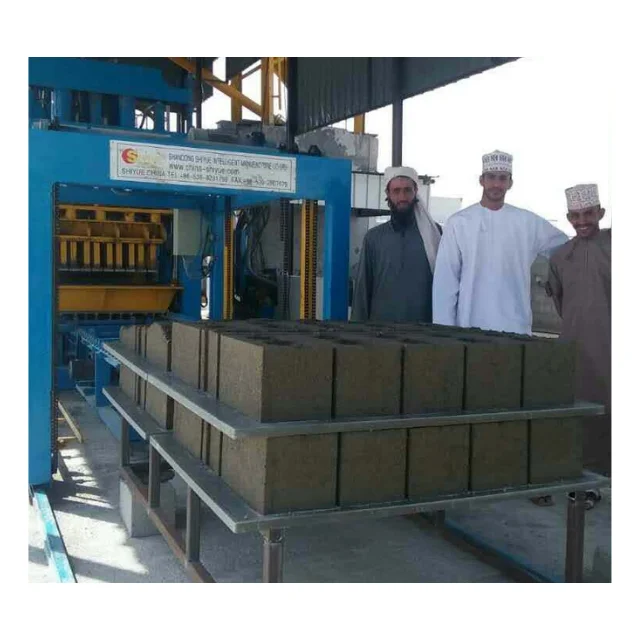
Integrated Cycle Matching — Every station from the PL1200 batching unit to the block conveyor is timed against the QT12-15 press cycle so the molding station never idles waiting for upstream feed or downstream clearance.
Technical Specifications
| Parameter | Value |
|---|---|
| Model | QT12-15 |
| Product Type | Stationary Automatic Concrete Block Making Machine |
| Overall Dimensions (L×W×H) | 9350 × 2520 × 2950 mm |
| Total Mass | 12,000 kg |
| Overall Power | 52 kW |
| Pallet Size | 1300 × 900 mm |
| Molding Cycle | 15–25 s (basis to be confirmed by block format and material) |
| Vibration Form | Platform Vibration |
| Control System | Electrical PLC Cabinet |
| Major Line Components | Pallet feeder, molding machine, storage hopper, block conveyor, hydraulic station, electrical PLC cabinet |
| Simple Line Configuration | PL1200 batching machine, JS500 or JS750 mixer, 8 m conveyor belt, stacker |
| Compatible Raw Materials | Fly ash, slag, gangue, industrial wastes, river sand, gravel, cement |
| Block Formats Supported | Hollow blocks, porous blocks, curbstone, pavement blocks, grass blocks, slope-protecting blocks, ring-tree blocks |
| Color Machine Add-on | Supported for paving block color layer |
| Automation Level | Automatic with PLC, pallet feeder, and block conveyor |
| Assembly State | Multi-component line requiring on-site assembly |
Application Suitability
| Application | Material or Output |
|---|---|
| Hollow block production for residential and commercial walls | Cement, fly ash, river sand, gravel |
| Pavement block and curbstone manufacturing for municipal projects | Crushed stone, slag, cement with color layer option |
| Porous and grass block production for permeable landscaping | Gangue, industrial waste aggregates, cement |
| Slope-protecting and ring-tree block molding for civil engineering | Heavy aggregate mixes with high cement content |
| On-site block production for housing development contractors | Locally sourced sand, gravel, and cement |
Why "Cycles per Hour" Means Nothing Without the Rest of the Line
A QT12-15 block making machine production line only delivers its rated cycle time when every upstream and downstream station is matched to the same beat.
I have spent years watching plant owners invest in a high-capacity press and then wonder why their daily pallet count falls short. The problem is rarely the press itself. The mixer discharges too slowly, the batching station cannot keep up with the aggregate demand, or the block conveyor jams because the stacker downstream has not cleared the previous batch. When you spec the QT12-15 block making machine production line, the conversation must start with what happens before and after the molding station — not just what happens inside it [NEED_CITE: common causes of idle time in concrete block plants].
How the Six Stations Connect and Where They Must Agree
The QT12-15 block making machine production line integrates six major components — pallet feeder, molding machine, storage hopper, block conveyor, hydraulic station, and PLC cabinet — into a single coordinated sequence. The PLC cabinet does not merely switch the press on and off; it times the pallet advance, triggers the vibration cycle, and signals the block conveyor to receive the finished pallet in one continuous loop. If any station falls out of sync, the press waits, and the quoted cycle time becomes theoretical.
Where the Batching and Mixing Stage Sets the Ceiling
The simple line configuration pairs the PL1200 batching machine with a JS500 or JS750 mixer feeding through an 8 m conveyor belt. The mixer must discharge a full batch into the storage hopper before the press completes its current cycle; otherwise the hopper runs dry and the press sits idle. During line planning I calculate the mixer discharge time against the press molding cycle for the specific block format the buyer intends to run, because a 15-second cycle on a small paver demands a very different feed rate than a 25-second cycle on a large hollow block [NEED_CITE: mixer sizing relative to block press throughput].
Reading the Specs That Actually Shape Your Output
The 1300 × 900 mm pallet size determines how many blocks you mold per cycle and what curing rack layout you need. A pallet this size typically holds a standard arrangement of hollow blocks or a denser grid of pavers, and the curing area must accommodate that footprint multiplied by your daily output. The platform vibration system delivers force across the full pallet surface rather than concentrating it at the mold edges, which matters when you switch between a lightweight porous block mix and a dense curbstone mix. The 52 kW overall power rating covers the hydraulic station, vibration motors, and conveyor drives together, so your electrical supply must be sized for that combined draw plus a safety margin for startup surge. The 9350 mm line length means you need a clear floor span of at least 12 meters once you allow space for the batching station and raw material stockpile on the upstream side.
The Cost of Specifying the Press Without the Periphery
Buyers who focus only on the press price often discover that pallet handling, stacking, and curing equipment were never part of the quotation. Pallets pile up at the end of the conveyor, operators stack blocks by hand, and the press has to slow down because nobody is clearing the output fast enough. I have seen lines where the pallet feeder was sized for a smaller machine, causing a pallet shortage every third cycle and forcing the PLC to pause the press repeatedly. These are not machine defects — they are planning gaps that surface only after commissioning [NEED_CITE: hidden costs of unmatched block line components].
What Goes Into a Complete Line Proposal
Block machinery is our single focus, so the QT12-15 block making machine production line is specified as one matched system rather than assembled from separate suppliers. The configuration is set against your actual mix design and local aggregate, not pulled from a catalogue default. Mould design covers the formats your market actually sells, with custom drawings available when standard molds do not fit your product range. Automation level is selectable, meaning you can start with the semi-automatic stacker arrangement and add automatic cubing later as your output grows. Installation support includes operator training so your crew understands the PLC sequence and can diagnose pallet feed or conveyor timing issues without waiting for a service call.
Documentation & Verification
- Line layout drawing showing station spacing and total floor requirement for the QT12-15 configuration
- Capacity calculation sheet stating which block format and mix design the quoted output assumes
- Hydraulic and electrical schematics matching your confirmed voltage, frequency, and PLC display language
- Factory test record documenting molding cycle and pallet feed timing before dispatch
- Pallet specification sheet covering size, material, and compatibility with your curing rack system
- Wear parts and mould list with part numbers for first replacement ordering
Installation, Commissioning & Support
- Foundation plan sized for the 12,000 kg total mass and dynamic vibration loads of the QT12-15
- Dedicated power circuit rated for the 52 kW overall draw with voltage and frequency confirmed pre-production
- On-site assembly of the six-component line including pallet feeder alignment and conveyor tensioning
- PLC language and display configuration verified during commissioning to match your operator team
- Spare pallets and hydraulic wear parts shipped with the line to cover the first replacement cycle
- Preventive maintenance schedule tied to vibration motor bearings and hydraulic valve service intervals
What We Need to Size Your Line Correctly
Before we can build a credible proposal for the QT12-15 block making machine production line, we need to understand your target block format, your daily output requirement, and the raw materials available at your site. Tell us your local voltage and frequency, the PLC display language your operators prefer, and the dimensions of your existing curing area so we can match the pallet specification accordingly. If you already have batching or mixing equipment in place, share the model and capacity so we can confirm whether it keeps pace with the press.
Frequently Asked Questions
Q: How is the daily output of the QT12-15 line calculated, and which block format is that figure based on?
A: Daily output is calculated by multiplying the molding cycle count per hour by the number of blocks per pallet for a specific block format. A 15-second cycle on a small paver yields a very different daily total than a 25-second cycle on a large hollow block. We state the assumed format and mix design on every capacity sheet so you know exactly what the number represents.
Q: How do you ensure the mixer and batching station can feed the press without causing cycle gaps?
A: We calculate the JS500 or JS750 mixer discharge time and the PL1200 batching cycle against the press molding interval for your chosen block format. If the mixer cannot replenish the storage hopper before the next cycle begins, we adjust the mixer size or add a buffer hopper so the press never runs dry mid-cycle.
Q: What pallet size and material does the line require, and is it compatible with my existing curing area?
A: The line uses 1300 × 900 mm pallets. We confirm pallet material — typically bamboo, PVC, or steel — based on your block weight and curing method. Before finalizing the quotation we check your curing rack spacing and forklift fork width to ensure the pallets integrate with your existing handling equipment.
Q: Is pallet handling, stacking, and curing equipment included in the line quotation or quoted separately?
A: The standard quotation covers the pallet feeder, block conveyor, and stacker. Curing racks, cubing systems, and additional pallet inventory are listed as separate line items so you can see exactly what is included. Nothing is left to arrive as a surprise after shipment.
Q: What voltage, frequency, and PLC language will the control cabinet be configured for before shipment?
A: We confirm your site voltage, frequency, and preferred PLC display language during the proposal stage and lock those values before production begins. The factory test is run on the confirmed electrical specification so the cabinet arrives ready to connect without rewiring or reprogramming.


