
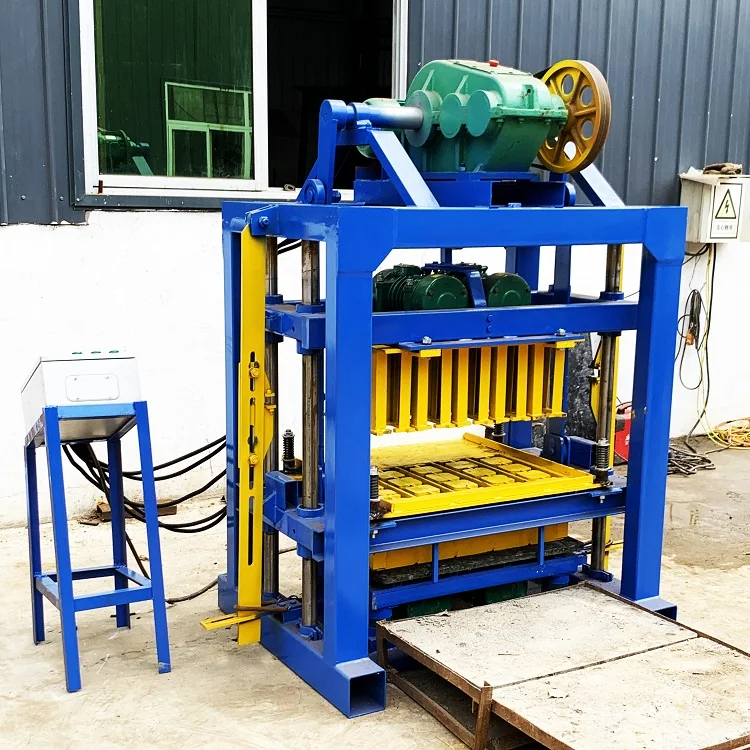
Line Integration — The QTJ4-40 stationary block machine is specified not as an isolated press but as the cycle-time anchor around which raw material feeding, mixing, pallet circulation and stacking are balanced so no station waits on another.
Technical Specifications
| Parameter | Value |
|---|---|
| Model | QTJ4-40 |
| Product Type | Stationary Concrete Block Making Machine |
| Vibration Form | Platform Vibration |
| Vibration Frequency | 2800 r/min |
| Pallet Size | 850×450 mm |
| Overall Dimensions (L×W×H) | 1350×1460×1800 mm |
| Machine Weight | 1 T (basis to be confirmed) |
| Workers Required | 1–3 people |
| Mould Change System | Top die push and pull with automatic scraper |
| Capacity (400×200×200 mm hollow block) | 360 pcs/h, 2880 pcs/day (4 pcs per mould) |
| Capacity (400×150×200 mm hollow block) | 500 pcs/h, 4000 pcs/day (5 pcs per mould) |
| Capacity (225×112.5×60 mm interlocking paver) | 900 pcs/h, 7200 pcs/day (9 pcs per mould) |
| Raw Materials | Concrete, cement, fly ash, crushed stone, sand, gravel, slag |
| Recommended Mix Ratio | Cement 8–10%, sand 30–40%, stone 50–60% (approx. 1:4:5) |
| Factory Area Required | 200 m² |
| Voltage & Frequency | To be confirmed before production |
| Automation Level | Semi-automatic (manual pallet handling implied) |
Application Suitability
| Application | Material or Output |
|---|---|
| Hollow block production for wall construction | Cement, crushed stone, sand and fly ash blends |
| Solid block manufacturing for load-bearing structures | Concrete with graded aggregate up to 10 mm |
| Interlocking paver production for walkways and yards | Colored concrete mixes with fine sand |
| Kerbstone and curb unit forming | High-cement-ratio concrete with coarse gravel |
| Small to medium block plant start-up | Locally sourced aggregate including slag and stone dust |
Why the Line Layout Matters More Than the Press Alone
A stationary block machine production line only produces as fast as its slowest supporting station.
When quotations list only the press cycle rate, buyers frequently discover that manual pallet handling, unmatched mixer output or a curing rack bottleneck cut real daily output well below the headline figure. I once configured a line where the mixer fed material faster than the press could accept it, and the overflow forced the operator to stop the upstream belt every third cycle — a rhythm that wasted more time than a slower, matched setup would have [NEED_CITE:line throughput matching principles for block plants]. The lesson is simple: every station in the stationary block machine production line must be capacity-balanced against the press format you actually run most often.
Upstream Matching: Mixer Output and Feed Timing
The QTJ4-40 completes a mould cycle that requires a consistent volume of mixed material delivered on schedule. If the mixer batch size does not align with the hopper capacity, the press either starves or overflows. For a stationary block machine production line running hollow blocks, the mixer must discharge a full batch within the press cycle window so the feed belt never runs empty mid-cycle.
Downstream Flow: Pallet Return and Curing Rack Capacity
After pressing, each pallet carrying fresh blocks must travel to the curing area and return before the next cycle begins. With an 850×450 mm pallet, the curing rack spacing, forklift turning radius and return conveyor speed must all accommodate that exact dimension. If the rack bays are sized for a different pallet, operators end up restacking by hand — a hidden cost that appears only after the first production week [NEED_CITE:pallet circulation and curing layout requirements].
Specifying What the Numbers Mean for Your Mix
Platform vibration at 2800 r/min compacts the concrete inside the mould, but the effective densification depends on the mix moisture and aggregate grading available locally. A fly-ash-heavy blend flows differently from a crushed-stone mix, so the vibration force must be evaluated against your actual raw material ratio — roughly one part cement, four parts sand, five parts stone — rather than a laboratory reference mix. The 200 m² factory area footprint includes space for the press, mixer, pallet circulation and a basic curing zone, which must be confirmed against your site dimensions before the line layout is finalised.
The Hidden Cost of Skipping the Line Audit
Buyers who approve a press quotation without reviewing the full station list often face pallet shortages in week two, because the curing racks hold fewer pallets than the daily output requires. Others discover that the voltage at the site differs from the motor nameplate, delaying commissioning while a transformer is sourced locally [NEED_CITE:industrial voltage mismatch delays in block plant commissioning]. These are not machine defects; they are gaps in line specification that turn a stationary block machine production line into a collection of mismatched stations.
Why Sourcing the Full Line from One Supplier Changes the Outcome
Block machinery is our single focus, so the QTJ4-40 press, moulds, pallets and handling equipment are specified as one matched system. We configure the line against your actual mix design and local aggregate, not a catalogue default. Mould formats are selected for the products your market sells, and the automation level can start semi-automatic with a clear upgrade path. Installation support includes operator training so your crew understands not just the press but every station around it.
Documentation & Verification
- Line layout drawing with capacity stated per block format at each station
- Pallet specification sheet confirming 850×450 mm size and load rating
- Voltage and control language confirmation form signed before production
- Factory test record on your chosen block format before dispatch
- Hydraulic and electrical schematic for on-site maintenance reference
- Wear parts and mould list with first-replacement intervals
Installation, Commissioning & Support
- Foundation plan for 1350×1460 mm press footprint with vibration isolation pads
- Dedicated power circuit matching confirmed voltage and frequency before arrival
- Press shipped partially assembled to fit standard container loading
- On-site alignment of pallet feed conveyor with curing rack entry height
- Operator training covering mould change, scraper adjustment and daily greasing
- Wear parts kit covering first mould liner and scraper blade replacement cycle
Before You Request a Quotation
Share the block formats your market demands, your local aggregate type and the daily output you need per format so we can size every station around the press. Confirm the voltage and frequency at your site, along with the PLC display language your operators require. If you already have a mixer or curing racks in place, provide their specifications so the stationary block machine production line is designed to connect rather than duplicate.
Frequently Asked Questions
Q: How do I verify that the mixer output matches the QTJ4-40 cycle time?
A: Request a line capacity sheet that states mixer batch volume and discharge time against the press cycle for your specific block format. The mixer must deliver a full batch within one press cycle window so the feed belt never idles. If your existing mixer is undersized, the line quotation should include a matched replacement rather than leaving the gap to be discovered on site.
Q: What pallet size and material should I choose for my curing area?
A: The QTJ4-40 uses an 850×450 mm pallet, so your curing rack bays and forklift fork spacing must accept that dimension. Bamboo, PVC and steel pallets each carry different load ratings and lifespans; the choice depends on your block weight and curing humidity. Confirm pallet material and thickness in the line specification before production begins.
Q: Which voltage and control language must be confirmed before shipment?
A: Provide your site voltage, phase and frequency so the motors and control panel are built to match. At the same time, specify the PLC display language your operators read. Both items are confirmed in writing before production starts, preventing delays that otherwise surface only when the container arrives [NEED_CITE:voltage and frequency standards by export market].
Q: How is daily capacity calculated per block format?
A: Each mould produces a fixed number of pieces per cycle — four for a 400×200×200 mm hollow block, five for a 400×150×200 mm hollow block, nine for a 225×112.5×60 mm paver. Daily capacity is that number multiplied by achievable cycles in an eight-hour shift, which depends on pallet return speed and mixer feed rate matching the press, not on the press alone.
Q: What supporting equipment is included versus left to manual operation?
A: The base quotation covers the press and mould. Feeding conveyors, mixer, pallet return system, stacking and curing rack handling are line items that must be explicitly included or excluded. Ask for a station-by-station list in the quotation so no manual handling step appears unexpectedly after installation.


