
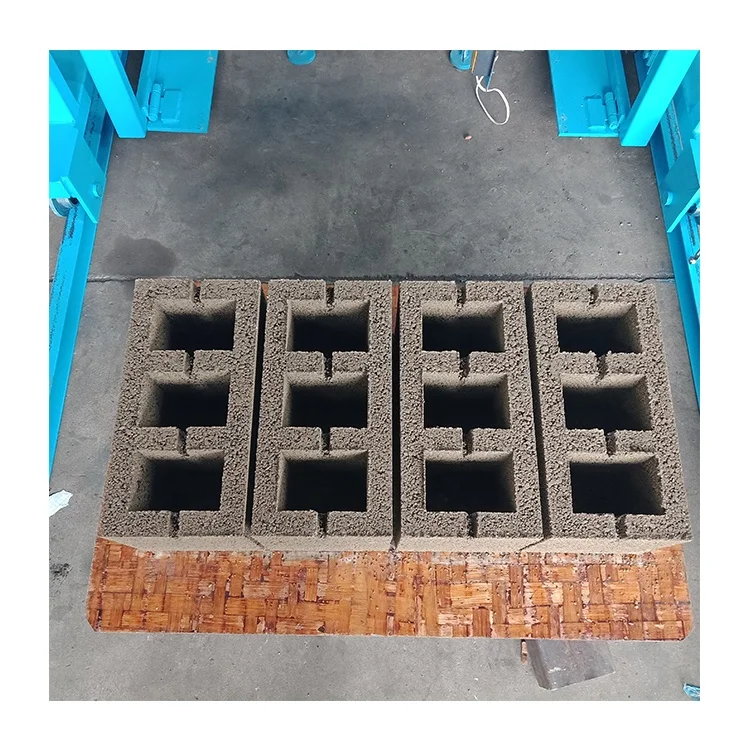
Matched System Configuration — The QTJ4-25 press, JQ350 mixer, conveyor, and pallet loop are specified together so the 25-second cycle is never starved by an upstream bottleneck.
Technical Specifications
| Parameter | Value |
|---|---|
| Model | QTJ4-25 |
| Product Type | Concrete Block Making Machine |
| Rated Power | 17.9 kW |
| Overall Dimensions | 6400×1500×2700 mm |
| Net Weight | 2500 kg |
| Cycle Time | 25 s |
| Output Capacity | 960 pcs/h or 7680 pcs/day (based on 400×200×200 mm hollow block, 4 pcs/mould) |
| Pallet Size | 850×550×20 mm |
| Vibration Force | 60 kN |
| Vibration Frequency | 2800 r/min |
| Configuration | Host machine 1 set, block mould 1 set, JQ350 mixer |
| Automation Level | Semi-automatic |
| Hydraulic Station | Equipped |
| Mould Compatibility | Hollow, solid, paver, curbstone (mould change required) |
| Voltage & Frequency | (source value — verify against manufacturer catalog) |
| Control System | (source value — verify against manufacturer catalog) |
Application Suitability
| Application | Material or Output |
|---|---|
| Hollow block production for small to medium plants | Crushed stone, sand, cement, fly ash blends |
| Solid block manufacturing for masonry walls | Aggregate-cement mixes with local sand |
| Paving block runs for walkways and yards | Fine aggregate with pigment additives |
| Curbstone forming for road and kerb projects | Coarse aggregate with higher cement content |
| On-site block production for housing contractors | Site-sourced aggregate after sieve testing |
What a "7680 Blocks Per Day" Quotation Leaves Out of the Line Layout
The cycle time is only as honest as the slowest station around the press.
I spent years on the workshop floor in Shandong, and the most frustrating calls come from buyers who received a press that hits every spec on paper yet produces half the quoted daily volume. The reason is rarely the press itself. Pallet return takes longer than the forming cycle, the mixer batch size does not match the mould volume, or the curing yard cannot accept pallets fast enough. [NEED_CITE: typical bottlenecks in semi-automatic block production lines] When these stations are sourced separately, the concrete block making machine production line runs at the speed of its weakest link.
Matching Every Station to the 25-Second Press Cycle
A 25-second cycle sets the ceiling for the entire concrete block making machine production line. The JQ350 mixer included in this configuration is sized to deliver a fresh batch before the press completes its current mould, preventing idle time between cycles. The belt conveyor between mixer and hopper is selected so material transit does not extend the interval beyond the press rhythm.
Pallet Handling Determines the Real Daily Output
The 850×550×20 mm pallet governs how many blocks leave the line per hour, but it also dictates curing rack spacing, forklift tine width, and drying yard layout. A buyer who confirms pallet dimensions against existing racking before ordering avoids a situation where freshly pressed blocks sit on the pallet return conveyor because there is nowhere to rack them. [NEED_CITE: pallet size and curing rack compatibility in block plants] This upstream-downstream alignment is where most semi-automatic lines lose their quoted capacity.
What the Vibration and Hydraulic Numbers Mean on the Floor
The 60 kN vibration force combined with the hydraulic station compresses the mix from both directions, producing consistent block density across every pallet. For a plant running hollow blocks from locally sourced crushed stone, this means the wall thickness holds tolerance and breakage during pallet transfer stays low. The 2800 r/min vibration frequency is suited to standard aggregate gradations; if your sand is finer or your stone dust carries more clay, the mix design must be tested before locking the cycle time, because a denser mix may need longer vibration to fill the mould corners.
The Cost of Sourcing the Line in Pieces
Buyers who purchase the press from one supplier and the mixer, conveyor, and pallets from three others often discover that station-to-station distances were never calculated. The mixer sits too far from the hopper, pallets pile up at the press exit, and operators manually carry wet blocks to the curing yard. [NEED_CITE: hidden costs of unmatched block line stations] The result is a semi-automatic line that requires manual intervention at every transfer point, erasing the labour advantage the buyer paid for.
Why a Matched Line Specification Matters Here
Every station around the QTJ4-25 is specified as part of one system, so mixer output, conveyor length, pallet loop speed, and press cycle are calculated against the same block format. The line layout drawing shows station-to-station distances and the 25-second beat that each must satisfy. Mould design covers the formats your market actually sells, and pallet material is confirmed against your curing racks before production starts. Automation level is selectable, so you can begin with semi-automatic pallet handling and add automatic stacking later without replacing the press. [NEED_CITE: block line upgrade paths from semi-automatic to automatic]
Documentation & Verification
- Line layout drawing with every station distance and cycle time noted for your block format
- Capacity calculation sheet stating the exact hollow or solid block dimensions assumed
- Pallet specification including material grade and thickness matched to your curing rack spacing
- Electrical schematic with voltage, frequency, and control language confirmed before build
- Factory test record using your mix design on your target block format before dispatch
Installation, Commissioning & Support
- Foundation plan sized to the 6400×1500 mm footprint and 2500 kg static load
- Dedicated circuit for the 17.9 kW total draw, with breaker rating confirmed to your local voltage
- Press and mixer arrive partially assembled; on-site bolting and conveyor alignment included
- First-run parameter setting for vibration frequency and hydraulic pressure on your aggregate
- Operator training covering mould change sequence for hollow, solid, paver, and curbstone formats
- Wear parts list with hydraulic seal and vibration motor brush replacement intervals
Planning Your Line Before the Quotation
To size this concrete block making machine production line correctly, share your target block format with dimensions, the daily volume you need per format, and the local aggregate sieve analysis and clay content. Confirm your existing pallet inventory dimensions and curing yard layout, along with the site voltage and frequency. If you are integrating into an existing plant, note the upstream and downstream equipment already in place so the station layout can be drawn around it.
Frequently Asked Questions
Q: How is daily output calculated, and which block format is the capacity figure based on?
A: The quoted 7680 pieces per day is based on a 400×200×200 mm hollow block at 4 pieces per mould with a 25-second cycle. If your target format is smaller, such as a paver, the pieces per mould and cycle time change, so daily output must be recalculated for that specific format before ordering.
Q: What upstream and downstream stations are included in the line?
A: The configuration includes the JQ350 mixer, belt conveyor, host press, one mould set, and the pallet loop. Each station is timed to the 25-second press cycle. Stacking and curing rack handling are manual at this automation level and can be upgraded later.
Q: How do I confirm pallet size against my curing area and forklift?
A: The standard pallet is 850×550×20 mm. Before production, share your curing rack shelf width and forklift tine spacing so the pallet material and thickness are verified against your existing handling equipment, avoiding mismatches after the line arrives.
Q: Can I start semi-automatic and upgrade individual stations later?
A: Yes. The press and mould interface remain the same whether pallet feeding and stacking are manual or automatic. You can add an automatic stacker or pallet return system in a later phase without replacing the host machine or changing the mould mounting.


