
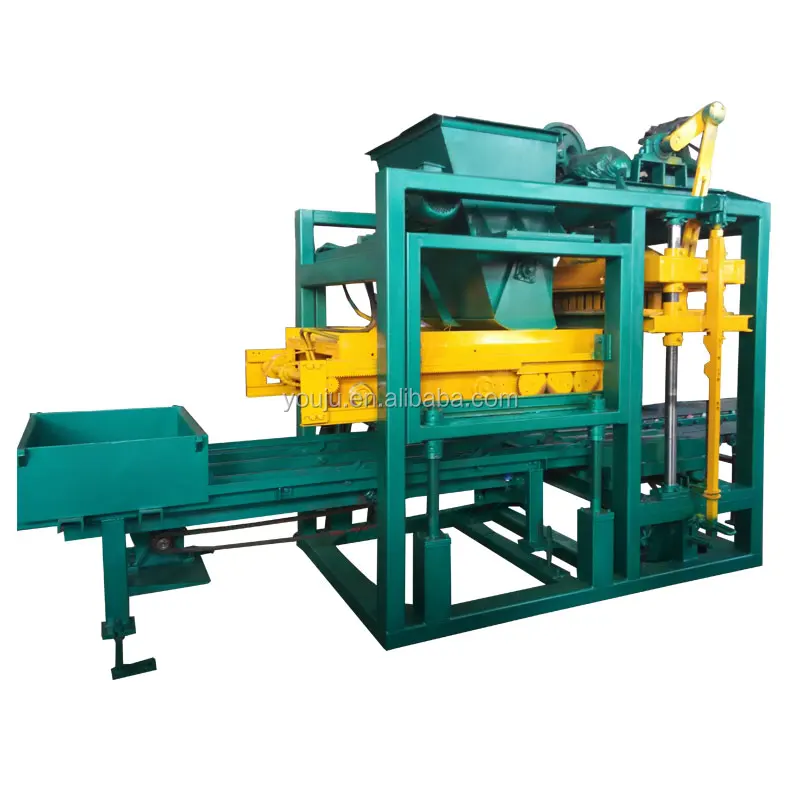
Configured as one matched line — every station from the JQ350 mixer through to the manual pallet trolley is timed against the 25-second press cycle so the QTJ4-25 is never left waiting for the next batch.
Technical Specifications
| Parameter | Value |
|---|---|
| Model | QTJ4-25 |
| Product Type | Semi-Automatic Concrete Block Making Machine |
| Rated Power | 17.9 kW |
| Overall Dimensions | 6400 × 1500 × 2700 mm |
| Total Mass | 2500 kg |
| Molding Cycle | 25 s |
| Pallet Size | 850 × 550 × 20 mm |
| Vibration Frequency | 2800 r/min |
| Vibration Force | 60 kN |
| Vibration Method | Bed mould vertical vibration + upper mould compression vibration |
| Hydraulic Station | Equipped (pressure value basis to be confirmed) |
| Output Capacity | 960 pcs/h, 7680 pcs/day (based on 400×200×200 mm hollow block, 4 pcs/mould) |
| Included Line Stations | Host machine, one block mould set, JQ350 mixer, material conveyor, manual pallet trolley |
| Voltage & Frequency | To be confirmed for target market |
| Control System | To be confirmed (PLC or relay) |
Application Suitability
| Application | Material or Output |
|---|---|
| Hollow block production for load-bearing walls | Crushed stone, sand, cement, water |
| Solid block production for partition walls | Crusher dust, fly ash, cement blend |
| Paving block production for walkways and yards | Fine aggregate with pigment addition |
| Curb stone production for road edges | Coarse aggregate with higher cement ratio |
| On-site block production for housing projects | Locally sourced sand and gravel |
What the "7,680 Blocks a Day" Figure Leaves Out of Your Line
A press capacity number means nothing if the mixer cannot keep pace and the pallets pile up with nowhere to go.
I spent years in the test bay running full-line commissioning before moving into configuration work. The most common complaint we received was never about the press itself — it was about daily throughput falling well short of the quoted number. Almost every time, the issue traced back to stations around the press being specified independently. A buyer pairs a small batch mixer with a host that finishes a cycle in 25 seconds, and the press sits idle for eight seconds per cycle waiting for the next hopper load. Multiply that across a shift and you lose thousands of blocks. The QTJ4-25 block making machine production line is specified by checking every upstream and downstream station against the host cycle first, then building the quotation around what actually sustains continuous operation [NEED_CITE: typical causes of throughput shortfall in semi-automatic block lines].
How the Mixer and Conveyor Keep the Press Fed
The JQ350 mixer included in this line is sized to deliver a fresh batch within the 25-second molding window of the QTJ4-25 block making machine production line. When the hopper sensor calls for material, the conveyor carries it to the press before the current cycle completes. If the mixer is undersized or the conveyor belt too slow, the press waits — and the daily count drops regardless of what the nameplate says.
Pallet Flow from Press to Curing Area
Each pallet leaving the press carries a freshly formed block set that cannot be stacked immediately. The manual trolley provided in this configuration transfers pallets to the curing zone on a continuous loop. The number of pallets in circulation must cover the distance from press to curing rack and back again without interrupting the cycle. We typically recommend a pallet pool sized to the buyer’s specific curing layout, because a shortage here stalls the entire line [NEED_CITE: pallet circulation calculations for semi-automatic block plants].
Matching Vibration to the Mix You Actually Run
The bed mould vertical vibration combined with upper mould compression vibration at 2800 r/min and 60 kN exciting force consolidates the concrete mix within the mould cavity. This dual action is necessary because a single vibration source cannot compact both the bottom corners and the top surface evenly on a hollow block format. The mix design — specifically the aggregate grading and moisture content available at your site — determines whether the vibration parameters produce full density or leave weak cores. Configuration starts with your local material, not a default setting.
Reading the Specification Sheet Beyond the Host Machine
The 17.9 kW rated power covers the host press, vibration motors, and hydraulic station. When you add the JQ350 mixer and conveyor, total connected load rises, and the incoming supply must account for all stations running simultaneously. The 850 × 550 × 20 mm pallet size defines the curing rack spacing and the forklift tine width you need on-site. The 6400 × 1500 × 2700 mm overall dimension of the host determines the minimum bay width, but the full line footprint extends further once the mixer, conveyor and curing area are laid out. Voltage and frequency must be confirmed before production so that the motor winding, control panel and any PLC display match your local supply [NEED_CITE: industrial voltage standards across export markets].
The Cost of Treating Each Station as a Separate Purchase
When buyers source the mixer from one supplier, the pallets from another, and the press from a third, nobody is responsible for the gaps between stations. The mixer output does not match the conveyor speed, the pallet material warps under local humidity and jams the guide rails, and the curing racks do not accept the pallet dimension. These mismatches surface only after the line is installed, when rework means replacing equipment you already paid for. Specifying the QTJ4-25 block making machine production line as a single package from one supplier transfers the responsibility for station-to-station timing to the party who designed it.
Why Line Configuration Matters More Than Host Machine Specs Alone
Every quotation we prepare starts with the buyer’s target block format, local aggregate sample, and site layout rather than a catalogue page. The machine, mould, pallet and handling equipment are specified as one system so that cycle times align across every station. Mould drawings are produced for the formats your market actually sells, including custom designs where standard formats do not apply. Automation level is selectable — a buyer can begin with the semi-automatic configuration shown here and add automatic pallet feeding or stacking later as production volume grows. Installation support includes operator training on the specific line delivered, not generic press operation. Factory test records are generated using the buyer’s confirmed block format so that capacity figures are verified before the equipment leaves the workshop.
Documentation & Verification
- Line layout drawing showing mixer, conveyor, press and curing zone with cycle time annotations
- Capacity calculation sheet stating 400×200×200 mm hollow block as the basis for output figures
- Mould drawing and format list covering every block size included in the order
- Pallet specification matched to your curing rack spacing and forklift tine width
- Hydraulic and electrical schematic with confirmed voltage and control language
- Factory test record on your specified block format before dispatch
Installation, Commissioning & Support
- Foundation pad must accommodate the 6400 × 1500 mm host footprint plus mixer and conveyor run
- Dedicated power circuit sized for total connected load across all line stations
- Host machine ships in bolted sections for container loading and on-site reassembly
- First-cycle commissioning verifies 25-second molding cycle with your local mix
- Operator training covers mould change procedure and daily vibration bed inspection
- Wear parts list includes vibration springs, hydraulic seals, and mould liner plates
What We Need to Configure Your Line Accurately
Send us the block formats your market demands along with a sample of the aggregate and sand you plan to use. Let us know your available curing area dimensions and whether you already have forklifts and racks on-site. Confirm your local voltage, frequency, and preferred control display language so that the electrical package matches before the QTJ4-25 block making machine production line ships.
Frequently Asked Questions
Q: How do I verify daily output across different block formats on this line?
A: The 7,680 pieces per day figure is based on 400×200×200 mm hollow blocks at 4 pieces per mould. A smaller solid block format will yield more pieces per cycle, while a larger paving block yields fewer. We provide a capacity calculation sheet listing realistic output for each format included in your mould set, all based on the same 25-second molding cycle and continuous mixer-conveyor feed.
Q: What supporting equipment is included versus what I source locally?
A: The line package includes the host press, one mould set, the JQ350 mixer, material conveyor, and a manual pallet trolley. Pallets, curing racks, and water supply connections are typically sourced locally to match your existing infrastructure. We provide pallet specifications so your local supplier can match the 850 × 550 × 20 mm dimension required by the press guide rails.
Q: How does pallet size and material affect my curing workflow?
A: The 850 × 550 mm pallet determines curing rack slot width, forklift tine spacing, and how many blocks move per trip from press to curing zone. Bamboo, PVC, and steel pallets each behave differently under local humidity and block weight. We confirm pallet material with you based on your climate and curing area layout before including them in the shipment.
Q: How are the stations timed so the press never waits between cycles?
A: The JQ350 mixer batch time, conveyor belt speed, and manual trolley return loop are each calculated against the 25-second press cycle. If any station falls behind, the press sits idle and daily output drops. Our line layout drawing annotates the cycle time at each station so the timing logic is visible before installation begins.
Q: What is involved in changing moulds on this machine?
A: The QTJ4-25 uses a bolted mould frame that can be swapped by the operator. Change time depends on the format size and whether the vibration bed needs repositioning for a different pallet contact area. We provide a mould change procedure in the operation manual and train your operator during commissioning so the switch between hollow, solid, and paver formats does not consume half a shift.


