
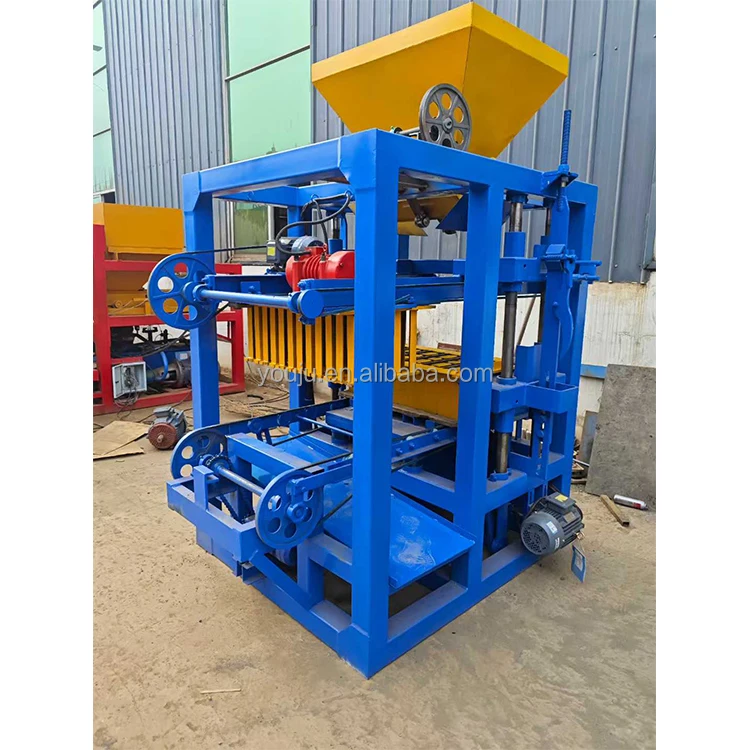
Matched System Sizing — the QTJ4-24 line is specified as one balanced workflow from JQ350 mixer through belt conveyor, press, pallet transport and optional stacking, so no station waits on another.
Technical Specifications
| Parameter | Value |
|---|---|
| Model | QTJ4-24 |
| Product Type | Semi-Automatic Concrete Block Making Machine |
| Molding Type | Platform Vibration |
| Overall Dimensions (working state) | 3600mm × 1700mm × 2560mm |
| Total Mass | 1750 kgs |
| Pallet Size | 850mm × 450mm |
| Overall Power | 14.25 kW |
| Mould Format (hollow block) | 390mm × 190mm × 190mm, 4 pcs/mould (source value — verify against manufacturer catalog) |
| Mould Format (solid brick) | 240mm × 115mm × 53mm, 21 pcs/mould (source value — verify against manufacturer catalog) |
| Vibration System | Lower platform vibration (two 3kW motors) + Upper vibration (1.5kW attached device) |
| Control System | Electronic controlling part (PLC or relay to be confirmed) |
| Elevating System | Cone-shape motor with JZQ250 speed reducer, V-belt drive |
| Delivery Device | Cycloidal pin wheel speed reducer with chain and V-belt drive |
| Frame Construction | Dragon gate style, super steel with four wear-resisting vertical shafts |
| Included Support Equipment | JQ350 pan mixer, 6m belt conveyor |
| Optional Equipment | Auto stacker (3–6 layers depending on block height) |
| Included Accessory | Trolley for pallet transport to curing yard |
Application Suitability
| Application | Material or Output |
|---|---|
| Small-scale hollow block plant | Crushed stone, sand, cement and water mix |
| On-site solid brick production for contractors | Local aggregate with standard cement ratio |
| First-time block production line | Standard concrete mix with locally available sand and gravel |
| Existing plant adding standard formats | Pavers, kerbstones or partition blocks with mould change |
What "Semi-Automatic" Really Means for Your Daily Output
The semi-automatic block machine production line only delivers its rated output when every upstream and downstream station is timed to the press cycle.
I have watched lines arrive on site where the mixer batch size was too small for the press hopper, forcing the operator to wait for the next mix before completing a full pallet. On another project the belt conveyor ran faster than the material releasing hopper could accept, spilling aggregate onto the workshop floor. The semi-automatic block machine production line is only as productive as its slowest station, and that slowest station is usually something the quotation never mentioned [NEED_CITE: typical station mismatch causes in small block plants]. When the pan mixer, conveyor speed and pallet feed are all calculated against the press cycle, the operator simply loads raw material at one end and moves cured pallets at the other. When they are not, the press sits idle and your daily count falls well short of what the brochure promised.
How the Stations Connect on the QTJ4-24 Line
The JQ350 pan mixer batches raw material and feeds it onto the 6m belt conveyor, which carries the mix up into the material storing hopper mounted above the press. From there the material releasing hopper drops a measured charge into the mould box. This semi-automatic block machine production line keeps material moving without manual shovelling between stations.
Where Pallet Flow Determines Your Real Cycle Time
After the press completes a cycle, the operator pulls the loaded pallet onto the trolley and pushes it toward the curing yard. If the curing area is too far or the trolley count is too low, the press waits for an empty pallet to return. The optional auto stacker handles three to six layers per pallet, cutting the number of pallets in circulation and reducing the distance each one travels [NEED_CITE: pallet circulation requirements for semi-automatic block lines]. Matching pallet count to curing yard distance is part of the line calculation, not an afterthought.
Reading the Vibration and Frame Specifications
The QTJ4-24 uses two 3kW lower vibration motors beneath the platform and a 1.5kW upper vibration device attached to the mould head. This dual-source vibration compacts the concrete mix from both directions, which matters when you are running a stiff mix with coarse local aggregate. The dragon gate frame with four wear-resisting vertical shafts keeps the mould head aligned through every cycle, preventing uneven block density that would show up as weak corners after curing. The 850mm × 450mm pallet size defines your curing rack spacing and forklift tine width — if your existing racks were built for a different pallet dimension, they need to be adjusted before the line arrives, not after.
The Cost of Skipping the Line-Level Calculation
When a buyer focuses only on the press and treats the mixer, conveyor and pallet handling as commodity add-ons, the first week of production reveals the gap. The mixer runs continuously but never fills the hopper in time. The belt conveyor jams because the incline angle was not matched to the mix moisture content. Pallets pile up at the curing yard entrance because nobody calculated how many trolleys the layout actually requires. These are not machine faults — they are line design faults, and they cost the same amount of lost output whether the press itself is running perfectly [NEED_CITE: line design versus machine fault diagnosis in block production].
Why Buyers Source the Full Line From One Supplier
Every station on this semi-automatic block machine production line is specified together, so the JQ350 batch size, the 6m conveyor throughput and the press hopper capacity are calculated against the same cycle assumption. The mould formats — 390mm × 190mm × 190mm hollow block and 240mm × 115mm × 53mm solid brick — are confirmed against your local market demand before production begins. The pallet size and material are chosen with your curing yard dimensions and forklift in mind. Voltage, frequency and control language are locked in before the machine enters assembly, so commissioning does not stall over a wiring mismatch. Mould drawings and a format list are provided so you know exactly which block types the line will produce on day one.
Documentation & Verification
- Line layout drawing showing station spacing and pallet flow path for the QTJ4-24 configuration
- Capacity calculation stating the block format and shift hours assumed for daily output
- Voltage, frequency and control language confirmation sheet signed before assembly
- Mould drawing and format list covering hollow block and solid brick dimensions
- Factory test record on your specified mix before dispatch
Installation, Commissioning & Support
- Foundation pad sized to the 3600mm × 1700mm footprint with anchor bolt template provided
- Dedicated circuit rated for 14.25 kW total draw with voltage confirmed to your local supply
- Machine arrives in working-state configuration; vertical shafts and vibration motors checked on site
- Mixer and conveyor positioned per the line layout drawing to match press hopper height
- Operator training covers mould change procedure, pallet loading sequence and daily greasing points
- Wear parts list identifies vibration motor mounts, hopper liners and belt conveyor splices
What to Include With Your Inquiry
Send your target block format, daily output requirement and shift duration so the capacity calculation reflects your actual production plan. Confirm your local voltage and frequency, plus the language you need on the control display. Share your curing yard dimensions and existing forklift capacity so the pallet specification and trolley count are matched before the line ships.
Frequently Asked Questions
Q: How is daily output calculated and which block format is the capacity based on?
A: Daily output is calculated per block format, shift duration and confirmed cycle time. The quotation states which mould — hollow block or solid brick — the capacity figure assumes, so there is no single headline number that applies to every format the machine can produce.
Q: What supporting equipment is included and what is optional in the line?
A: The JQ350 pan mixer, 6m belt conveyor and pallet transport trolley are included. The auto stacker is optional and can handle three to six layers depending on block height, reducing manual labour at the output end of the line.
Q: How do the mixer output and conveyor speed match the press cycle time?
A: The JQ350 batch volume and the belt conveyor feed rate are calculated against the press hopper capacity and cycle interval, so the material storing hopper stays charged without overflow or starvation during continuous operation.
Q: Can the auto stacker be added later if I start with manual pallet handling?
A: Yes. The line layout reserves space and power for the stacker, so you can add it when production volume justifies the investment without rearranging the press, mixer or conveyor positions.
Q: What pallet size and material does the line require, and how does it relate to my curing setup?
A: The line uses 850mm × 450mm pallets. The material — wood, bamboo or composite — is selected based on your curing yard conditions and forklift capacity, and the pallet count is calculated against your curing area distance to keep the press fed.


