
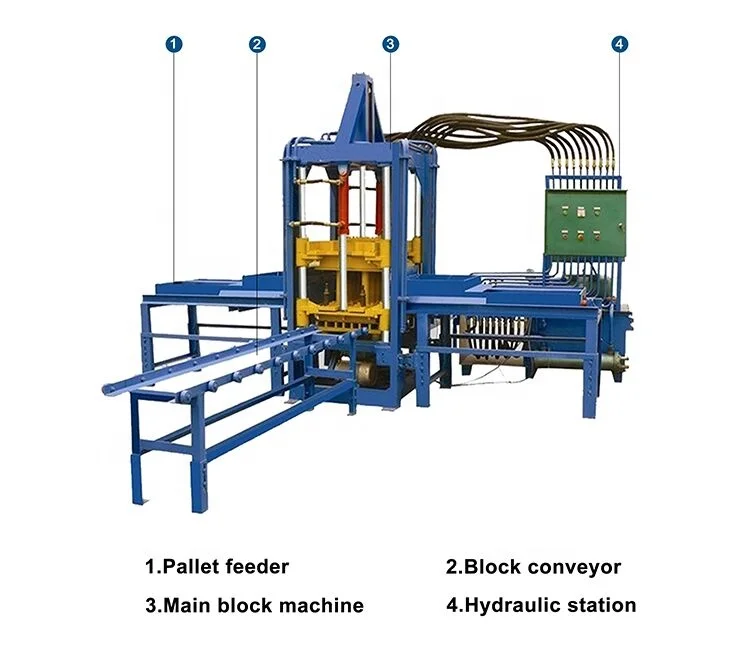
Matched System Approach — Host press, feeders, pallet handling and conveyor specified as one line so cycle times align and no station waits.
Technical Specifications
| Parameter | Value |
|---|---|
| Model | QTF3-20 |
| Product Type | Stationary Block Making Machine |
| Overall Dimensions (L×W×H) | 4000×3500×2300 mm |
| Net Weight | 2870 kg |
| Total Power | 17.5 kW |
| Control System | Semi-Automatic |
| Vibration Form | Platform Vibration |
| Drive System | Hydraulic |
| Layer Configuration | Double layer (raw material + color surface) |
| Output Capacity | 4320 pcs/day (basis not stated in source — confirm block format) |
| Raw Materials | Cement, Sand, Fly Ash, Coarse aggregate, Slag |
| Brick Formats | Hollow, solid, color pavers, interlock, grass, porous brick |
| Monitoring | No-contact proximity switch |
| Line Stations | Host machine, material feeder, color material machine, pallet feeder, block conveyor, hydraulic station, electricity box |
| Compatible Mixer | JQ350 mixer with 8-meter conveyor belt |
| Voltage & Frequency | To be confirmed before order |
| Pallet Size | To be confirmed before order |
| Electrical Components | German import or Chinese brand (specify before order) |
Application Suitability
| Application | Material or Output |
|---|---|
| Hollow block production for masonry walls | Cement, sand and coarse aggregate mixes |
| Color paving brick for walkways and plazas | Double-layer feed with pigmented surface material |
| Interlocking brick for retaining structures | Standard aggregate blends with hydraulic compaction |
| Park grass brick for permeable landscaping | Porous mix designs with open-cell format |
| Environmental brick from industrial by-products | Fly ash and slag as partial cement replacement |
Why the Pallet Question Must Precede the Quotation
A block line stops the moment pallets run out or do not fit the curing racks you already built.
Plant owners reviewing stationary block making machine production line proposals often discover after delivery that pallet dimensions were never matched to the curing area or the forklift on site [NEED_CITE: pallet circulation and curing area planning]. Pallets pile up on the floor, wet blocks tip over, and the press sits idle while workers scramble to clear space manually. The cycle time printed on the specification sheet becomes meaningless when the downstream stations cannot absorb the output.
Line Stations That Must Keep Pace
A stationary block making machine production line is only as fast as its slowest station. The QTF3-20 line includes a material feeder, color material machine, pallet feeder, block conveyor and hydraulic station — each must complete its task within the press cycle. When the pallet feeder lags, the press waits empty. When the conveyor moves slower than the discharge rate, freshly pressed blocks collide on the belt.
Double-Layer Feeding for Color Paver Production
The dual material feed system delivers base mix and pigmented surface material in separate layers before pressing. This arrangement allows the line to produce color pavers without a second press or offline surface treatment. The color material machine meters the face mix onto the pallet immediately before the main hopper fills the body cavity, keeping face thickness consistent across the production run [NEED_CITE: double-layer feeding accuracy in paver production].
Pressure, Vibration and Mix Compatibility
Hydraulic drive combined with platform vibration compacts the mix from below while pressure is applied from above. The density of the finished block depends on how well the vibration frequency suits the aggregate grading and cement content of the local mix. A fly-ash-heavy blend responds differently from a crushed-stone mix, so the vibration force and hydraulic pressure must be set against the material the plant will actually use, not a default factory setting.
What Happens When Stations Are Mismatched
When the mixer output does not match the press consumption rate, the hopper runs dry mid-cycle and the next pallet enters with an incomplete fill. Blocks come out underweight, strength varies pallet to pallet, and the curing yard fills with product that cannot be sold at full grade [NEED_CITE: mix starvation and block strength inconsistency]. Replacing a feeder motor on site is possible, but lost production days are not recoverable.
Why Source the Entire Line Together
Block machinery is the single focus here, which means the press, mould, pallet and every handling station are specified as one matched set. The line layout states the block format assumed for capacity figures, so 4320 pcs/day is verified against your actual product before the order is placed. Pallet size is confirmed against your curing rack spacing and forklift capacity. Voltage, frequency and PLC display language are locked in writing before production begins, avoiding commissioning delays when the line arrives on site.
Documentation & Verification
- Line layout drawing with capacity stated per target block format
- Machine specification sheet listing every station in the line
- Mould drawing and supported format list for your market
- Pallet size and material spec matched to your curing racks
- Hydraulic and electrical schematic with confirmed voltage
- Factory test record on your mix design before dispatch
Installation, Commissioning & Support
- Foundation pad sized to the 4000×3500 mm footprint and 17.5 kW load
- Dedicated circuit for the hydraulic station with confirmed voltage and frequency
- Machine shipped in dismantled modules for standard container loading
- On-site assembly with pallet feeder and conveyor alignment verified
- Operator training covering mould change and double-layer feed setup
- Wear parts and mould list supplied with first replacement schedule
Before You Send an Inquiry
Share the block format your market sells most, the daily volume you need, and the aggregate sources available near your site. Confirm the voltage and frequency at your plant, the PLC language your operators read, and the curing area dimensions so pallet size can be matched. If you already have a mixer or forklift, include those details so the line can be configured around them.
Frequently Asked Questions
Q: How is the 4320 pcs/day capacity calculated and for which block format?
A: That figure appears in the source data without a stated block format, so it must be verified against the specific hollow, solid or paving format you plan to produce. We provide a line layout and capacity calculation that names the format, cycle time and pallet count so the daily output is realistic for your product.
Q: Which stations are included and where must cycle times match?
A: The line comprises the host press, material feeder, color material machine, pallet feeder, block conveyor and hydraulic station. The feeder discharge, pallet advance and conveyor speed must all complete within one press cycle, otherwise the press waits or blocks collide downstream.
Q: How do I confirm pallet size for my existing curing area?
A: Measure the rack shelf width and spacing, note the forklift tine dimensions, and share those figures before the order. We specify pallet length, width and material to match the racks and handling equipment already on your site.
Q: Can I start with the JQ350 mixer and add stations later?
A: Yes. The line supports a semi-automatic start with the JQ350 mixer and 8-meter belt. Upgrading feeding or stacking stations later is possible because each station connects through defined interfaces rather than hard-wired sequences.


