
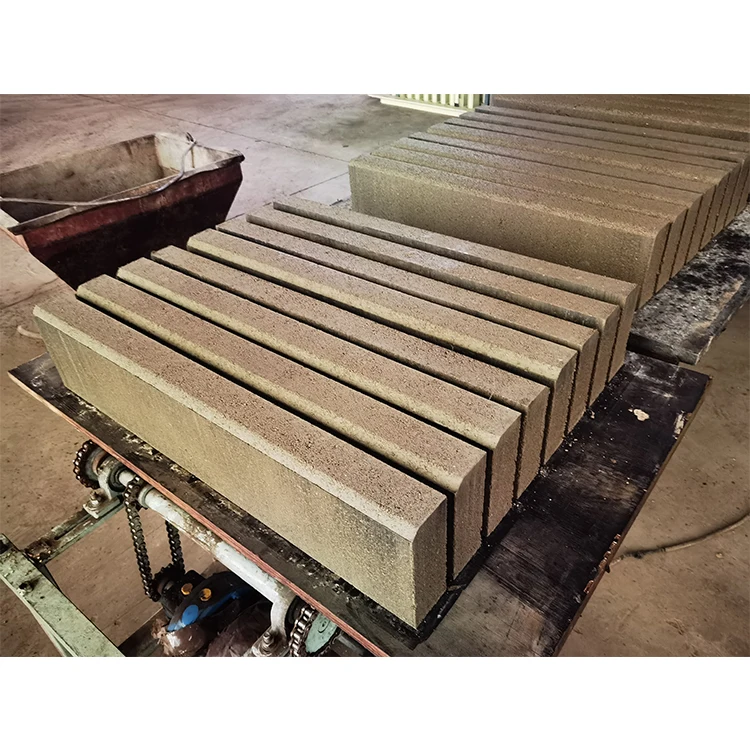
Complete line synchronization — every station from raw material feeding through stacking is timed to the press cycle so the QT8-15 never sits idle waiting for upstream or downstream equipment.
Technical Specifications
| Parameter | Value |
|---|---|
| Model | QT8-15 |
| Product Type | Automatic Concrete Paver Block Making Machine |
| Overall Dimensions (L×W×H) | 8300×1860×3000 mm |
| Total Mass | 9 T |
| Rated Pressure | 21 MPa |
| Main Vibration Form | Platform Vibration |
| Vibration Frequency | 2800~4500 r/min |
| Vibration Force | 60 kN |
| Pallet Size | 950×900 mm |
| Molding Cycle | 15-25 s (basis to be confirmed for specific block format) |
| Overall Power | 55.5 kW |
| Demolding Method | Hydraulic |
| General Water Consumption | 12 T/Day |
| Factory Area | 600 m² |
| Control System | PLC aptitude control with human-machine interface dialogue system |
| Feeding System | Semi-closed screen reticular rotational feeding unit (forced feeding) |
| Automation Level | Fully automatic with hydraulic loading unit |
| Output Capacity | 20% higher productivity than similar products (basis not stated in source — confirm block format, material, and thickness) |
| Applied Products | Concrete blocks, hollow/solid blocks, pavers, interlocking blocks, curbstone, colored pavers |
| Raw Material | Crushed stone, sand, cement, dust, fly ash, gravel, slag |
| Block Formats Supported | Solid blocks, hollow blocks, pavers, interlocking blocks, curbstone, colored pavers (plus-material-feeder machine required for pavers and curb stones) |
Application Suitability
| Application | Material or Output |
|---|---|
| High-capacity block and paver production plants | Crushed stone, sand, cement, fly ash mixtures across multiple block formats |
| Construction contractors producing on-site | Hollow blocks, solid blocks, and interlocking bricks from locally sourced aggregate |
| Manufacturers adding formats to an existing range | Colored pavers, curbstone, and interlocking blocks with plus-material-feeder attachment |
| Development and housing project contractors | Standard hollow and solid blocks from gravel, slag, and cement blends |
What "15-25 Second Cycle Time" Actually Means for Your Line
The molding cycle range only becomes meaningful once you pin down which block format and thickness you intend to produce.
When I quote an automatic concrete paver block making machine production line, I always ask which specific block format drives the buyer’s revenue. A 15-second cycle on a thin paver is a completely different daily output than 25 seconds on a tall hollow block. Buyers who skip this step end up with a press that technically runs at spec while the rest of the line — the mixer discharge rate, the pallet return conveyor, the stacker indexing speed — was sized to a different number entirely [NEED_CITE: block format and cycle time correlation in stationary block machines]. The result is a plant that delivers roughly half the throughput everyone expected on paper.
How Each Station Must Match the Press Rhythm
The QT8-15 press completes a cycle in 15 to 25 seconds depending on format, which means the raw material feeding system must deliver a fresh batch to the hopper within that same window. If the mixer discharges slower than the press consumes, the hopper runs dry and the press idles. This is the single most common reason a complete automatic concrete paver block making machine production line underperforms its nameplate capacity in actual operation.
Pallet Circulation as the Hidden Bottleneck
With a 950×900 mm pallet and a 60 kN vibration force, each cycle produces a loaded pallet that must travel through the stacking station and return empty before the next press stroke. If the stacker cannot index and release a pallet fast enough, or if the forklift operator cannot clear cured racks quickly enough, pallets queue up on the return line and the press stops. Sizing the pallet inventory and the return conveyor speed to the press cycle is where line throughput is genuinely decided [NEED_CITE: pallet circulation and press idle time in block production].
Reading the Specs That Matter Beyond the Press
The 21 MPa rated pressure and 2800–4500 r/min vibration frequency range together determine the density and surface finish of the finished block. A higher vibration frequency produces a tighter surface on pavers but requires a well-graded aggregate to avoid segregation. The semi-closed screen reticular rotational feeding unit forces material evenly across the mould cavity, which keeps block-to-block weight variation low when the mix design is consistent. The PLC control with human-machine interface dialogue system ties all stations together, so an operator can see mixer discharge timing, press cycle count, and stacker position on one screen rather than walking the line. Voltage, frequency, and display language must be confirmed before the control cabinet is wired, because reprogramming a PLC on-site after arrival adds days to commissioning [NEED_CITE: PLC language and voltage configuration delays in exported machinery].
When One Undersized Station Drags the Whole Line Down
I once watched a plant owner in West Africa run a high-capacity press while a single-shaft mixer fed it. The mixer could not discharge fast enough, so the press sat idle for roughly half of every hour. The owner had paid for a fully automatic line but was effectively running a semi-automatic one because the mixer was never included in the original quotation scope. Similar mismatches happen when the curing rack system is too small for the pallet output rate, forcing wet blocks to wait on the stacker conveyor and risking surface damage before they set. Every station in the automatic concrete paver block making machine production line must be quoted and timed as one system, not assembled from separate purchase orders.
Why Sourcing the Entire Line from One Scope Matters
Block machinery is the single focus here, so the QT8-15 press, its moulds, pallets, and handling equipment are specified as one matched set rather than collected from separate suppliers. The configuration is built around the buyer’s actual mix design, local aggregate, and target block format instead of a catalogue default. Mould design covers the formats the buyer’s market actually sells, and custom drawings are available when standard options do not match. The automation level is selectable, so a buyer can start with semi-automatic pallet handling and upgrade to full stacking and cubing later without replacing the press. Installation and commissioning include operator training on the PLC interface, and mould and wear parts support continues after the line is running.
Documentation & Verification
- Line layout with capacity calculation stating the exact block format and cycle time assumed
- Machine specification sheet covering all press and supporting equipment parameters
- Mould drawing and format list matching the buyer’s confirmed product range
- Pallet specification cross-referenced to the buyer’s curing rack dimensions and forklift capacity
- Voltage, frequency, and PLC display language confirmation signed before production begins
- Factory test record showing press cycle performance on the agreed block format before dispatch
Installation, Commissioning & Support
- Foundation plan sized to the 9 T total mass and 8300 mm length with vibration isolation provisions
- Dedicated electrical circuit rated for the 55.5 kW overall power draw at the buyer’s confirmed voltage
- Machine shipped dismantled with reassembly sequence documented and labeled for site crews
- First-run commissioning with the buyer’s actual raw material to validate molding cycle and block density
- Operator training on the PLC dialogue system covering fault codes, format changeover, and daily checks
- Wear parts list with hydraulic seal and vibration motor brush intervals specific to the QT8-15 platform
What to Include in Your Inquiry
To size the automatic concrete paver block making machine production line correctly, provide the target block format and daily output you need, the raw materials available locally with typical aggregate gradation, and the dimensions of any existing curing racks and forklifts. Confirm your site voltage and frequency, the preferred PLC display language, and whether the quotation should include upstream batching and downstream stacking equipment or only the press station.
Frequently Asked Questions
Q: How do I verify the QT8-15 real daily output when cycle time is quoted as 15-25 seconds?
A: Ask for a capacity calculation that states which block format and thickness each end of the cycle range assumes. A 15-second cycle on a thin paver produces a very different daily total than 25 seconds on a tall hollow block. Without format-specific figures, the quoted output is only a theoretical maximum.
Q: What supporting equipment must match the press cycle so the line does not bottleneck?
A: The mixer discharge rate, pallet return conveyor speed, and stacker indexing time must all fall within the press molding cycle. If any station is slower, the press idles and actual throughput drops. Request a line layout showing each station’s cycle contribution before committing to a quotation.
Q: Can the 950×900 mm pallet work with my existing curing racks and forklift?
A: Measure your current rack spacing and forklift tine width before ordering. If the pallet dimensions differ from what your infrastructure was built for, you will need to modify racks or change pallets, which affects the entire line layout and curing area calculation.
Q: How does the forced feeding system affect my local mix design?
A: The semi-closed screen reticular rotational feeding unit distributes material under pressure, which works best with well-graded aggregate and consistent moisture. If your local sand is very fine or your crushed stone is gap-graded, the feeding behavior changes and may require mix adjustment before block strength targets are met.
Q: What is the mould change procedure and how long does it take on the QT8-15?
A: Mould changeover time depends on the format and whether quick-release clamps are fitted. Request the specific changeover time for the moulds included in your quotation, and confirm whether the formats your market sells are covered or require custom engineering separately.


