
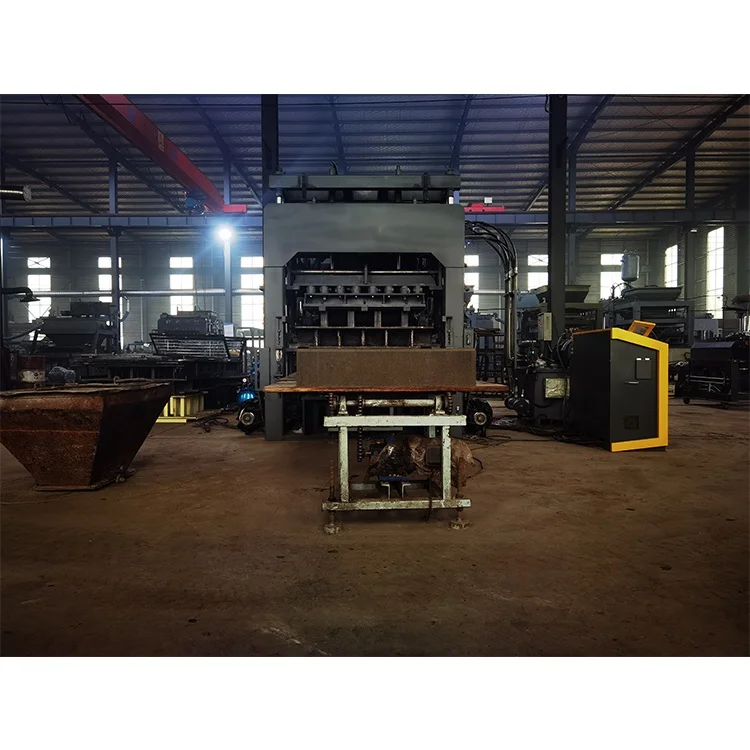
Complete Line Matching — every station from mixer to stacker is sized against the QT8-15 press cycle so the bottleneck stays where you designed it.
Technical Specifications
| Parameter | Value |
|---|---|
| Model | QT8-15 |
| Product Type | Automatic Hydraulic Concrete Block Making Machine |
| Overall Dimensions (L×W×H) | 8300×1860×3000 mm |
| Total Mass | 9 T |
| Overall Power | 55.5 kW |
| Rated Pressure | 21 MPa |
| Main Vibration Form | Platform Vibration |
| Vibration Frequency | 2800~4500 r/min |
| Vibration Force | 60 kN |
| Pallet Size | 950×900 mm |
| Molding Cycle | 15-25 s |
| Demolding Method | Hydraulic |
| Control System | PLC aptitude control with human-machine interface |
| Feeding System | Semi-closed screen reticular rotational feeding unit |
| Automation Level | Fully automatic |
| Output Capacity | 20% higher productivity than similar products (basis not stated in source — confirm block format, material and thickness) |
| General Water Consumption | 12 T/Day |
| Factory Area Required | 600 m² |
| Standards | CE declaration where applicable |
Application Suitability
| Application | Material or Output |
|---|---|
| Hollow block production for residential and commercial walls | Crushed stone, sand, cement, fly ash |
| Solid block manufacturing for load-bearing structures | Gravel, sand, cement, slag |
| Interlocking paver and colored paver production for landscaping | Fine aggregate, cement, pigment |
| Curbstone and kerb production for road and pavement edging | Coarse aggregate, cement, dust |
| Porous and permeable block runs for drainage applications | Graded aggregate, cement |
What a Press-Only Quotation Leaves Off the Line
The press is only as fast as the slowest station feeding or clearing it.
When a quotation covers the block machine alone, the hidden cost appears on day one of production. Wet blocks sit on pallets waiting for someone to carry them to the curing area. Empty pallets pile up at the press exit because no return conveyor was specified. The mixer runs at its own pace, sometimes starving the hopper, sometimes overflowing it. I have walked onto sites where a capable QT8-15 block making machine production line was effectively halved in output because the pallet handling and stacking stations were never part of the conversation [NEED_CITE: typical block plant throughput losses from mismatched auxiliary stations].
Matching Every Station to the 15-25 Second Press Cycle
The QT8-15 completes a molding cycle in 15 to 25 seconds depending on block format and mix. That window dictates the tempo for every upstream and downstream station. The semi-closed screen reticular rotational feeding unit must deliver a full, even charge into the mould box within that cycle, or the press sits idle waiting for material. The mixer output rate, the belt conveyor speed and the hopper gate timing all converge on this single constraint. When we lay out a QT8-15 block making machine production line, we calculate each station’s throughput against the worst-case cycle time for the thickest block in the buyer’s format list.
Pallet Flow, Curing Rack Space and the Return Loop
A 950×900 mm pallet loaded with fresh blocks weighs considerably more than an empty one, and the forklift or rack handler must be rated for both. The automatic stacking station pulls finished pallets off the press exit and places them onto curing racks or floor stacks at a pace the press demands. Meanwhile, cleaned and oiled empty pallets feed back into the press inlet on a return conveyor. If the curing area is too small or the rack spacing does not match the pallet dimensions, the stacker has nowhere to place output and the entire line pauses. This loop — press to stacker to cure to return — is where most unplanned stoppages originate, and it is the section most single-machine quotations skip entirely [NEED_CITE: pallet handling as a cause of downtime in concrete block plants].
Reading the Specs That Actually Shape Line Output
The 21 MPa rated pressure and 60 kN vibration force work together to compact the mix into the mould. Higher pressure alone does not guarantee denser blocks; the vibration frequency between 2800 and 4500 r/min must be tuned to the aggregate gradation and moisture content of the local mix. Platform vibration transmits energy through the pallet into the material, which is why pallet stiffness and flatness matter — a warped pallet absorbs energy that should be compacting the block. The 55.5 kW overall power draw tells the electrical team what dedicated circuit and transformer capacity the plant needs before the machine arrives. And the 12 tonnes per day water consumption figure shapes the supply piping and drainage plan for the mixing and curing zones.
The Hidden Cost of Skipping Line-Level Configuration
A buyer who selects a press based on a catalogue cycle time, then sources pallets locally without checking dimensional tolerance, will discover on commissioning day that the pallets jam the return conveyor or wobble under vibration. If the PLC display language was not confirmed before production, the operator cannot navigate fault codes during the first week. When the voltage and frequency at the site do not match the motor windings, the machine either refuses to start or runs hot enough to shorten bearing life [NEED_CITE: industrial motor failures caused by voltage and frequency mismatch]. These are not press defects — they are line-integration gaps that surface only when all stations are expected to run together.
Why Sourcing the Full Line from One Supplier Matters Here
Block machinery is our single focus, which means the QT8-15 press, its moulds, pallets and every handling station are specified as one matched system rather than assembled from separate vendors. We set the configuration against the buyer’s actual mix design and local aggregate, not a catalogue default, so vibration force and hydraulic pressure land in the right range for the block strength the market demands. Mould design covers the formats the buyer’s market actually sells, with custom drawings available when a standard mould does not fit. The automation level is selectable — a buyer can start with manual pallet handling and add automatic stacking and cubing later without replacing the press. Installation and commissioning include operator training on the full line, not just the press in isolation.
Documentation & Verification
- Line layout drawing with capacity calculation stated per block format for each station
- Machine specification sheet covering press, mixer, feeder and stacker as one system
- Pallet specification matched to the buyer’s curing rack spacing and forklift rating
- Hydraulic and electrical schematic for every station in the QT8-15 line
- Voltage, frequency and PLC display language confirmation signed before production
- Factory test record covering the full line sequence from feed to stack
Installation, Commissioning & Support
- Foundation plan sized to the 8300×1860 mm footprint and 9 T operating mass
- Dedicated 55.5 kW circuit with voltage and frequency confirmed to local grid standards
- Press, feeder and stacker arrive dismantled; reassembly and alignment on site included
- First-run parameter tuning of vibration frequency and hydraulic pressure against the buyer’s mix
- Operator training on PLC human-machine interface covering all line stations and fault recovery
- Wear parts and mould list with reorder references for hydraulic seals and screen feeding unit
What We Need to Size Your Line Correctly
To build an accurate line layout, share the block formats you plan to produce, the daily output target per format, and the raw materials available locally including aggregate type and gradation. Tell us the curing area dimensions and the forklift capacity you already have on site, so the pallet size and stacking station are matched to your existing equipment. Confirm your local voltage, frequency and preferred PLC display language so the electrical and control systems are built right the first time.
Frequently Asked Questions
Q: How is cycle time matched across feeding, pressing, stacking and curing so no station idles?
A: We calculate each station’s throughput against the longest expected molding cycle for your thickest block format. The mixer output, belt speed, feeding unit charge time, stacker placement rate and pallet return speed are all set to stay ahead of the press, so the QT8-15 never waits for material or pallet clearance.
Q: What supporting equipment is included beyond the press — and what must I supply separately?
A: The line quotation covers raw material feeding, mixing, pallet feeding, automatic stacking and pallet return. You supply the curing area, water connection matching the 12 T/day consumption, and the electrical feed matching the confirmed voltage. Site civil works and foundation are also buyer scope.
Q: How is pallet size chosen to match my existing curing racks and forklift?
A: The 950×900 mm pallet is the press default, but we confirm your curing rack slot width, rack height and forklift tine spacing before locking the order. If your existing infrastructure does not align, we adjust the pallet dimension or recommend rack modifications so the full line runs without manual handling.
Q: Can the line start semi-automatic and upgrade to full stacking and cubing later?
A: Yes. The QT8-15 press and its control system are designed to accept automatic stacking and cubing modules as an upgrade. Starting semi-automatic means manual pallet handling at first; when you add the stacker, the PLC programme is extended without replacing the main controller.
Q: How is raw material feed configured for my local aggregate and mix design?
A: We review your aggregate type, maximum particle size and cement ratio before setting the mixer type, feeding unit screen aperture and hopper gate timing. The semi-closed screen reticular rotational feeding unit is adjusted so that each mould charge is even and consistent with the block strength your market requires.


