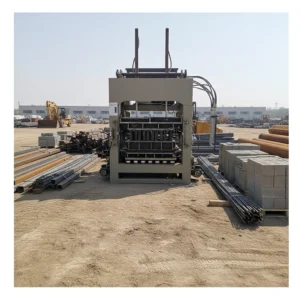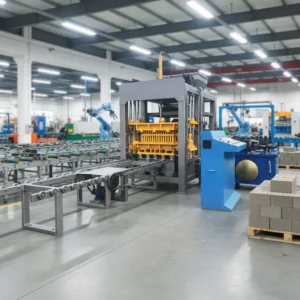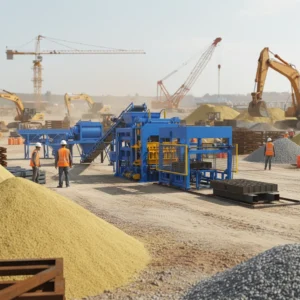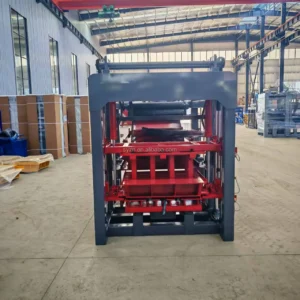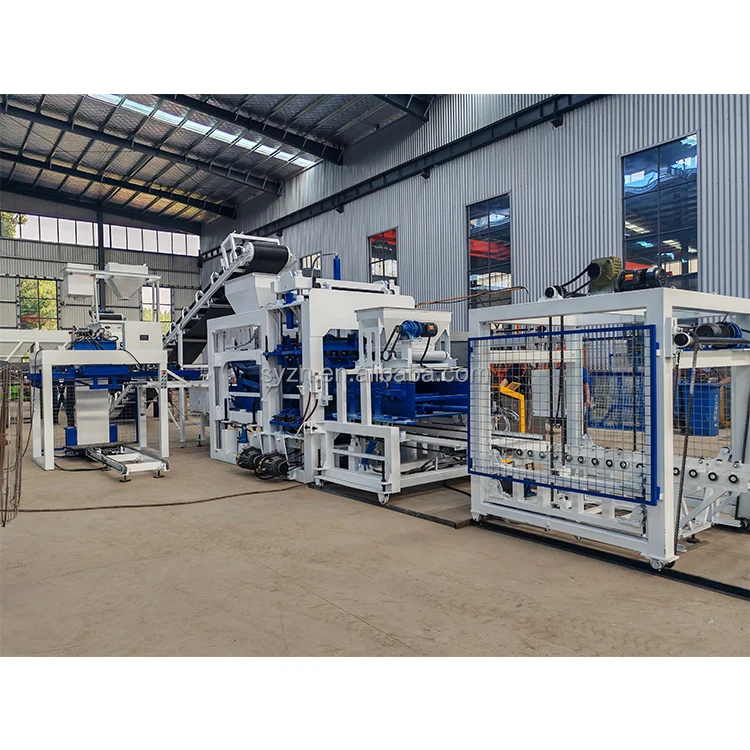
Integrated Line Matching — Every station from mixer to stacker is specified against the QT8-15 molding cycle so the press runs continuously rather than waiting on upstream or downstream equipment.
Technical Specifications
| Parameter | Value |
|---|---|
| Model | QT8-15 |
| Product Type | Hydraulic Concrete Block Making Machine |
| Overall Dimension | 8300 × 1860 × 3000 mm |
| Rated Pressure | 21 MPa |
| Main Vibration Form | Platform Vibration |
| Vibration Frequency | 2800–4500 r/min |
| Vibration Force | 45 kN |
| Pallet Size | 950 × 900 mm |
| Molding Cycle | 15–20 s (basis not stated in source — confirm block format, material, and thickness) |
| Overall Power | 55.5 kW |
| Total Mass | 8 T |
| Demolding Method | Hydraulic |
| Factory Area | 300 m² |
| Applied Products | Hollow blocks, solid blocks, pavers, interlocking blocks, kerbstones, colored pavers |
| Raw Materials | Crushed stone, sand, cement, fly ash, gravel, slag |
| Warranty | 1 year for the whole machine (excluding spare parts) |
| Loading | 1 × 40HQ container (basic equipment) |
Application Suitability
| Application | Material or Output |
|---|---|
| Hollow block production for building walls | Crushed stone, sand, cement, fly ash |
| Solid block manufacturing for load-bearing structures | Gravel, sand, cement, slag |
| Paving block and colored paver runs | Crushed stone, sand, cement with pigment |
| Interlocking brick for retaining walls | Sand, gravel, cement |
| Kerbstone for road and site edging | Coarse aggregate, sand, cement |
| On-site block production for housing projects | Locally sourced aggregate and cement |
What "15–20 Seconds per Cycle" Leaves Out on a QT8-15 Block Making Machine Production Line
The cycle time only translates to real output when the block format, mix design, and every upstream and downstream station are matched to that same rhythm.
A 15–20 second molding cycle sounds productive on paper. But when the mixer discharges one batch every 90 seconds while the press needs a fresh batch every 45 seconds, the QT8-15 block making machine production line spends half its shiftsitting idle. I have seen this exact mismatch cut actual daily throughput well below what the catalog promises [NEED_CITE: typical block line cycle matching requirements for hydraulic presses]. The same problem appears downstream: if the stacker cannot clear cured pallets fast enough, the press operator ends up moving wet blocks by hand. Quoted capacity is meaningless unless every station in the line is timed to the same beat.
Matching Mixer Output to the Press Rhythm
The QT8-15 block making machine production line centers on a press that completes a molding cycle in 15–20 seconds depending on the block format. To keep the press running without pauses, the upstream mixer must deliver a fresh batch of concrete within that same window, accounting for discharge time and conveyor travel. When I configure the mixer and feeder for this press, I calculate the batch weight the QT8-15 hopper consumes per cycle, then size the mixer drum and discharge gate so the next batch arrives before the hopper runs dry. If the mixer is undersized, the press waits; if oversized, concrete sits in the drum losing workability.
Synchronizing Pallet Flow and Stacking
Downstream, the 950 × 900 mm pallets must circulate from the press through the curing racks and back to the pallet feeder in a closed loop. Each pallet carries a wet product that cannot be stacked immediately, so the curing rack system needs enough positions to hold output for the required curing period. If rack capacity is short, pallets pile up at the press exit and the operator clears them manually — the exact bottleneck that turns an automatic line into a semi-manual one [NEED_CITE: pallet circulation and curing rack sizing for block plants]. The stacker at the end of the line must also lift and cube cured blocks at a rate that frees pallets before they are needed back at the press.
Reading the Specs That Actually Matter for Line Balance
The 21 MPa rated pressure and 45 kN vibration force together determine how densely the concrete is compacted in the mould. Higher vibration frequency (2800–4500 r/min) works well with fine aggregates and thinner blocks, while lower frequency with sustained hydraulic pressure suits larger hollow blocks with coarse gravel. The 55.5 kW overall power draw tells you the electrical supply the entire line must support — the mixer, feeder, and stacker add their own loads on top. The 8 T total mass defines the foundation slab thickness needed to absorb vibration without cracking over time. The 300 m² factory area figure sets the minimum floor space for the press and immediate handling zone; add curing rack footprint separately.
The Hidden Cost of Specifying the Press Alone
When a quotation covers only the QT8-15 press and omits pallet handling, stacking, and curing rack equipment, the buyer discovers after delivery that the line stops at the press exit. Wet blocks sit on pallets with nowhere to go. Workers move them by hand, which slows the cycle, risks breakage, and introduces inconsistent curing [NEED_CITE: manual handling impact on block breakage rates in small plants]. The buyer paid for a 15–20 second cycle machine but runs it at a 35–40 second effective cycle because the downstream stations cannot keep up. By the time the missing equipment is ordered and shipped, weeks of production are lost.
Why Source the Full Line Configuration Here
Block machinery is our single focus, so the QT8-15 press, moulds, pallets, and handling equipment are specified as one matched system rather than assembled from unrelated suppliers. We set the configuration against your actual mix design and local aggregate, not a catalog default — the vibration frequency and hydraulic pressure are adjusted to produce consistent block strength with the materials you can actually source. Pallet size (950 × 900 mm) is confirmed against your existing curing area and forklift capacity before production begins. Automation level is selectable, so you can start with manual pallet handling and add automatic stacking later. Documentation includes line layout with capacity calculation stated per block format, hydraulic and electrical schematics, and a wear parts list so maintenance planning starts before the machine arrives.
Documentation & Verification
- Line layout showing station-by-station cycle times matched to the QT8-15 press rhythm
- Capacity calculation stating the specific block format assumed for each output figure
- Pallet specification sheet confirming size, material, and quantity against your curing rack system
- Hydraulic and electrical schematics for your maintenance team before arrival
- Factory test record run on your target block format and mix design before dispatch
- Voltage, frequency, and PLC display language confirmation signed off before production
Installation, Commissioning & Support
- Foundation slab designed for the 8 T mass and platform vibration load of the QT8-15
- Electrical supply sized for 55.5 kW plus upstream mixer and downstream stacker loads
- Machine dismantled for 40HQ container loading with reassembly guide included
- On-site commissioning with cycle timing verified across every station in the line
- Operator training covering mould change, pallet loading, and hydraulic pressure adjustment
- Wear parts and mould list supplied for first-year maintenance planning
What to Share When Requesting a Line Quote
Tell us the block formats you sell most — hollow, solid, paver, interlocking — along with the daily output you need per format. Share your local aggregate type and cement brand so the mix design can be tested before the line is built. Confirm your site voltage, frequency, and preferred PLC display language. If you already have curing racks or forklifts, send their dimensions so the 950 × 900 mm pallets and rack handling equipment are validated against them before production starts.
Frequently Asked Questions
Q: How is the QT8-15 cycle time calculated, and which block format does the output assume?
A: The 15–20 second molding cycle varies by block format, wall thickness, and mix design. We state the exact format used for each capacity figure in the line layout, so you can verify daily throughput against your actual product mix before placing the order. If your primary product is a 400 × 200 × 200 mm hollow block, the cycle and output are calculated specifically for that format.
Q: How do upstream mixer and feeder cycle times match the press to prevent bottlenecks?
A: We calculate the concrete volume the QT8-15 consumes per cycle, then size the mixer drum, discharge gate, and feeder conveyor so a fresh batch arrives before the hopper runs empty. Each upstream station’s timing is documented in the line layout alongside the press cycle, making any mismatch visible before equipment is built.
Q: Is pallet feeding, automatic stacking, and curing rack handling included in the quotation?
A: These stations are included as part of the QT8-15 block making machine production line configuration. The quotation lists pallet specification, stacker model, and curing rack capacity explicitly, so nothing is left for you to source separately after delivery. Each item is matched to your site’s existing forklift and curing area dimensions.
Q: What voltage, frequency, and PLC language options are confirmed before production?
A: Voltage, frequency, and PLC display language are confirmed in writing and signed off before the QT8-15 enters production. This prevents the common situation where a machine arrives on site but cannot be powered or operated because the electrical specification or control language was never checked against local standards [NEED_CITE: voltage and frequency standards by export market].
Q: How is the 950 × 900 mm pallet size validated against existing equipment?
A: Before production, we ask for your curing rack dimensions and forklift fork width to confirm that 950 × 900 mm pallets fit your handling system. If your existing racks require a different size, the pallet specification is adjusted and the press mould layout is updated accordingly, so pallets, racks, and press all align from day one.