
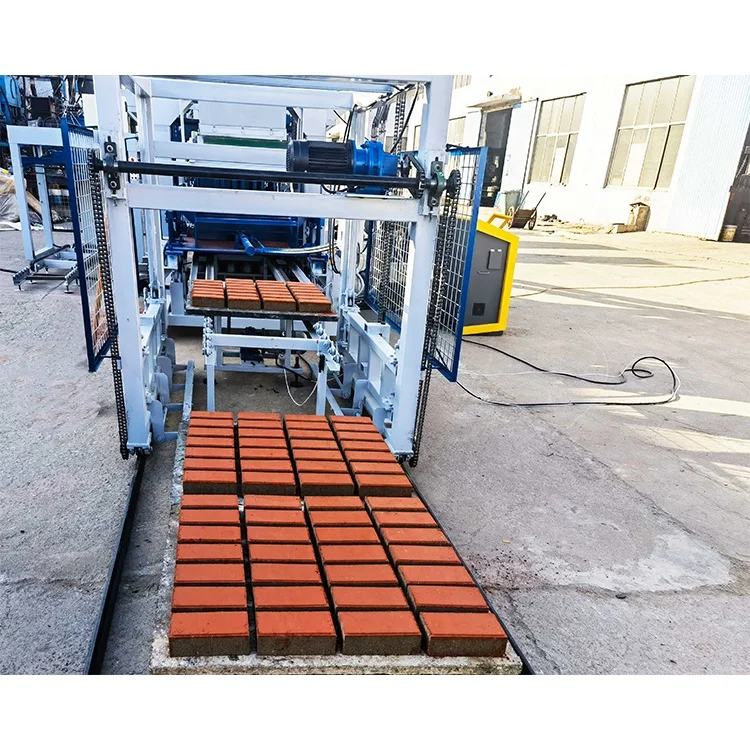
Coordinated Line Design — Every QT8-15 station is sized against the next so the press never idles waiting for pallets, material or stacking capacity.
Technical Specifications
| Parameter | Value |
|---|---|
| Model | QT8-15 |
| Product Type | Automatic Concrete Block Making Machine |
| Overall Dimensions | 8300×1860×3000 mm |
| Total Mass | 9 T |
| Rated Pressure | 21 MPa |
| Main Vibration Form | Platform Vibration |
| Vibration Frequency | 2800–4500 r/min |
| Vibration Force | 60 kN |
| Pallet Size | 950×900 mm |
| Molding Cycle | 15–25 s (basis not stated in source — confirm block format / material / thickness) |
| Overall Power | 55.5 kW |
| Demolding Method | Hydraulic |
| General Water Consumption | 12 T/Day |
| Factory Area | 600 m² |
| Control System | PLC with human-machine interface |
| Feeding System | Semi-closed screen reticular rotational feeding unit |
| Automation Level | Fully automatic (automatic raw material feeding and block stacking) |
| Applied Products | Concrete blocks, hollow/solid blocks, pavers, interlocking blocks, curbstone, colored pavers |
| Raw Material | Crushed stone, sand, cement, dust, fly ash, gravel, slag |
Application Suitability
| Application | Material or Output |
|---|---|
| Hollow block production for residential and commercial walls | Crushed stone, sand, cement, fly ash blends |
| Solid block manufacturing for load-bearing structures | Gravel, cement, slag mixes |
| Paving and interlocking block runs for roads and walkways | Fine aggregate, cement, colored pigment |
| Kerbstone and curb production for municipal infrastructure | Coarse aggregate, cement, high-density mix |
| On-site block production for housing projects | Locally sourced sand, stone dust, cement |
What "Cycles per Hour" Leaves Out About an automatic concrete block making machine production line
A cycle rate only matters when every station around the press can keep up.
I have watched lines where the QT8-15 press finishes a cycle in under twenty-five seconds, but the pallet return conveyor takes longer. The press sits idle, the operator watches, and by end of shift the real count is nowhere near the brochure figure. That gap is not a machine problem — it is a line-balancing problem, and it shows up the moment the first week of production ends. When upstream batching, pallet circulation and downstream stacking are specified independently, the weakest link sets the pace for the entire automatic concrete block making machine production line [NEED_CITE: typical causes of throughput shortfall in block plants].
How Stations Connect Around the Press
Raw material moves from the batching station through the mixer and into the semi-closed rotational feeding unit on the QT8-15. The feeding unit meters material into the mould box at a controlled rate, which matters because uneven fill causes weight variation from one block to the next. Once the press completes its vibration and hydraulic demould cycle, the loaded pallet transfers onto the return conveyor. If that conveyor or the pallet feeder cannot match the press cycle, the automatic concrete block making machine production line loses seconds on every stroke — and those seconds compound across a full shift.
Pallet Circulation as the Hidden Bottleneck
The 950×900 mm pallet is the single item that touches every station: it receives the wet block at the press, rides through the stacking station, and returns empty via the conveyor loop. When pallet count, material and return speed are chosen without checking against curing rack spacing and forklift capacity at the buyer’s site, pallets pile up on the floor and the stacker cannot clear them fast enough. I once reconfigured a pallet return path for a Middle East project because the curing racks the buyer already owned were too narrow for the standard pallet rack layout — a mismatch that would have forced a full rack replacement before the first block left the plant [NEED_CITE: pallet handling and curing area coordination in block production].
Reading the Specs That Actually Matter
The 21 MPa rated pressure and 60 kN vibration force work together: pressure compacts the mix from above while platform vibration densifies it from below. If your local aggregate is coarse crushed stone rather than fine sand, the vibration frequency range of 2800–4500 r/min lets the operator tune densification without changing the mix. The 55.5 kW total power draw covers the press, feeder and hydraulic pump but not the mixer, stacker or conveyor drives — those loads must be added when sizing the site transformer. Hydraulic demoulding delivers consistent block release across formats, reducing edge damage compared with mechanical knock-out, and the PLC human-machine interface lets the operator store cycle parameters per mould so format changeover does not require manual timer adjustment each shift.
The Cost of Ignoring Line Balance
When a buyer selects a press based on cycle rate alone and sources pallets, stackers and conveyors separately, each supplier optimises for their own equipment. The pallet feeder runs slightly slower than the press. The stacker arm reaches full extension a half-second late. No single station triggers an alarm, but the line never hits the quoted output [NEED_CITE: impact of station mismatch on daily block output]. Multiply that gap by six working days and the shortfall is measured in tens of thousands of blocks per week — enough to miss delivery deadlines on a housing contract.
Why This Line Is Configured Together
The QT8-15 and its supporting stations are specified as one system. Pallet size is confirmed against your existing curing racks and forklift fleet before the order is placed. The batching station output rate is calculated to fill the mixer within the press cycle window, so material is ready when the mould box calls for it. Stacking and cubing equipment is included in the quotation, not left as a surprise add-on after the press arrives. Voltage, frequency and PLC display language are locked in before production starts, so commissioning is not delayed by a language pack or a transformer swap. Moulds are designed around the block formats your market actually buys, and custom drawings are available when a standard format does not fit [NEED_CITE: block format and mould matching for regional markets].
Documentation & Verification
- Line layout drawing showing station positions and pallet loop path
- Capacity calculation sheet stating the block format used for cycle time
- Hydraulic and electrical schematic matching your site voltage and frequency
- Mould drawing and format list for every block type in the quotation
- Factory test record run on your target mix before dispatch
- CE declaration documentation where applicable to your import market
Installation, Commissioning & Support
- Foundation plan sized to the QT8-15 footprint and 9 T operating mass
- Dedicated power circuit rated for 55.5 kW plus supporting station loads
- Pallet return conveyor alignment checked against your curing rack spacing
- PLC language and voltage confirmed before the control cabinet leaves the factory
- Operator training covering mould change, vibration tuning and daily maintenance
- Wear parts list with hydraulic seal and vibration motor service intervals
Before You Request a Quote
Share the block formats you currently sell and the daily output you need to hit. Tell me the local aggregate type, cement source and any fly ash or slag available in your area. Confirm your site voltage, frequency and the language your operators read. If you already have curing racks, forklifts or a mixer in place, send the dimensions and capacities so the automatic concrete block making machine production line is configured around them rather than replacing them.
Frequently Asked Questions
Q: How is daily output calculated per block format, and which format does the quoted cycle time assume?
A: The 15–25 second molding cycle must be confirmed against your specific block format, wall thickness and mix. Daily output is then calculated by multiplying confirmed cycle rate by working hours and subtracting pallet return time, mould change intervals and scheduled stops. We provide a capacity sheet stating the exact format and mix assumed so your projection is honest from day one.
Q: How do upstream batching and downstream pallet return cycle times align with the press?
A: Each station is timed to the QT8-15 press cycle. The mixer discharge, feeding unit fill, pallet feed and stacker arm stroke are all specified so no station forces the press to wait. If your site conditions change — different mix, new pallet type — the line timing is recalculated before hardware is adjusted.
Q: Can the line start semi-automatic and upgrade to full automatic stacking later?
A: Yes. The QT8-15 platform supports a semi-automatic start with manual pallet handling and hand stacking, then adds automatic pallet feeding, stacking and cubing modules later. The PLC architecture and mechanical interfaces are designed to accept those additions without replacing the press or control cabinet.
Q: What pallet size and material are specified, and how do they match my curing racks and forklift?
A: The standard 950×900 mm pallet is confirmed against your existing curing rack dimensions and forklift fork width before the order is placed. Pallet material — bamboo, PVC or steel — is selected based on your local climate and expected service life, not chosen in isolation from the rest of the line.
Q: Which supporting stations are included in the quotation and which are optional?
A: The quotation covers the QT8-15 press, mould, pallets, raw material feeding system and automatic stacker as standard. Mixer capacity, conveyor length and cubing station are sized to your layout and listed separately so you can see exactly what is included and what you may already have on site.


