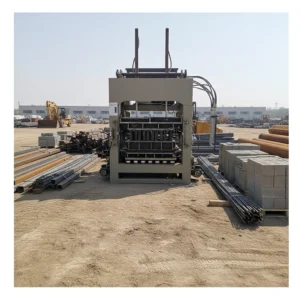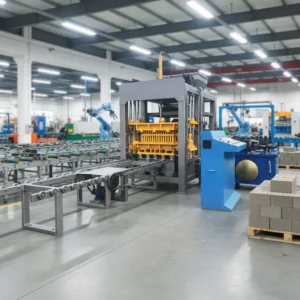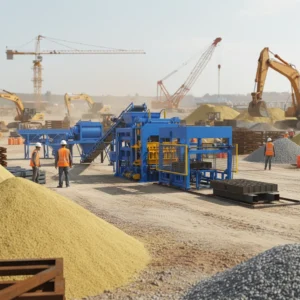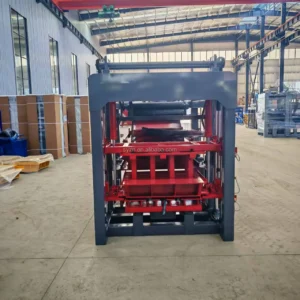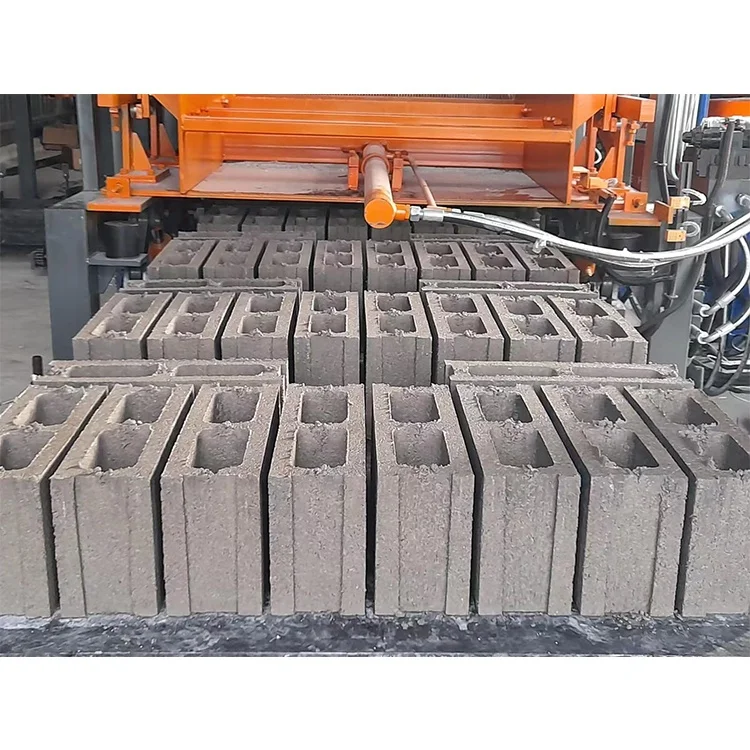
Integrated Line Matching — Every station from raw material feeding through curing rack handling is timed to the QT7-15 press cycle, so no single machine waits on another.
Technical Specifications
| Parameter | Value |
|---|---|
| Model | QT7-15 |
| Product Type | Automatic Hollow Block Making Machine |
| Pallet Size | 1150 x 700 mm |
| Molding Cycle | 15-20s |
| Overall Power | 45 kW |
| Vibration Force | 100 kN |
| Vibration Frequency | 0-60 Hz |
| Vibration Form | Platform Vibration |
| Total Mass | 8 T |
| Demolding Method | Hydraulic |
| Control System | PLC with touch screen interface, remote fault diagnosis |
| Output (Hollow block 400x200x200mm) | 1260-1680 pcs/hour; 10080-13440 pcs/8hr |
| Output (Hollow block 400x150x200mm) | 1440-1920 pcs/hour; 11520-15360 pcs/8hr |
| Output (Rectangular brick 200x100x60mm) | 3888-4860 pcs/hour; 31104-38880 pcs/8hr (Molding cycle 20-25s) |
| Mould Change System | Simple mould replacement for multi-format production |
Application Suitability
| Application | Material or Output |
|---|---|
| Hollow block production for load-bearing walls | Crushed stone, cement, sand aggregate mixes |
| Multi-cellular brick manufacturing | Lightweight concrete with varied aggregate gradations |
| Paving brick production for hardscapes | Dense concrete mixes requiring high vibration force |
| Standard solid brick for masonry | Cement-bound local aggregate with hydraulic compaction |
| On-site block production for housing projects | Regionally sourced raw materials matched to mix design |
Why "1680 Pieces per Hour" Means Nothing Without the Rest of the Line
The press is only as fast as the slowest station feeding it or clearing its output.
I once watched a QT7-15 cycle beautifully at rated speed while wet blocks piled up at the discharge end because the pallet return conveyor was specified for a slower machine two tiers down. The automatic block making machine production line had a bottleneck that no amount of PLC tuning could fix. The buyer paid for capacity they never saw. [NEED_CITE: production line synchronization principles in concrete block manufacturing]
When the mixer discharge rate, pallet feed interval, and stacking speed are not calculated against the press cycle, the quoted hourly output becomes a theoretical ceiling the plant never reaches. The real question is not what the press can do alone — it is what the complete system delivers across an eight-hour shift.
Station-to-Station Timing Across the Complete Line
Every automatic block making machine production line built around the QT7-15 starts with a cycle map. The 15-20 second molding cycle sets the heartbeat, and every upstream and downstream station is configured to match or slightly lead that interval. The raw material feeder and mixer must deliver a fresh batch to the hopper before the press calls for it, not after. The pallet feeder must present a clean, cured pallet at the press inlet within the same window the finished block exits.
When these intervals drift — even by a few seconds per cycle — the loss compounds across hundreds of cycles per shift. A two-second delay at the pallet feeder, repeated over 1600 cycles, costs nearly an hour of production time. The line layout and capacity calculation we provide names the block format assumed and shows the timing at each station so there are no hidden gaps.
Where Supporting Equipment Determines Actual Daily Output
The press itself is a single station. The automatic block making machine production line includes raw material feeding, mixing, pallet feeding, automatic stacking, curing rack handling, and cubing — and each must be specified together. A pallet size of 1150 x 700 mm was chosen for this model, and that dimension dictates the curing rack spacing, the forklift fork width, and the stacking pattern the cuber must execute. [NEED_CITE: pallet dimension standards and curing area logistics in block plants]
If the pallet specification is chosen without regard to the curing area the buyer already has, blocks end up stacked by hand in an overflow yard. The supporting equipment is not optional accessory work — it is the difference between the rated 10080-13440 hollow blocks per eight-hour shift and whatever the plant actually manages when the stacker falls behind and operators are pulling pallets off the line manually.
How Vibration, Pressure, and Mould Design Interact on the Press
The QT7-15 runs a platform vibration system with adjustable frequency from 0 to 60 Hz, delivering up to 100 kN of vibration force alongside hydraulic demolding. Vibration compacts the aggregate particles into a dense matrix, while hydraulic pressure holds the mould cavity closed against the outward force of that compaction. If vibration frequency is set too high for a coarse aggregate mix, the material segregates and blocks crack during demolding. Set too low and density drops, producing blocks that fail compressive strength tests.
The 1150 x 700 mm pallet must absorb this vibration energy uniformly across its surface. A warped or undersized pallet creates uneven density — one side of the block hits strength targets while the other crumbles. The 45 kW total power rating reflects the combined draw of vibration motors, hydraulic pump, and conveyor drives running simultaneously at peak cycle, so the electrical supply must be sized for continuous load at that level, not just startup surge.
The Hidden Cost of a Press That Runs Faster Than Its Line
When a buyer specifies the QT7-15 for its output capacity but leaves pallet handling and stacking to separate procurement, the mismatch surfaces on day one. The press discharges a loaded pallet every 15-20 seconds. If the stacking station can only clear a pallet every 30 seconds, wet blocks queue at the press exit. Operators start pulling pallets by hand. Breakage rises. The 1260-1680 hollow blocks per hour figure collapses to whatever the manual crew can physically move. [NEED_CITE: manual versus automated pallet handling impact on block breakage rates]
The electrical cost does not drop when throughput falls — the 45 kW system still draws full power whether it is producing at rate or idling between jams. The buyer pays for the capacity, runs a fraction of it, and attributes the shortfall to the machine rather than the line configuration.
Why Buyers Source the Complete Line from One Supplier
The QT7-15 and its supporting equipment are specified as one matched system rather than assembled from separate suppliers who do not communicate on cycle times. The pallet size, vibration frequency range, and mould change system are all factored into the line layout before the quotation is issued.
Configuration is set against the buyer’s actual mix design and local aggregate, not a catalogue default. Mould design covers the formats the buyer’s market actually sells, with custom drawings when standard formats do not match. The automation level is selectable — a buyer can start with semi-automatic pallet handling and add automatic stacking and cubing later without replacing the press. Installation and commissioning include operator training so the PLC touch screen and remote fault diagnosis features are used from week one, not discovered months later.
Documentation & Verification
- Line layout with capacity calculation stating block format assumed at each output tier
- Machine specification sheet with vibration force and hydraulic pressure matched to mix design
- Pallet specification cross-referenced to curing rack dimensions and forklift capacity
- Hydraulic and electrical schematic for integration with upstream mixer and downstream stacker
- Voltage, frequency, and PLC display language confirmation recorded before production
- Factory test record on buyer’s specified block format before dispatch
Installation, Commissioning & Support
- Foundation must support 8 T total mass with level tolerance across the full line footprint
- 45 kW overall power requires dedicated circuit with voltage and frequency confirmed pre-shipment
- Press arrives with hydraulic system pre-filled; connecting pallet conveyor and stacker on site
- PLC touch screen calibrated to buyer’s language during commissioning with operator walk-through
- Remote fault diagnosis configured for live support on vibration frequency and cycle timing adjustments
- Wear parts list provided with mould and hydraulic seal replacement intervals by production volume
Before You Request a Quote
Send us your target block format and daily volume requirement so the capacity calculation reflects what you will actually produce. Tell us your local aggregate type and source so the mix design matches available materials. Confirm your site voltage, frequency, and preferred PLC display language so commissioning proceeds without delay once the automatic block making machine production line arrives.
Frequently Asked Questions
Q: How do cycle times match across line stations so the press is not left waiting?
A: The QT7-15 molding cycle of 15-20 seconds sets the base interval. The mixer discharge, pallet feeder, and stacking station are each configured to complete their task within or slightly ahead of that window. The line layout document shows the timing at every station so you can verify synchronization before the equipment ships.
Q: What supporting equipment is included in the quotation?
A: The quotation covers raw material feeding, mixing, pallet feeding, automatic stacking, curing rack handling, and cubing as one package. Each station is sized to the QT7-15 output rate so no single point becomes a bottleneck. Items are listed individually so you can see exactly what is included.
Q: How is pallet size chosen to fit my existing curing area?
A: The 1150 x 700 mm pallet for the QT7-15 is matched to standard curing rack spacing and common forklift fork widths. Before confirmation, we verify your curing area dimensions and existing handling equipment so pallets move from press to rack to dispatch without manual repositioning or double-handling.
Q: What automation level is standard, and what is the upgrade path?
A: The QT7-15 ships with PLC intelligent control and touch screen interface as standard. Pallet handling and stacking automation is selectable — you can start with manual pallet return and upgrade to fully automatic stacking and cubing later. The press control system supports both configurations without hardware replacement.
Q: How do you verify daily output against my specific block format?
A: The capacity calculation in the line layout states the block format assumed for each output figure. For the QT7-15, that means 10080-13440 hollow blocks per eight-hour shift is tied to the 400x200x200mm format at a 15-20 second cycle. If your primary format differs, the calculation is recalculated for your actual product before quotation.