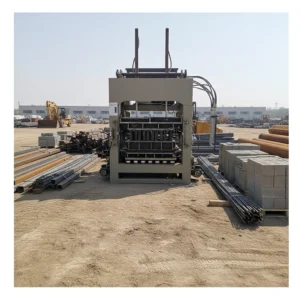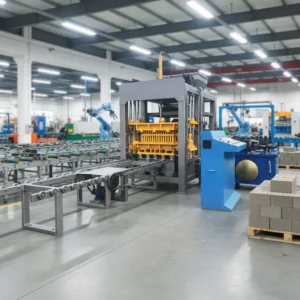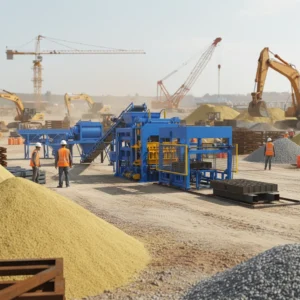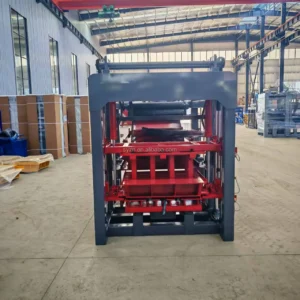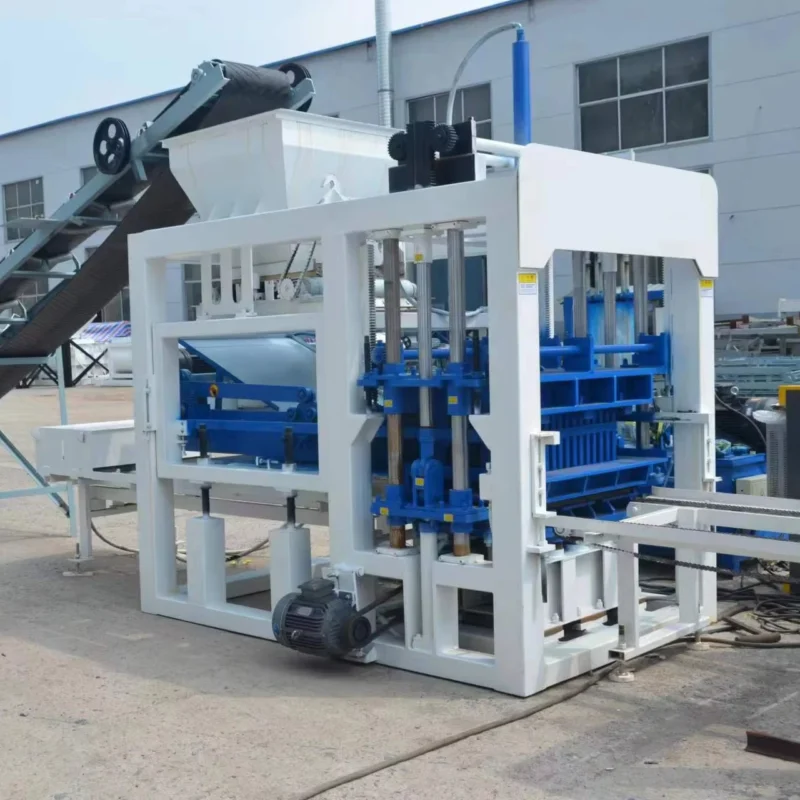
Unified Line Synchronization — every station from the PLD1200 batching hopper through the JS500 mixer to the QT6-15 press and SY-4 stacker is calculated against the same 15-second molding cycle so the block making machine production line never starves for material or pallets.
Technical Specifications
| Parameter | Value |
|---|---|
| Model | QT6-15 |
| Product Type | Automatic Block Making Machine |
| Host Machine Dimensions | 5870 × 2220 × 2850 mm |
| Host Machine Weight | 5.5 Tons |
| Molding Area | 1050 × 500 mm |
| Molding Period | 15 Seconds |
| Vibration Force | 55 KN |
| Vibration Method | Hydraulic + Platform Vibration |
| Vibration Frequency | 2800–4500 Times/Minute |
| Pallet Size | 1100 × 550 × 25 mm |
| Host Machine Power | 31.5 kW |
| Voltage | 220/380/415/440 V (Customized) |
| Control System | Siemens PLC with independently developed control program |
| Motor | Germany SIEMENS or CE standard brand |
| Travel Switch | France Schneider / Japan Omron |
| Mould Treatment | Heat treatment + carburizing, 54–58 HRC, lifespan over 100,000 cycles |
| Batching Machine | PLD1200, 1200L weigh-batching hopper, 4 × 2.5 m³ storage, 56 m³/h theoretical productivity |
| Concrete Mixer | JS500, 800L charging / 500L discharging, 25 m³/h capacity, 18.5 kW motor |
| Stacker | SY-4 mobile pallet stack, 3 kW, 600 kg |
| Workshop Area | 200 ㎡ |
| Standards | CE |
Application Suitability
| Application | Material or Output |
|---|---|
| Hollow block production | Crushed stone, sand, cement, fly ash aggregate blends |
| Interlocking brick production | Graded sand and cement with pigment additives |
| Paving brick production | High-density aggregate mixes with fine sand |
| Solid block production | Coarse aggregate and cement for load-bearing walls |
| Construction materials manufacturing | Multiple format changes within a single shift |
Why a Block Making Machine Production Line Fails Before the Press Even Starts
Most output losses trace back to stations upstream and downstream of the press, not the press itself.
When the JS500 mixer discharges 500 L per batch but the press cycle demands material every 15 seconds, a gap opens between what the host machine can form and what the mixer can deliver. I once configured a line for a West African buyer where the mixer ran noticeably slower than the press cadence. The press sat idle between cycles, and the buyer spent two months chasing an output figure the line was never set up to reach. A block making machine production line must be calculated station by station, not quoted as a single headline number [NEED_CITE: concrete batch plant throughput matching guidelines].
Raw Material Feeding and Batching as the Line’s First Beat
The PLD1200 batching machine holds four compartments of 2.5 m³ each and weighs each ingredient to ±2 % precision before discharge. Its theoretical productivity of 56 m³/h is deliberately set above the JS500 mixer’s 25 m³/h capacity, so the mixer is never left waiting for a weighed batch. This headroom keeps the entire block making machine production line feeding forward rather than stalling at the first transfer point.
Mixer-to-Press Handoff and Cycle Matching
The JS500 mixer discharges 500 L of mixed concrete per batch. Against the QT6-15’s 15-second molding period, the mixer must complete a full charge, mix, and discharge within the window that keeps the press hopper replenished. If the mixer motor’s 18.5 kW output or the mixing time is set too conservatively, the press begins each cycle with a partially filled feed box, which reduces vibration compaction consistency across the pallet. The Siemens PLC program coordinates the timing signals between the mixer gate and the press feeder to close that gap [NEED_CITE: PLC synchronization in concrete block lines].
Stacking and Pallet Return Loop
The SY-4 mobile pallet stacker lifts finished pallets off the press exit conveyor and stacks them for transport to the curing area. Without this station, operators hand-stack every pallet, which limits how fast the press can release its next mold. The stacker’s 3 kW drive and 600 kg capacity are matched to the loaded pallet weight at 1100 × 550 × 25 mm, ensuring the press pallet return loop keeps pace with the 15-second cycle.
Reading the Spec Sheet Against Your Actual Product
The vibration force of 55 KN and the hydraulic-plus-platform vibration method together determine the density and compressive strength of each block. Higher frequency settings within the 2800–4500 range are better suited to fine-sand mixes used in paving bricks, while coarser aggregate blends for hollow blocks benefit from lower frequency and higher amplitude. The 1050 × 500 mm molding area defines how many blocks fit per pallet, and the pallet size must match both the press table and the curing racks already on site. Mould carburizing to 54–58 HRC extends the interval between mould swaps, which directly affects how much format flexibility the line delivers during a working shift [NEED_CITE: heat treatment standards for concrete mould steels].
What Happens When Stations Are Specified in Isolation
If the pallet size is chosen without checking the buyer’s existing forklift fork width or curing rack spacing, the entire output has to be re-stacked manually at the curing area, cancelling the benefit of the SY-4 stacker. Likewise, specifying a batching machine with fewer compartments forces the buyer to pre-mix certain aggregates off-line, adding a handling step that was never in the production plan. These mismatches surface only after commissioning, when the line is already installed and the buyer has committed to a production schedule.
Why Buyers Source the Whole Line from One Configuration Point
Block machinery is the single focus here, so the QT6-15 press, PLD1200 batcher, JS500 mixer, and SY-4 stacker are specified as one matched system rather than assembled from separate suppliers. Configuration is set against the buyer’s actual mix design and local aggregate, not a catalogue default. Mould design covers every format the buyer’s market sells, including custom drawings. Automation level is selectable, letting a buyer start with semi-automatic pallet handling and move to full stacking later. Installation support includes operator training on the Siemens PLC program that coordinates the entire line [NEED_CITE: CE machinery directive compliance documentation].
Documentation & Verification
- Line layout and capacity calculation stating the block format assumed for each station
- Machine specification sheet with pallet size, vibration force, and moulding area confirmed
- Mould drawing and format list matching the buyer’s product range
- Voltage, frequency, and PLC display language confirmation for all line stations
- Factory test record demonstrating synchronized cycle times across batching, mixing, pressing, and stacking
- Operation and maintenance manual with wear parts and mould replacement intervals
Installation, Commissioning & Support
- Foundation plan accounts for the 5870 × 2220 mm host machine footprint and 5.5-ton operating weight
- Dedicated power circuit sized for the 31.5 kW host machine plus 18.5 kW mixer motor
- Equipment ships grouped and is assembled on-site with station spacing verified against the line layout
- First-run parameter setting covers vibration frequency, molding period, and batching precision targets
- Operator training covers Siemens PLC interface, mould change procedure, and SY-4 stacker operation
- Wear parts list includes mould plates rated to 54–58 HRC and hydraulic seals with reorder codes
What to Share When Requesting a Line Proposal
To size a block making machine production line correctly, provide the target block format and daily output requirement, along with the local aggregate types and mix ratios you plan to use. Include the voltage and frequency at your site, the PLC display language preference, and the dimensions of your existing curing area and forklift specifications. If you already operate a batching plant or mixer upstream, share its model and throughput so the new stations can be matched to it.
Frequently Asked Questions
Q: How do you ensure batching and mixing capacity matches the block press cycle time?
A: The PLD1200 batcher is rated at 56 m³/h and the JS500 mixer at 25 m³/h, both calculated against the QT6-15’s 15-second molding period. If the buyer’s target format changes the cycle time, we re-verify each station’s throughput before finalizing the line layout.
Q: Is the pallet size and stacker compatible with my existing curing setup?
A: The standard pallet measures 1100 × 550 × 25 mm and the SY-4 stacker is matched to it. Before shipment, we confirm your curing rack spacing and forklift fork dimensions so the stacked pallets transfer without rehandling.
Q: Which supporting stations are included in the line quotation?
A: The quotation covers the PLD1200 batching machine, JS500 mixer, QT6-15 press, and SY-4 mobile stacker as grouped equipment. Raw material storage silos and curing rack systems are specified separately based on your site conditions.
Q: How are voltage and PLC language confirmed for every station?
A: Voltage is customized to 220/380/415/440 V for the entire line, not just the press. The Siemens PLC display language is confirmed in writing before production so the operator interface matches your team’s language at commissioning.
Q: What workshop footprint does the complete line require?
A: The listed workshop area is 200 ㎡, covering the press, mixer, batcher, and stacker operating zones. The actual layout depends on your raw material storage position and the distance to the curing area, which we map during the proposal stage.