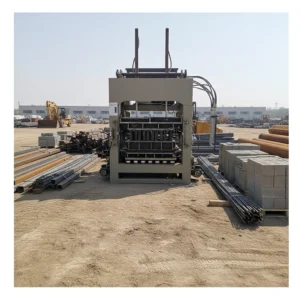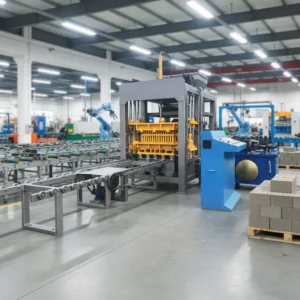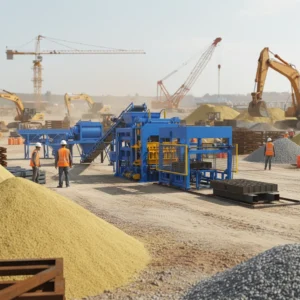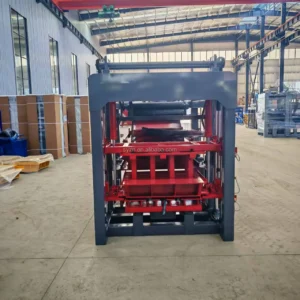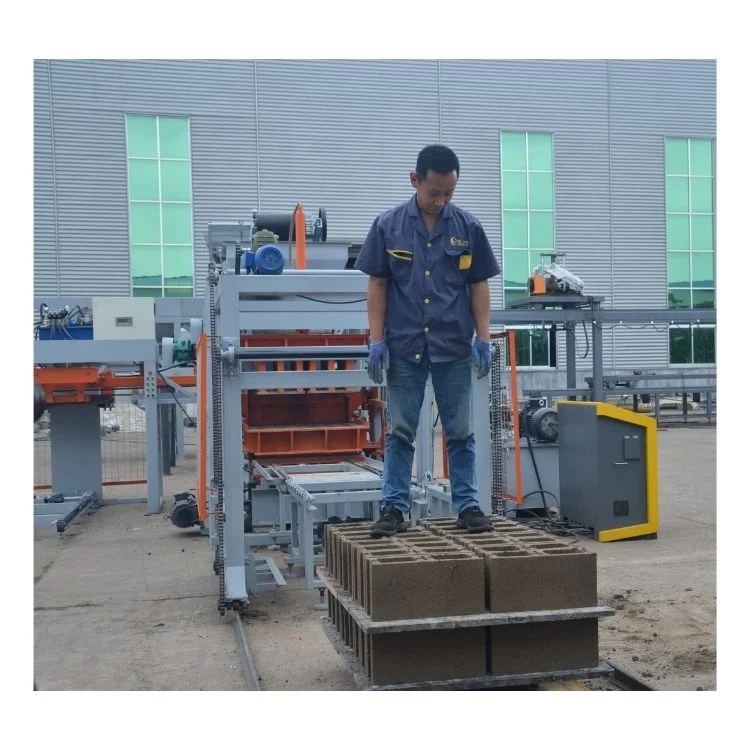
Upstream and downstream stations matched to the press cycle — Every conveyor, mixer discharge, pallet feeder, and stacker in the QT6-15 line is timed so the press completes its 15–20 second molding cycle without waiting on material, pallets, or block removal.
Technical Specifications
| Parameter | Value |
|---|---|
| Model | QT6-15 |
| Product Type | Automatic Hydraulic Block Making Machine |
| Overall Dimensions (L×W×H) | 7350×1780×2950 mm |
| Rated Pressure | 16 MPa |
| Main Vibration | Platform vibration |
| Vibration Frequency | 4600 r/min |
| Pallet Size | 880×700 mm |
| Molding Cycle | 15–20 s |
| Overall Power | 30.5 kW |
| Voltage & Frequency | Configurable to buyer’s site (to be confirmed) |
| Control System | PLC with selectable display language (to be confirmed) |
| Output Capacity – Hollow Block | 8640 pcs/day based on 400×200×200 mm, 6 pcs/mould, 16–20 s cycle |
| Output Capacity – Porous Brick | 22400 pcs/day based on 240×115×90 mm, 14 pcs/mould, 15–18 s cycle |
| Output Capacity – Standard Solid Brick | 54400 pcs/day based on 240×115×53 mm, 30 pcs/mould, 14–17 s cycle |
| Key Features | Hydraulic press with platform vibration, automatic operation, interchangeable moulds, CE / SGS / ISO 9001 certified |
Application Suitability
| Application | Material or Output |
|---|---|
| Hollow block production for building walls | Crushed stone, sand, cement, fly ash |
| Paving stone and kerbstone production | Sand, gravel, cement, industrial slag |
| Porous brick manufacturing | Fly ash, cinder, gangue, cement |
| Interlocking and grass block production | Perlite, slag, cement blends |
| Solid brick output for masonry | Local aggregate, cement, water |
When the Mixer Finishes Before the Press Is Ready
A block production line only runs as fast as its slowest station upstream or downstream of the press.
I have watched a QT6-15 sit idle because the batch mixer dumped a full load every 90 seconds while the press consumed material every 20 seconds, leaving the hopper overflowing and the operator shovelling excess back into the mixer. The block machine production line looked powerful on paper yet delivered half its rated output on site [NEED_CITE: matching mixer discharge rate to press consumption in block plants].
How Each Station Connects to the QT6-15
Raw material feeding, weighing, and mixing form the upstream chain. Each must deliver a fresh batch to the press hopper before the current cycle ends. The block machine production line is specified so the mixer discharge, belt conveyor speed, and hopper level sensor close the loop within the 15–20 second molding window.
Pallet Circulation and Block Removal Downstream
After the press forms a layer of blocks on a pallet, that pallet must move to the curing rack before the next cycle begins. If the pallet feeder or stacker lags, the press holds. The 880×700 mm pallet dimension is chosen to match standard curing rack slots and the forklift the plant already operates, preventing a bottleneck between the press output and the curing area [NEED_CITE: pallet and curing rack dimension coordination in block manufacturing].
Reading the Specs That Actually Govern Output
The 16 MPa rated pressure and 4600 r/min platform vibration work together to compact the mix into a dense block before the mould lifts. Higher vibration frequency shortens compaction time, but only when hydraulic pressure is sufficient to hold the mould head down. The 30.5 kW total power covers the press, mixer motor, pallet conveyor, and hydraulic pump; undersizing any circuit breaker on site causes nuisance trips during peak draw. Pallet size 880×700 mm dictates the block layout per mould and the curing rack grid, so changing pallet dimension later means replacing racks and possibly the forklift forks.
The Cost of Skipping the Line Audit
Buyers who quote the press alone often discover that manual pallet handling adds labour, slows output, and introduces pallet misalignment that chips block edges. A line without an automatic stacker forces workers to lift green blocks by hand, risking breakage before curing. These gaps show up as lost output per shift and higher reject rates, long after the purchase order is signed [NEED_CITE: hidden costs of incomplete block production line quotations].
Why Source the Full Line from One Supplier
The QT6-15 press, pallets, moulds, and handling equipment are specified as one system rather than assembled from separate vendors, so cycle times match across every station. Moulds for hollow, porous, solid, paving, and interlocking formats are designed to the same pallet footprint, cutting changeover steps. Configuration starts from the buyer’s actual mix design and local aggregate, not a catalogue default. Automation level is selectable, allowing a semi-automatic start with a clear path to full stacking and cubing later. Factory testing covers press and supporting stations running together before container loading.
Documentation & Verification
- Line layout drawing showing station positions and material flow for the QT6-15
- Capacity calculation sheet stating the block format assumed for each daily output figure
- Pallet specification matched to buyer’s curing rack dimensions and forklift
- Voltage, frequency, and PLC display language confirmation signed before production
- Factory test record covering press, mixer, pallet feeder, and stacker running together
- Hydraulic and electrical schematic for on-site maintenance reference
Installation, Commissioning & Support
- Foundation plan based on the 7350×1780 mm footprint and 30.5 kW total load
- Dedicated circuit requirement for the hydraulic pump to prevent voltage sag during press stroke
- Machine arrives dismantled; reassembly sequence provided with pallet conveyor alignment checks
- PLC display language set and tested before dispatch to avoid commissioning delays
- Operator training covers mould change procedure and vibration frequency adjustment for different mixes
- Wear parts list with reorder codes for hydraulic seals and vibration motor bearings
What to Share Before Requesting a Quote
Provide the block formats your market sells, the daily output you need per format, and your local raw material source. Confirm site voltage, frequency, and preferred PLC display language. If you already operate curing racks or forklifts, send their dimensions so the 880×700 mm pallet spec is verified against your existing handling equipment.
Frequently Asked Questions
Q: How is daily output calculated for each block format on the line?
A: Each output figure in the specs carries its own premise — block dimensions, pieces per mould, and cycle time. The hollow block figure assumes 400×200×200 mm blocks at 6 per mould with a 16–20 second cycle. Line capacity is then matched so upstream feeding and downstream pallet removal do not interrupt that cycle rate.
Q: Are pallet feeding, stacking, and curing rack handling included?
A: These stations are part of the line quotation when specified together with the QT6-15. The pallet size, stacking method, and curing rack configuration are confirmed during the proposal stage so no station is left to manual handling after arrival.
Q: How do mixing and feeding cycle times match the press?
A: The mixer batch size and belt conveyor speed are calculated against the 15–20 second molding cycle so the hopper never runs empty or overflows. Discharge timing is coordinated during factory testing before shipment.
Q: What electrical and control details must be confirmed first?
A: Site voltage, frequency, and the PLC display language must be locked before production starts. These values affect motor winding, transformer sizing, and the HMI interface, so confirming them early avoids commissioning delays on site.
Q: Is lead time different for a complete line versus the press alone?
A: A complete line includes supporting stations that may require additional fabrication and assembly testing. Lead time for the full configuration is quoted upfront once pallet size, automation level, and mould list are confirmed.