
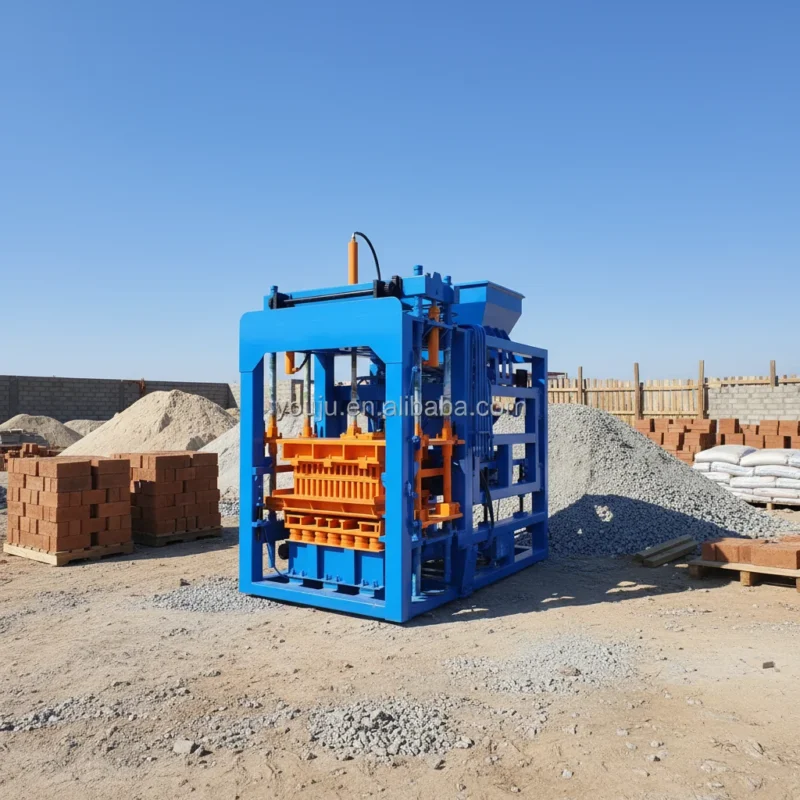
Matched Line Configuration — the QT6-15 press is specified together with feeding, mixing, pallet circulation and stacking stations so that every cycle matches the next without bottleneck.
Technical Specifications
| Parameter | Value |
|---|---|
| Model | QT6-15 |
| Product Type | Stationary Hydraulic Concrete Block Making Machine |
| Overall Dimensions | 7100×1500×3000 mm |
| Net Weight | 8700 kg |
| Overall Power | 31.25 kW |
| Rated Pressure | 21 MPa |
| Main Vibration Form | Platform vibration |
| Vibration Frequency | 4500–5100 r/min |
| Pallet Size | 880×850 mm |
| Molding Cycle | 15–25 s |
| Control System | PLC intelligence control (dialogue between human and machine) |
| Drive Type | Hydraulic drive |
| Automation Level | Fully automatic |
| Raw Material Ratio (cement:sand:stone) | 1:4:5 (cement 8–10%, sand 30–40%, stone 50–60%) |
| Daily Raw Material Consumption | 150–190 T |
| Water Consumption | 3–5% of raw material weight |
| Hollow Block Compressive Strength | 8–10 MPa |
| Solid Brick Compressive Strength | 10–20 MPa |
| Output Capacity | basis to be confirmed per block format |
| Voltage & Frequency | source value — verify against manufacturer catalog |
| PLC Display Language | source value — verify against manufacturer catalog |
Application Suitability
| Application | Material or Output |
|---|---|
| Hollow block production for building construction | Crushed stone, sand, cement with 8–10 MPa target strength |
| Solid brick production for structural masonry | Dense aggregate blend targeting 10–20 MPa compressive strength |
| Medium-to-high capacity block plant | Multi-format concrete products on 880×850 mm pallets |
| On-site contractor production | Local sand and stone mix with cement proportion 8–10% |
Why the Line Stops When the Mixer Cannot Keep Up
A QT6-15 block machine production line only runs as fast as its slowest upstream station.
When I was setting up projects across Southeast Asia, a recurring issue kept appearing: the press would complete its 15–25 s molding cycle, then sit idle because the mixer had not finished the next batch or the pallet return conveyor was still carrying the previous load. The rated cycle time means little when the feeder cannot deliver material in time. In one plant, a standalone QT6-15 was paired with an undersized mixer, and the actual daily tonnage fell to roughly half of what the press could theoretically produce. The bottleneck was never the press itself — it was the surrounding stations that were specified independently [NEED_CITE: typical block line throughput losses from station mismatch].
How Each Station Connects to the Press Cycle
A complete QT6-15 block machine production line balances raw material feeding, mixing, pallet feeding, automatic stacking and curing rack handling so the press never waits. The PLC coordinates mechanism, electricity and hydraulics across stations, triggering the feeder to release material, the mixer to discharge, and the pallet return to advance — all timed to the 15–25 s press window. When any station falls outside that rhythm, the entire line slows to match the slowest link.
Matching Output to the Block Format You Actually Sell
Quoted cycle times assume a specific block size and mix, yet many buyers discover after installation that the format they sell most requires a longer press cycle or a different material feed rate. The QT6-15 press supports replaceable moulds for hollow blocks, solid bricks and pavers, but the realistic daily output shifts with each format change. A line configured around one format will underperform if the buyer switches to a heavier or thicker product without adjusting the upstream batching ratio or the downstream stacking speed [NEED_CITE: block format impact on cycle time and daily throughput].
Pressure, Vibration and Mix Design — Why All Three Matter Together
The 21 MPa hydraulic pressure and platform vibration at 4500–5100 r/min work together to compact the concrete mix into a dense, consistent block. Pressure alone cannot achieve uniform density if the vibration frequency is too low for the aggregate size, and vibration alone produces weak blocks if the hydraulic clamp force is insufficient. The raw material ratio of 1:4:5 (cement:sand:stone) is a starting point; local aggregate shape and moisture content shift the water demand, which in turn affects how the mix behaves under pressure. A buyer sourcing angular crushed stone will need a different vibration duration than one using rounded river gravel to reach the same 8–10 MPa hollow block strength. The pallet size of 880×850 mm also determines how many blocks are produced per cycle, and that dimension must align with the curing rack spacing and the forklift fork width already on site.
The Cost of Leaving Pallet Handling and Stacking Out of the Quotation
When pallet feeding, stacking and curing rack handling are treated as optional extras rather than integral stations, the result is a press that produces blocks faster than workers can move them by hand. Pallets pile up in front of the press, wet blocks get damaged during manual transfer, and the curing area becomes a bottleneck. I have seen plants where the press was fully automatic but the output was still stacked manually, cutting real throughput dramatically and increasing breakage rates [NEED_CITE: manual pallet handling losses in concrete block plants].
Why Buyers Source the Full Line from One Supplier
The QT6-15 is specified as the centre of a matched system — machine, mould, pallet and handling equipment are configured together rather than assembled from separate vendors. The configuration is set against the buyer’s actual mix design and local aggregate, not a catalogue default. Mould design covers the formats the buyer’s market actually sells, with custom drawings available for non-standard sizes. The automation level is selectable, so a buyer can begin with semi-automatic pallet handling and upgrade to full automatic stacking and cubing later. Installation and commissioning include operator training so the line runs correctly from the first day.
Documentation & Verification
- Line layout drawing showing station positions and pallet flow path around the QT6-15
- Capacity calculation stating the block format assumed for each output figure
- Hydraulic and electrical schematic matching the shipped control system
- Voltage, frequency and PLC display language confirmation before production
- Factory test record on the buyer’s specified block format and mix ratio
- Wear parts and mould list with replacement part numbers
Installation, Commissioning & Support
- Foundation plan sized for the 7100×1500 mm footprint and 8700 kg operating weight
- Dedicated power circuit matching the 31.25 kW total load and confirmed voltage
- Pallet return conveyor aligned to the 880×850 mm pallet and curing rack height
- PLC language and control parameters verified on site during first startup
- Operator training covering mould change procedure and cycle adjustment per format
- Spare hydraulic seals and vibration motor brushes stocked for first-year maintenance
What to Include in Your Inquiry
To size a QT6-15 block machine production line correctly, share the block formats you sell and the daily volume for each, the local sand and stone type available, and the curing area dimensions you already have or plan to build. Confirm the voltage and frequency at your site along with the preferred PLC display language. If you have existing mixers, forklifts or curing racks, include their specifications so the line can be matched to them rather than replaced.
Frequently Asked Questions
Q: How is the QT6-15 cycle time matched to the upstream mixer and downstream pallet return?
A: The PLC triggers each station in sequence so the mixer discharges, the feeder delivers material, and the pallet return advances within the 15–25 s press window. If the mixer batch size or discharge speed does not align with that cycle, the press waits and daily output drops.
Q: What pallet size is used and how does it relate to my curing racks?
A: The standard pallet is 880×850 mm. That dimension determines how many blocks are pressed per cycle and must match the spacing of your curing racks and the fork width of your existing forklift to avoid double-handling.
Q: Which stations are included in the quotation and which are left to me?
A: Raw material feeding, mixing, pallet feeding, stacking and curing rack handling can all be included. Confirming this before order avoids a situation where the press arrives but pallets and stacking are still handled manually on site.
Q: How do I confirm voltage, frequency and PLC language before shipment?
A: Provide your site electrical specification and preferred control language during inquiry. A written confirmation is issued before production so the QT6-15 block machine production line arrives ready to commission without electrical rework.
Q: Can I start semi-automatic and add full automatic stacking later?
A: Yes. The line can be specified with semi-automatic pallet handling initially, and the stacking and cubing stations can be added later. The PLC architecture supports this upgrade path without replacing the press or control cabinet.


