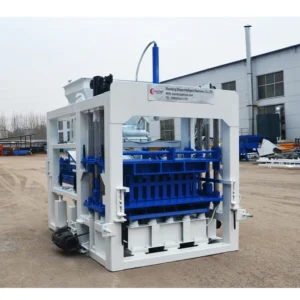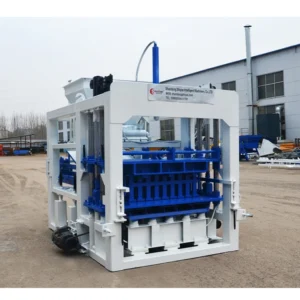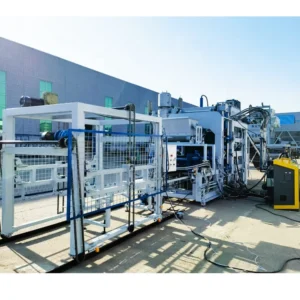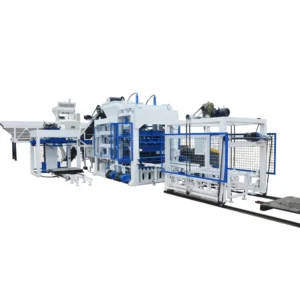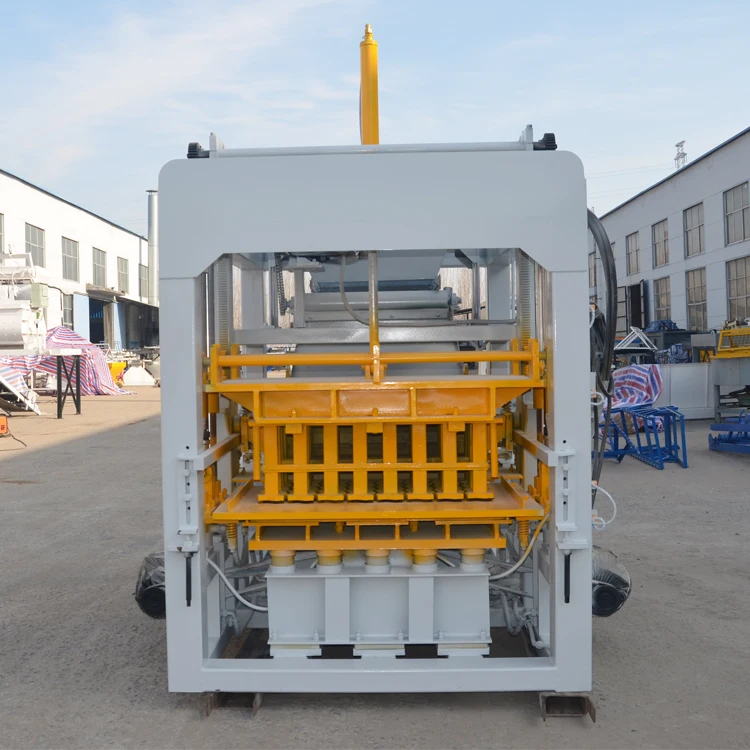
Line synchronization — every station from PLD1200 batching through JS500 mixing to the SY-4 stacker is timed against the QT5-15 press cycle so material and pallets flow without idle gaps.
Technical Specifications
| Parameter | Value |
|---|---|
| Model | QT5-15 |
| Product Type | Automatic Concrete Block Making Machine |
| Host Machine Dimensions | 5870 × 2220 × 2850 mm |
| Host Machine Weight | 5.5 Tons |
| Molding Area | 1050 × 500 mm |
| Pallet Size | 1100 × 550 × 25 mm |
| Vibration Force | 55 kN |
| Vibration Method | Hydraulic + Platform Vibration |
| Vibration Frequency | 2800–4500 times/min |
| Molding Period | 15 seconds |
| Host Machine Power | 31.5 kW |
| Control System | Siemens PLC with custom control program |
| Motor | Germany Siemens or CE standard brand |
| Travel Switch | France Schneider / Japan Omron |
| Mould Hardness | 54–58 HRC (heat treatment + carburizing) |
| Voltage | 220 / 380 / 415 / 440 V (Customized) |
| Batching Machine | PLD1200, 3-bin, 1200 L hopper, ±2% precision |
| Mixer | JS500, 500 L discharge, 25 m³/h (basis to be confirmed) |
| Stacker | SY-4 mobile pallet stack, 3 kW |
| Automation Level | Full automatic |
| Standards | CE |
Application Suitability
| Application | Material or Output |
|---|---|
| Hollow block production for building walls | Crushed stone, sand, cement, fly ash |
| Paving brick manufacturing for roads and yards | Aggregate, cement, pigment additives |
| Interlocking brick for retaining walls | Local sand, gravel, cement blends |
| Solid block for load-bearing structures | Dense aggregate, cement, water |
| On-site block production for housing projects | Project-specific mix designs using available local materials |
Why Your Block Line Throughput Drops After the First Mould Change
An automatic block making machine production line only delivers its quoted capacity when every station keeps pace across every format you run.
Sellers often quote cycle times on a single ideal block — typically the smallest, lightest format in the catalogue. The moment you switch to a heavier paver or a thicker hollow block, the mixer may not discharge fast enough, the batching bins may not replenish between cycles, or the stacker may not clear pallets quickly enough. I have walked onto sites where the press sat idle for minutes between strokes because one upstream or downstream station could not keep up, and the operator had no idea the line was supposed to run continuously. [NEED_CITE: line synchronization requirements in block production]
How Each Station Connects to the Press Cycle
The PLD1200 batching machine feeds three aggregate species with ±2% ingredient precision into the JS500 mixer, and the combined material flow is calculated against the press stroke interval. When the 15-second molding period is the governing rhythm, the mixer must discharge a full batch before the next cycle begins, and the batching hoppers must refill before the mixer calls for the next charge. This is the core principle behind a properly engineered automatic block making machine production line — every station sized so that no single link dictates the pace.
Pallet Flow and Stacking as Part of the Line, Not an Afterthought
The SY-4 mobile pallet stacker is included in the line specification because leaving pallet handling to manual labor creates a bottleneck that cancels out the press speed. The stacker collects finished blocks on pallets and moves them to the curing area, clearing the return conveyor for the next press stroke. When pallet size — here 1100 × 550 × 25 mm — is chosen to match the buyer’s existing curing racks and forklift capacity, the entire flow from press to curing runs without transfer delays. [NEED_CITE: pallet handling impact on block line throughput]
What the Specs Mean on the Factory Floor
The 55 kN vibration force combined with hydraulic pressure determines how densely the mix is compacted inside the mould, and density directly governs block strength and surface finish. Adjustable vibration frequency from 2800 to 4500 cycles per minute allows the operator to match the vibration profile to the aggregate size and cement content in the local mix. The Siemens PLC coordinates batching weight, mixer discharge timing, press cycle, and stacker movement as a single sequence, so changing a mould does not require recalibrating every station manually. Carbon dioxide protection welding on the frame maintains structural rigidity under continuous vibration loading, which matters when the machine runs multiple shifts per day.
The Hidden Cost of Buying the Press Alone
I once worked with a buyer who purchased a QT5-15 host machine without specifying the batching, mixing, and stacking stations as a matched set. The press ran fine in the factory test, but on site the stand-alone mixer could not keep up with the press rhythm, and pallets piled up at the exit with no stacker to clear them. The result was a line that ran at roughly half its potential output for the first three months while the buyer sourced and installed additional equipment. Mismatched stations do not just slow production — they force operators into manual workarounds that introduce inconsistency into block weight and strength. [NEED_CITE: block line bottleneck case study]
Why Source the Full Line Here
Block machinery is the sole focus of this operation, which means the press, mould, pallet, and handling equipment are specified as one coordinated system rather than assembled from unrelated suppliers. Configuration is set against your actual mix design, local aggregate, and target block format — not pulled from a catalogue default. Mould design covers every format your market sells, including custom drawings for non-standard shapes. The automation level is selectable, so a buyer can begin with semi-automatic pallet handling and add the stacker and cubing system later. Installation support includes operator training at your site so the team understands how station synchronization works in practice.
Documentation & Verification
- Line layout drawing with station-by-station cycle time for the QT5-15
- Capacity calculation stating exact block format and mix assumptions
- Voltage, frequency, and PLC display language confirmed in writing
- Factory test record on your specified pallet size and mould set
- Hydraulic and electrical schematic for on-site maintenance reference
Installation, Commissioning & Support
- Foundation plan matching the 5870 × 2220 mm host machine footprint and vibration load
- Electrical supply verified for the chosen voltage from 220 V to 440 V before dispatch
- PLD1200 batching machine positioned to feed JS500 mixer within the line flow path
- Siemens PLC parameters set to your block format during on-site commissioning
- Operator training covering mould change procedure and cycle time adjustment
- Wear parts list with mould lifespan reference for first reorder planning
What to Share When Requesting a Line Proposal
To size an automatic block making machine production line correctly, provide the block formats you intend to produce with dimensions and wall thickness, the aggregate and cement sources available locally, and the daily output target per format. Confirm your site voltage and frequency, the PLC display language your operators require, and the curing rack and forklift specifications already on site so pallet dimensions can be matched. If you have existing batching or mixing equipment, share the model and capacity so the line can be designed around it.
Frequently Asked Questions
Q: How is the daily output of this line calculated, and which block format is it based on?
A: Output is calculated per block format using the 15-second molding cycle, the mould cavity count for that format, and the number of operating hours. The proposal states the exact block dimensions and wall thickness assumed, so you can verify the figure against your own shift plan rather than relying on a single generic capacity number.
Q: What happens to line throughput when I change moulds for a different block format?
A: Each format has its own cycle time and cavity count, so throughput shifts accordingly. The PLC stores parameters for each mould, and the batching and mixer discharge rates adjust to match. The line proposal includes a format-by-format capacity table so you can plan production schedules around actual numbers.
Q: How are the batching machine, mixer, and press cycle times synchronized?
A: The Siemens PLC sequences the PLD1200 batching charge, JS500 mixer discharge, and QT5-15 press stroke as one coordinated cycle. Each station’s timing window is calculated so material arrives before the press needs it, and the stacker clears pallets before the next stroke. No station waits on another.
Q: Is the pallet size fixed, or can the line work with my existing curing setup?
A: The standard pallet is 1100 × 550 × 25 mm, but the line can be configured around your existing curing racks and forklift capacity. Confirming pallet dimensions early prevents a situation where finished blocks cannot be moved to curing efficiently after the press produces them.
Q: What voltage and PLC language options are confirmed before shipment?
A: Voltage is configurable across 220, 380, 415, and 440 V at your required frequency. The PLC display language is confirmed in writing before production begins so operators can read the interface from day one, avoiding commissioning delays caused by language mismatches on site.