
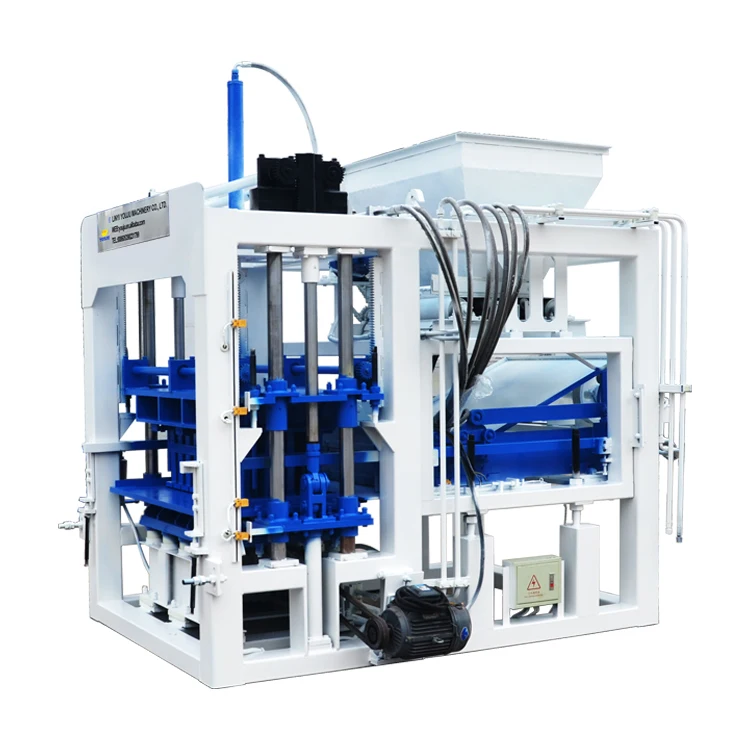
Stationary Block Machine — the QT5-15 is engineered as the centerpiece of a synchronized production line where raw material feeding, mixing, pallet circulation, and stacking must all align with its 15–20 second cycle time so the press never sits idle.
Technical Specifications
| Parameter | Value |
|---|---|
| Model | QT5-15 |
| Product Type | Automatic Hydraulic Concrete Block Making Machine |
| Overall Dimensions (L×W×H) | 7400 × 1950 × 2800 mm |
| Rated Pressure | 21 MPa |
| Main Vibration Form | Hydraulic platform vibration |
| Vibrating Frequency | 2800–4500 rolls/minute |
| Cycle Time | 15–20 seconds (basis not stated in source — confirm block format / material / thickness) |
| Motors Power | 26.5 kW |
| Pallet Size | 1100 × 550 mm |
| Net Weight | 6 T |
| Voltage | Configurable to buyer needs (voltage & frequency to be confirmed before production) |
| Control System | PLC with fault diagnosis and remote monitoring capability |
| Automation Level | Fully automatic |
| Assembly State | Stationary |
| Warranty | 1 year for the whole machine |
Application Suitability
| Application | Material or Output |
|---|---|
| Hollow block production | Crushed stone, cement, sand, fly ash |
| Multicellular brick production | Cementitious mixes with lightweight aggregates |
| Paving brick production | High-density concrete mixes with fine aggregates |
| Standard solid brick production | Standard concrete mixes with local sand and gravel |
| On-site construction block production | Locally sourced aggregates matched to site mix designs |
What the "Automatic Block Making Machine Production Line" Label Often Misses
A press rated for 15–20 seconds per cycle only delivers that speed when every upstream and downstream station keeps pace.
Many buyers receive a quotation listing a cycle time without knowing which block format or material thickness that figure assumes. When the mixer discharges slower than the press cycles, the QT5-15 sits waiting for material, and daily output drops noticeably below the quoted figure. I have seen lines where the press was ready every eighteen seconds but the mixer needed forty seconds per batch, cutting actual throughput nearly in half. [NEED_CITE: common causes of output shortfall in block production lines] The automatic block making machine production line only performs when raw material feeding, mixing, pallet circulation, stacking, and curing rack handling are specified as one matched system rather than assembled from separate suppliers.
How Line Stations Must Align Around the Press
The QT5-15 operates as a stationary unit within a broader production sequence. Raw material feeding must deliver batches to the mixer at intervals that match the press cycle, and the mixer discharge must complete before the next mould is ready to fill. If any station upstream runs slower, the press idles. Downstream, the automatic stacking and pallet return system must clear finished blocks and return empty pallets within the same window. When planning a complete block production setup, each station’s capacity should be calculated against the press cycle, not treated as an independent figure.
Where Supporting Equipment Fits in the Quotation
Supporting equipment — raw material feeding hoppers, mixers, pallet feeders, stacking systems, curing rack handling, and cubing stations — is sometimes excluded from the initial quotation and added later as a cost surprise. A fully integrated automatic block making machine production line includes these stations from the start. [NEED_CITE: typical scope boundaries in block line quotations] When pallet handling and stacking are left out, the buyer must staff manual labour to move and stack blocks after the press, negating much of the automation investment. Confirming the full scope before ordering prevents downstream bottlenecks and unexpected labour costs.
Reading the Specifications That Actually Matter
The rated pressure of 21 MPa combined with hydraulic platform vibration at 2800–4500 rolls per minute determines how densely the concrete is compacted in each mould. Higher vibration frequency during compaction produces denser blocks with greater compressive strength, while lower frequency during material feeding allows the mix to flow evenly into the mould cavity before full compaction begins. The pallet size of 1100 × 550 mm must be coordinated with the dimensions of the buyer’s existing curing area and forklift fleet — ordering pallets that do not fit the curing racks or the forklift tines already on site creates a handling problem from day one. The 26.5 kW motor power rating indicates the electrical supply needed; the buyer must confirm voltage and frequency with the manufacturer before production begins so the motor and PLC are wound and programmed for the correct supply.
The Hidden Cost of Mismatched Line Components
When a buyer sources the press from one supplier and the mixer, pallet feeder, and stacker from others, the cycle times rarely align without modification. I have seen situations where the pallet feeder could not return pallets fast enough, causing the press to pause every third or fourth cycle. [NEED_CITE: integration challenges when sourcing line components separately] These pauses are not captured in the quoted cycle time. The buyer ends up with a line that technically runs but produces well below the expected daily volume, and the cost of retrofitting or replacing mismatched stations often exceeds what a unified quotation would have included.
Why Buyers Source the Full Line Here
Block machinery is the single focus, so the QT5-15 press, moulds, pallets, and handling equipment are specified as one matched system. Configuration is set against the buyer’s actual mix design and local aggregate, not a catalogue default. Mould design covers the formats the buyer’s market actually sells, with custom drawings available for non-standard sizes. The automation level is selectable, so a buyer can start with semi-automatic pallet handling and upgrade to full stacking and cubing later. Installation and commissioning support includes operator training so the line runs correctly from the first day.
Documentation & Verification
- Line layout and capacity calculation stating the exact block format assumed for each output figure
- Machine specification sheet with voltage and frequency confirmation before production
- Mould drawing and format list matching the buyer’s target block dimensions
- Pallet specification coordinated with curing area dimensions and forklift fleet
- Hydraulic and electrical schematic for maintenance reference
- Factory test record on the buyer’s specified block format before dispatch
Installation, Commissioning & Support
- Foundation must support the 6 T net weight and 7400 mm length with level tolerance for the stationary press frame
- Dedicated electrical circuit sized for the 26.5 kW motor load with confirmed voltage and frequency before wiring
- Machine arrives partially dismantled for container loading and requires on-site reassembly of the vibration platform and hydraulic system
- PLC control language confirmed before production so operators can read fault diagnosis messages in their working language
- Operator training covers mould change procedures, cycle time adjustment, and daily maintenance of hydraulic and vibration components
- Wear parts list provided at delivery so first replacement orders can be placed before stock runs out
Before You Send an Inquiry
Provide the block formats you plan to produce, your target daily output, and the raw materials available locally so the line can be configured around your actual mix design. Include your workshop dimensions and ceiling height so the layout accounts for curing rack placement and pallet circulation space. Specify your local voltage, frequency, and preferred PLC display language to avoid commissioning delays after the automatic block making machine production line arrives on site.
Frequently Asked Questions
Q: How is daily output verified across different block formats, and what happens when switching moulds?
A: Each output figure is calculated against a specific block format and mould cavity count. For example, 23,040–28,800 pieces per 8-hour shift assumes 240×115×90 mm solid bricks at 16 pieces per mould. Switching to a different format changes both the cavity count and cycle time, so the line layout document states output for every format included in the quotation.
Q: How do I ensure upstream and downstream stations match the press cycle time?
A: The line layout specifies each station’s capacity relative to the QT5-15 cycle time. The mixer discharge rate, pallet feeder return speed, and stacking system clearance time are all calculated so no station forces the press to wait. This matching is confirmed in the proposal before production begins.
Q: What supporting equipment is included in the quotation versus quoted separately?
A: Raw material feeding, mixing, pallet feeding, automatic stacking, curing rack handling, and cubing can all be included in a single line quotation. The scope is stated explicitly so there are no manual handling surprises after delivery. Any excluded items are listed clearly for buyer decision.
Q: How is pallet size selected to work with my existing curing area and forklift fleet?
A: The standard 1100 × 550 mm pallet is checked against your curing rack spacing and forklift tine width during the proposal stage. If your existing equipment requires a different dimension, pallet size is adjusted before the line is finalized so blocks move from press to curing without handling incompatibilities.
Q: What voltage, frequency, and PLC language options are available, and when must they be confirmed?
A: Voltage and frequency are configured to match the buyer’s local power supply, and the PLC display language is set to the operator’s working language. All three must be confirmed before production starts so the motor winding, control panel, and software are correct at delivery. [NEED_CITE: voltage and frequency standards by export market]


