
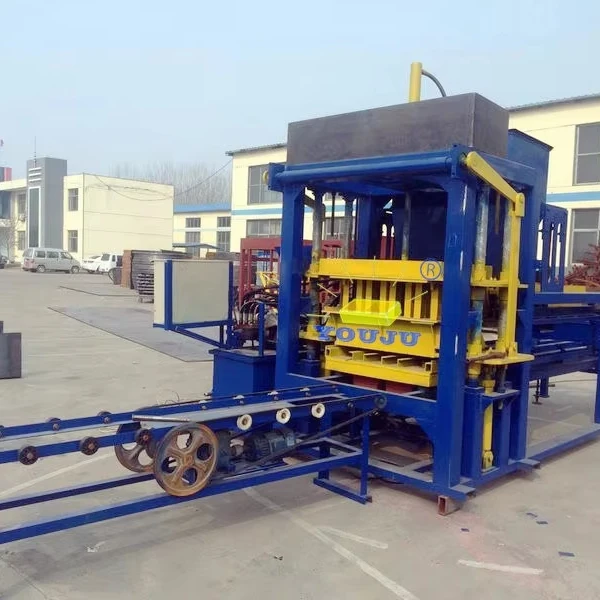
Line-Wide Cycle Synchronization — every station from raw material feeding to the pallet return on this QT4-20 line is specified against the press cycle time so the host machine never sits idle waiting for boards or fresh mix.
Technical Specifications
| Parameter | Value |
|---|---|
| Model | QT4-20 |
| Product Type | Stationary Hydraulic Block Making Machine |
| Overall Dimensions (L×W×H) | 7100×1600×2610 mm |
| Molding Area | 400×800 mm |
| Pallet Size | 1020×570 mm |
| Rated Hydraulic Pressure | 16-21 MPa |
| Vibration Frequency | 4600 r/min |
| Vibration Force | 40 kN |
| Main Vibration Form | Platform Vibration |
| Molding Cycle | 15-25 s |
| Demolding Method | Hydraulic |
| Overall Power | 27.5 kW |
| Total Mass | 5 T |
| Recommended Factory Area | 500 m² |
| Output – Hollow Block 400×200×200 mm | 7200-9600 pcs/day (4 pcs/mold, 15-20 s cycle) |
| Output – Porous Brick 240×115×90 mm | 20200-26800 pcs/day (14 pcs/mold, 15-20 s cycle) |
| Output – Standard Brick 240×115×53 mm | 47400-53700 pcs/day (28 pcs/mold, 15-17 s cycle) |
| Control System | PLC (brand and language options basis to be confirmed) |
| Voltage & Frequency | Basis to be confirmed |
| Automation Level | Basis to be confirmed |
| Mould Change Time | Basis to be confirmed |
| Certification | CE |
Application Suitability
| Application | Material or Output |
|---|---|
| Block and paver production plants | Hollow and solid blocks from crushed stone, sand and cement |
| On-site construction production | Standard bricks from locally available gravel and fly ash |
| Format expansion for existing manufacturers | Porous bricks and interlocking pavers using slag or dust blends |
| First-time block plant setups | Full product range using site-sourced aggregate and cement |
What a Synchronized stationary block making machine production Line Actually Requires
The press is only as fast as the slowest station feeding it or clearing its output.
A buyer who purchases the QT4-20 without specifying pallet return speed, mixer batch time and stacking capacity will find the host machine waiting forty seconds or more every cycle. Half the nameplate output disappears before the first block leaves the yard. I learned this after watching a line where the pallet return loop was undersized; the press cycled fine in the factory test but lost nearly half its daily volume once installed. Voltage mismatches and unconfirmed PLC languages add further delays at commissioning. [NEED_CITE: CE machinery directive requirements for industrial equipment]
Stations That Must Keep Pace with the Press Cycle
Raw material feeding, the mixer, pallet circulation and stacking each have their own cycle window. If any station exceeds the QT4-20 molding cycle of 15-25 seconds, the press sits idle. A stationary block making machine production line is only as productive as its weakest link, which is why the entire station list must be scoped together rather than assembled from separate quotations.
Where Line Integration Breaks Down First
The pallet return loop is the station most often left out of the initial scope. When pallets are carried back by hand or by an undersized conveyor, the press waits for the next board before it can press again. Mixer discharge timing is another common mismatch — if the mixer batch is too small or the discharge gate too slow, the hopper above the press runs dry mid-cycle. [NEED_CITE: typical block line station synchronization tolerances]
Reading the Specs That Determine Real Daily Output
The 16-21 MPa hydraulic pressure combined with platform vibration at 4600 r/min and 40 kN vibration force is what compresses the mix into a dense, consistent block. Pressure alone produces a weak block; vibration alone produces a crumbly one. The two forces must be matched to the buyer’s actual mix design and local aggregate gradation. The 1020×570 mm pallet size determines how many blocks fit per board and therefore how many boards must circulate through the curing area each shift. If the curing racks and forklifts on site were chosen for a different pallet dimension, the entire handling flow must be reworked. The 400×800 mm molding area sets the maximum format envelope — any mould that exceeds this area will not fit, and formats that use less area leave capacity on the table. The recommended 500 m² factory area covers the press, raw material storage, curing zone and pallet circulation, not just the machine footprint.
The Cost of Skipping Line-Level Specification
When pallet handling, stacking and curing are treated as afterthoughts, the buyer ends up stacking blocks by hand beside the press. Labour cost climbs, breakage rises, and the daily output never reaches the figures quoted in the proposal. A line configured for a mix the buyer cannot source locally forces a material change that may require new mould tooling. Unconfirmed voltage and PLC display language delay commissioning by weeks. [NEED_CITE: voltage and frequency standards by export market]
Why the Line Is Specified as One Matched System
Block machinery is the single focus here, so the QT4-20 press, moulds, pallets and handling equipment are specified as one matched set rather than assembled from separate suppliers. The configuration is built around the buyer’s actual mix design and target block format, not a catalogue default. Mould design covers the formats the buyer’s market sells, including custom drawings. Automation level is selectable, allowing a semi-automatic start with a clear upgrade path. Installation and commissioning include operator training so the line runs correctly from the first shift.
Documentation & Verification
- Line layout and capacity calculation stating the block format assumed for each output figure
- Machine specification sheet with hydraulic pressure and vibration force matched to the agreed mix
- Mould drawing and format list confirming every block type the QT4-20 will produce
- Pallet specification aligned with the buyer’s existing curing racks and forklift capacity
- Hydraulic and electrical schematic so the site electrician can prepare before arrival
- Factory test record documenting cycle time and block density per format before dispatch
Installation, Commissioning & Support
- 500 m² factory area preparation including level concrete floor and drainage for the QT4-20 footprint
- Dedicated power circuit sized for the 27.5 kW total load with confirmed voltage and frequency
- Machine arrives dismantled; reassembly covers press frame, vibration table and hydraulic unit
- First-run commissioning verifies molding cycle, hydraulic pressure and vibration frequency on the buyer’s mix
- Operator training covers PLC navigation, mould change procedure and daily greasing points
- Wear parts list and mould inventory provided so first replacements are on site before needed
What to Include in Your Inquiry
Provide the block formats you plan to produce, the target daily output per format, and the raw materials available locally including aggregate gradation. Confirm your site voltage, frequency and preferred PLC display language. Share the dimensions of your curing area and the forklift capacity you have on site so pallet size and circulation can be matched from the start.
Frequently Asked Questions
Q: How is daily output calculated for each block format on the QT4-20?
A: Output figures are based on a specific block size, mould cavity count and cycle time. For example, 7200-9600 hollow blocks per day assumes four cavities per mould and a 15-20 second cycle. Every station upstream and downstream — mixer, pallet return, stacker — must complete its task within that same cycle window, or the press waits and actual output drops.
Q: What mixer and feeding setup prevents the press from waiting for material?
A: The mixer must discharge a full batch into the press hopper before the current batch is consumed. Batch volume, discharge gate speed and conveyor length all affect this timing. If the mixer is undersized or too far from the press, the hopper runs dry mid-cycle and the press idles.
Q: Are pallet feeding, stacking and curing rack handling included in the quotation?
A: These stations must be specified explicitly. If they are not listed in the scope of supply, the buyer is responsible for sourcing them separately. Leaving them out means blocks are stacked by hand beside the press, which cuts real daily output and raises labour cost.
Q: How does the 1020×570 mm pallet size affect my curing area layout?
A: Pallet dimensions determine rack spacing, forklift tine width and the number of pallets that fit in a curing zone. If existing racks or forklifts were chosen for a different pallet size, either the pallets or the handling equipment must change. Confirming this early avoids costly rework after the line arrives.
Q: What electrical details must be confirmed before the QT4-20 ships?
A: Voltage, frequency, phase and PLC display language must all be agreed before production begins. A machine wired for the wrong supply cannot be commissioned on arrival, and a PLC menu in an unreadable language slows every adjustment the operator needs to make.


