
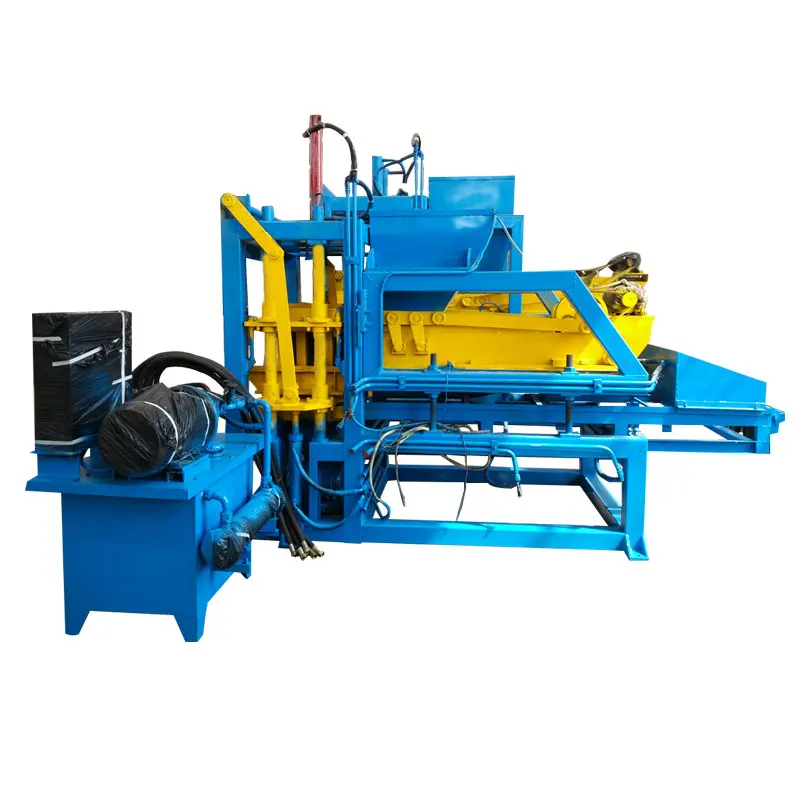
Matched System Sizing — Mixer output, pallet return speed, and stacker cycle are balanced to the QT4-20’s 15-25 s molding window so upstream and downstream stations never force the press to idle.
Technical Specifications
| Parameter | Value |
|---|---|
| Model | QT4-20 |
| Product Type | Hydraulic Concrete Block Making Machine |
| Overall Dimensions (L×W×H) | 7100 × 1600 × 2610 mm |
| Molding Area | 400 × 800 mm |
| Pallet Size | 1020 × 570 mm |
| Main Vibration Form | Platform Vibration |
| Vibration Frequency | 4600 r/min |
| Vibration Force | 40 KN |
| Rated Pressure | 16–21 MPa |
| Molding Cycle | 15–25 s (format dependent) |
| Demolding Method | Hydraulic |
| Overall Power | 27.5 kW |
| Total Mass | 5 T |
| Control System | PLC (Intelligent PLC Controlled) |
| Factory Area Requirement | 500 m² |
| Warranty | One year guarantee for the whole machine |
| Output Capacity (Hollow Brick 400×200×200 mm) | 7200–9600 pcs/day (basis: 4 pcs/mold, 15–20 s cycle) |
| Output Capacity (Porous Brick 240×115×90 mm) | 20200–26800 pcs/day (basis: 14 pcs/mold, 15–20 s cycle) |
| Output Capacity (Standard Brick 240×115×53 mm) | 47400–53700 pcs/day (basis: 28 pcs/mold, 15–17 s cycle) |
Application Suitability
| Application | Material or Output |
|---|---|
| Hollow block production for structural walls | Crushed stone, sand, cement, fly ash, gravel, slag |
| Solid block manufacturing for load-bearing partitions | Local aggregate blended with cement and stone dust |
| Porous brick firing for thermal insulation lines | Clay-free mix designs using industrial by-products |
| Paving brick output for hardstanding and walkways | High-density concrete with fine aggregate gradation |
| On-site contractor block plants | Raw materials sourced within the project region |
What "Cycles per Hour" Leaves Out When the Line Is Not Balanced
A press quoted at its fastest cycle will still underproduce if the mixer cannot discharge or the stacker cannot clear pallets within that same window.
Selling a block production line equipment package based on a single cycles-per-hour figure ignores the stations that feed and clear the press. I have watched plants where the host machine sits idle for seconds per cycle because the mixer batch is not ready or the pallet return conveyor is still clearing the previous board. The daily shortfall adds up quickly across a full shift. [NEED_CITE: mismatched line station cycle times and daily throughput loss]
Line Stations That Must Keep Pace With the Press
The QT4-20 completes a molding cycle in 15 to 25 seconds depending on block format, which sets the tempo for every other station. Raw material feeding must deliver a weighed batch to the mixer in time for the next discharge, pallet feeding must present a clean board before the mold descends, and the stacker must lift and remove the loaded pallet before the next cycle begins. When block production line equipment is specified as individual machines rather than a coordinated set, one slow station turns the press into a bottleneck waiting for support.
Pallet Handling Defines the Real Throughput Ceiling
A 1020 × 570 mm pallet loaded with wet concrete blocks is heavy and fragile until cured. The return conveyor, the lifting fingers on the stacker, and the spacing on the curing rack must all accept that pallet dimension without manual intervention. If the pallet size was chosen without checking the buyer’s existing curing rack slots or forklift tine width, the entire downstream flow stalls at the transfer point. [NEED_CITE: pallet dimension mismatch with curing rack and forklift specifications]
Why Voltage and Control Language Must Be Locked Before Production Starts
The PLC controls every timed movement in the line, from the mixer gate to the stacker clamp. Voltage, frequency, and the display language must match the destination plant before the cabinet is wired, not discovered during commissioning. A language mismatch on the HMI panel means operators cannot read fault codes, and an incorrect voltage supply can trip protection relays or damage motor drives on arrival.
Reading the Specs That Actually Govern Line Balance
Platform vibration at 4600 r/min and hydraulic pressure between 16 and 21 MPa work together to compact the mix into the mold cavity. Higher vibration frequency loosens the aggregate packing while hydraulic pressure forces it into corners, so the two values must be tuned to the buyer’s specific aggregate gradation and cement ratio rather than left at a catalogue default. The 27.5 kW total power rating covers the main press motors; the mixer, conveyor drives, and stacker add their own loads, which must be accounted for when sizing the main supply breaker and dedicated circuits. A molding area of 400 × 800 mm sets the maximum block footprint per cycle, and the pallet size of 1020 × 570 mm leaves clearance around the molded blocks for handling fingers.
The Cost of Treating the Press as a Standalone Purchase
When the host machine arrives without matched upstream and downstream equipment, the plant owner must source mixers, conveyors, and stackers separately and hope the cycle times align. I have seen pallets pile up on the floor beside the press because the stacker was rated for a longer cycle than the press could deliver, forcing manual clearing and negating the automation the buyer paid for. [NEED_CITE: manual pallet clearing after mismatched stacker cycle times]
Why This Line Configuration Works as a Single Package
The QT4-20 is specified with the mixer discharge rate, pallet return speed, and stacker lift cycle calculated against its 15–25 s molding window. Mould design is provided for the block formats the buyer’s market actually sells, and the pallet specification is checked against the curing rack and forklift the buyer already operates. Voltage, frequency, and PLC language are confirmed before the cabinet is built, and the 500 m² factory area requirement is broken down into mixing, pressing, curing, and storage zones so the plant layout is known before foundations are poured.
Documentation & Verification
- Line layout drawing with capacity calculation stated per block format and cycle time
- Hydraulic and electrical schematic for local maintenance team reference
- Voltage, frequency, and PLC display language confirmation sheet signed before production
- Factory test record on the buyer’s target block format before dispatch
- Pallet specification matched to curing rack slot width and forklift tine spacing
Installation, Commissioning & Support
- 500 m² floor area divided into raw material, mixing, pressing, curing, and stacking zones
- 27.5 kW press load plus auxiliary drives sized for a dedicated three-phase supply circuit
- PLC display language and HMI fault codes verified on site during first power-up
- Mould change procedure demonstrated with the buyer’s first production format
- Hydraulic hoses, vibration motor bearings, and pallet guide strips listed with replacement intervals
- Operator training covers mixer batch timing matched to the 15–25 s press cycle
What to Include in Your First Inquiry
Send the block formats your market sells along with the daily output you need per format, the aggregate and cement available locally, your existing curing rack dimensions and forklift model, and the plant voltage and frequency. With that information the full block production line equipment layout can be sized before a quotation is issued.
Frequently Asked Questions
Q: How are mixer output, pallet return speed, and stacker cycle balanced to the press molding window?
A: Each station is timed to complete its task within the QT4-20’s 15–25 second molding cycle. The mixer batch weight is calculated so discharge finishes before the next mold fill, the pallet return conveyor clears the board in time, and the stacker lift-and-remove sequence fits inside the same window.
Q: What pallet size and material should I choose given my existing curing rack and forklift?
A: The standard 1020 × 570 mm pallet must fit the curing rack slot width and the forklift tine spacing at your plant. We confirm both dimensions before quoting, and pallet material is selected based on the block weight and expected curing temperature range.
Q: Is raw material feeding, stacking, and cubing included in the quotation or only the press?
A: The quotation covers the complete block production line equipment set including raw material feeder, mixer, pallet feeder, press, stacker, and curing rack handling when specified. Each station is listed individually so you can see exactly which items are included and which are optional.
Q: How is the 500 m² factory area requirement broken down across zones?
A: The layout allocates space for aggregate storage bins, the mixer platform, the press and pallet return loop, curing rack rows with forklift aisles, and a finished block staging area. The drawing is provided with the proposal so you can verify the footprint fits your site before ordering.


