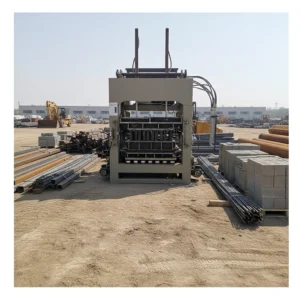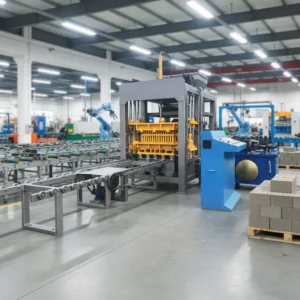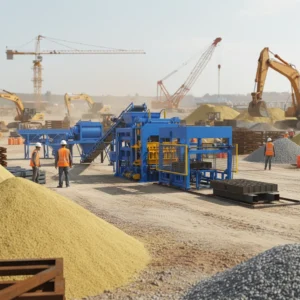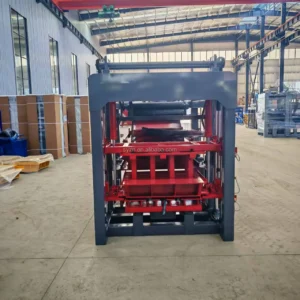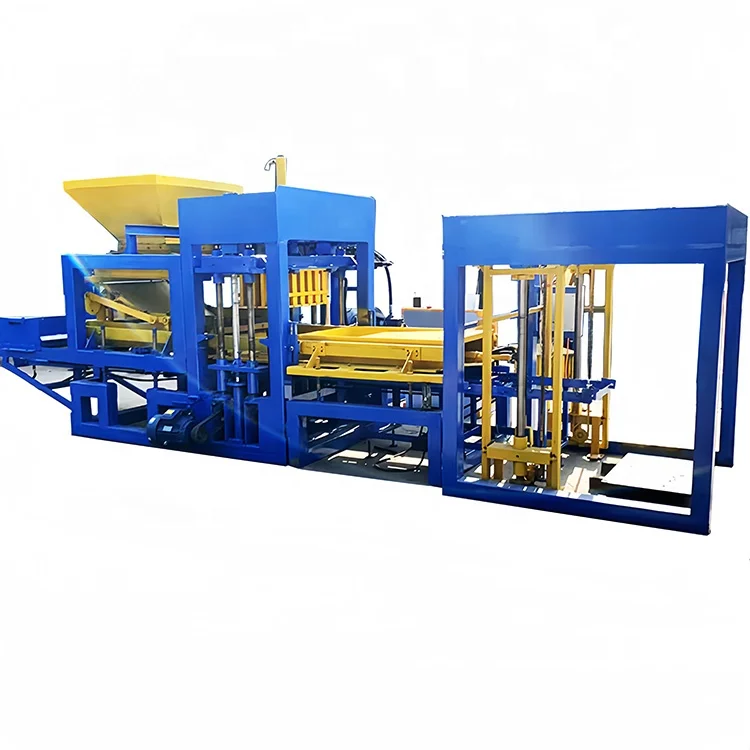
Matched Line Integration — every station from the JQ350 mixer through the brick conveyor is timed against the QT4-18 press cycle so upstream feeding and downstream off-line never force the hydraulic station into idle pauses.
Technical Specifications
| Parameter | Value |
|---|---|
| Model | QT4-18 |
| Product Type | Hydraulic Concrete Block Making Machine |
| Overall Dimensions (L×W×H) | 3900×1600×2300 mm |
| Molding Cycle | 15-25s (basis not stated in source — confirm block format and material) |
| Vibration Force | 40-50 kN |
| Rated Power | 24 kW |
| Mixer Model | JQ350 |
| Pallet Size | 850×550×25 mm |
| Net Weight | 3 T |
| Control System | PLC control system |
| Hydraulic Station | Included |
| Output Capacity (Hollow block 400×200×200mm) | 1200-1680 pcs/hr, 9600-13440 pcs/8hr |
| Output Capacity (Hollow block 400×150×200mm) | 1800-2400 pcs/hr, 14400-19200 pcs/8hr |
| Output Capacity (Solid brick 240×115×53mm) | 3240 pcs/hr, 16200-19440 pcs/8hr |
| Included Equipment | Block making machine, hydraulic station, PLC control system, pallet feeder, brick conveyor, block sweeper |
| Free Accessories | Manual hydraulic trolley, spare parts and tools |
Application Suitability
| Application | Material or Output |
|---|---|
| Hollow block production | Crushed stone, sand, cement, fly ash for structural and partition walls |
| Paver and curbstone forming | Dense aggregate mixes requiring higher vibration and hydraulic pressure |
| Solid brick manufacturing | Fine sand and cement blends for load-bearing masonry |
| On-site contractor production | Mobile batch runs where raw material sourcing varies by project location |
Why Cycle Time Mismatch Kills a Concrete Block Making Machine Production Line
The press is only as fast as the slowest station feeding or clearing it.
I once walked into a plant where the block press sat idle for several seconds each cycle because the manual pallet crew could not keep up. The owner had paid for a high-speed press but was running a manual handling operation around it, and the real daily output fell well short of the catalogue figure. When you evaluate a concrete block making machine production line, the quoted cycles per hour assume every station is ready on time — mixer charged, pallet loaded, conveyor cleared [NEED_CITE: realistic block line throughput assumptions by station coordination]. Without that coordination, the line bottlenecks shift from the press to the surrounding equipment.
How the Stations Connect Around the Press
The QT4-18 line starts with the JQ350 mixer delivering a consistent batch to the press hopper. The pallet feeder places an 850×550 mm pallet into the molding position at the start of each cycle, while the PLC control system coordinates the sequence so the hydraulic station, vibration motor, and pallet movement do not overlap or conflict. This concrete block making machine production line is specified as one unit, meaning the timing between stations is calculated before dispatch rather than adjusted on-site after weeks of trial runs.
Where Manual Handling Still Enters the Workflow
The included manual hydraulic trolley moves stacked pallets from the brick conveyor to the curing area. Sweeping is handled by the block sweeper station on the conveyor, so loose material does not accumulate and interfere with pallet return. Semi-automatic pallet handling at the curing end means you still need operators for off-line movement, but the press-to-conveyor stretch runs continuously. The PLC control system can be confirmed for your local voltage, frequency, and display language before the line leaves the factory, removing a common commissioning delay [NEED_CITE: PLC language and voltage confirmation before export dispatch].
Reading the Numbers Behind the Press Specification
The vibration force of 40-50 kN works together with the hydraulic station to compact the mix inside the mould. Higher vibration alone does not guarantee block strength; the hydraulic pressure must match the stiffness of your specific mix design and local aggregate gradation. The 850×550×25 mm pallet size determines how many blocks fit per cycle and must align with your existing curing rack dimensions and forklift fork width. The 24 kW rated power covers the press, vibration, and hydraulic pump, so your electrical supply must accommodate this draw plus the mixer motor on a separate circuit. Molding cycle is listed as 15-25 seconds, but the actual figure depends on block height, material, and whether you are running hollow blocks, pavers, or solid bricks — each format changes the fill, press, and cure timing.
The Cost of Specifying the Press in Isolation
When a buyer purchases a press without confirming the surrounding stations, the line arrives incomplete. Pallets get loaded by hand, slowing the cycle. The mixer batch size does not match the press hopper capacity, forcing the operator to wait for the next mix. Output stacks on the conveyor with nowhere to go, and blocks cure unevenly because pallets sit in a queue instead of moving to the rack. These problems do not show up in a catalogue photograph [NEED_CITE: common block line commissioning issues from incomplete station specification].
Why This Line Is Supplied as a Coordinated System
Block machinery is the single focus here, so the QT4-18 press, mould, pallet, and handling equipment are specified as one matched system rather than assembled from separate suppliers. Configuration is set against your actual mix design, local aggregate, and target block format instead of a catalogue default. Mould design covers the formats your market sells, and custom drawings are available if your project requires a non-standard block profile. Automation level is selectable, so you can start with the included semi-automatic pallet handling and add automatic stacking later as volume grows. Installation support includes operator training on the full line, not just the press, and wear parts and mould replacements are stocked for ongoing supply.
Documentation & Verification
- Line layout showing station spacing and capacity calculation per block format
- Machine specification sheet with hydraulic and electrical schematics for the full line
- Pallet specification confirming 850×550×25 mm size and material grade
- Voltage, frequency, and PLC display language confirmation record before production
- Factory test record on your target block format with cycle time measurement
- Wear parts and mould list with replacement intervals and part numbers
Installation, Commissioning & Support
- Foundation must support 3 T net weight plus dynamic vibration loads across the 3900×1600 mm footprint
- Dedicated electrical circuit for the 24 kW press and separate circuit for the JQ350 mixer
- Machine ships partially assembled; hydraulic station and PLC panel connect on-site
- First-day commissioning includes cycle timing verification across all line stations
- Operator training covers PLC sequence, mould change procedure, and daily greasing points
- Spare parts kit and manual hydraulic trolley included in the initial shipment
What to Prepare Before Requesting a Quotation
To configure this concrete block making machine production line for your site, share your target block format and required daily output along with a sample of your local raw materials. Confirm your facility voltage and frequency, the language your operators need on the PLC display, and whether your existing curing racks and forklift match the 850×550 mm pallet. If you are replacing a press within an operating line, note which surrounding stations you plan to keep and which need upgrading.
Frequently Asked Questions
Q: How do the line stations synchronize cycle times so the press is not left idle between pallets?
A: The PLC control system sequences the pallet feeder, vibration, hydraulic press, and brick conveyor as one coordinated loop. Each station’s response time is calculated against the QT4-18 molding cycle so the next pallet is in position before the press completes its current block. This prevents the idle pauses that reduce actual daily output below the quoted figure.
Q: What block format is assumed in the quoted pcs/hr, and what is the realistic daily output for my product mix?
A: The output table states capacity per format — 400×200×200 mm hollow block, 400×150×200 mm hollow block, and 240×115×53 mm solid brick — each with its own cycle time. Realistic daily output depends on your specific aggregate, cement ratio, and curing schedule, which we calculate during the configuration stage before quotation.
Q: Is the pallet size matched to my existing curing racks and forklift, or do I need to change handling equipment?
A: The standard pallet is 850×550×25 mm. Before production, we confirm this dimension against your curing rack spacing and forklift fork width. If your existing equipment uses a different pallet size, the line can be configured to match, avoiding the cost of replacing your handling infrastructure.
Q: What is included beyond the press, and what remains manual?
A: The line includes the JQ350 mixer, pallet feeder, brick conveyor, block sweeper, hydraulic station, and PLC control system. Pallet movement from the conveyor to the curing area is handled by the included manual hydraulic trolley, so off-line stacking remains a manual operation at this automation level.
Q: How does raw material feed configuration match my local aggregate and mix design?
A: We ask for your local sand, crushed stone, and cement type along with your target block strength. The mixer batch ratio, vibration force within the 40-50 kN range, and hydraulic pressure are then set to match that mix, rather than using a default configuration that may not suit your available materials.