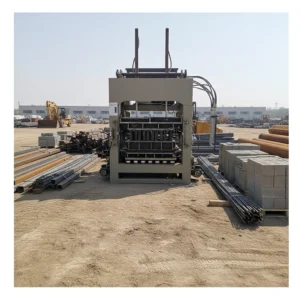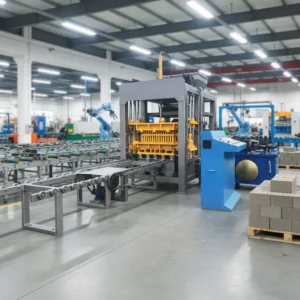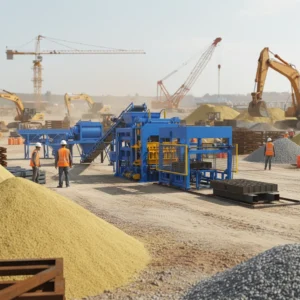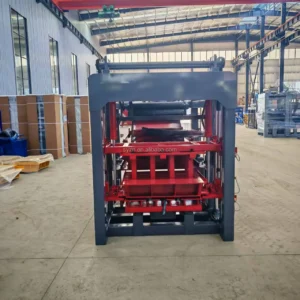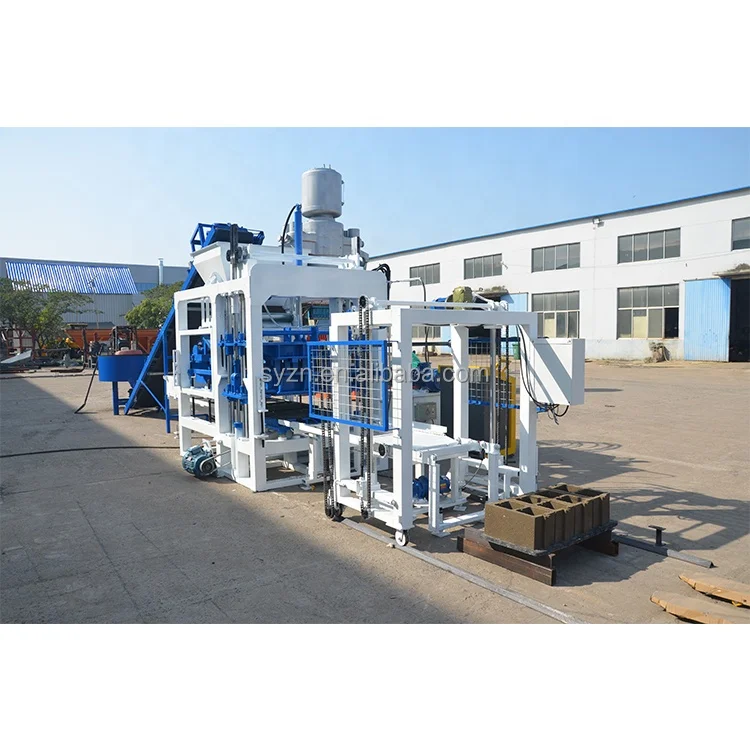
Integrated Line Synchronization — we specify the mixer, stacker, and pallet system against the QT4-18 cycle time, not as separate catalogue items.
Technical Specifications
| Parameter | Value |
|---|---|
| Model | QT4-18 |
| Product Type | Automatic Hydraulic Concrete Block Making Machine |
| Overall Dimensions (L×W×H) | 3900×1600×2300 mm |
| Total Weight | 3T |
| Rated Power | 24KW |
| Vibration Force | 40-50 KN |
| Molding Cycle | 15-25s |
| Mixer Model | JQ350 |
| Pallet Size | 850×550×25 mm |
| Hydraulic System | Equipped hydraulic station for high pressure and stable operation |
| Vibration Type | Bed mould vertical vibration and upper mould compression vibration |
| Automation Level | Semi-automatic (with automatic stacker option) |
| Output (Hollow Block 400×200×200mm) | 1200-1680 pcs/hr, 9600-13440 pcs/8hr |
| Output (Hollow Block 400×150×200mm) | 1800-2400 pcs/hr, 14400-19200 pcs/8hr |
| Output (Solid Brick 240×115×53mm) | 3240 pcs/hr, 16200-19440 pcs/8hr |
Application Suitability
| Application | Material or Output |
|---|---|
| Hollow block production | Crushed stones, sand, cement, dust, fly ash |
| Solid brick manufacturing | Crushed stones, sand, cement, dust, fly ash |
| Paving stone and kerbstone forming | Crushed stones, sand, cement, dust, fly ash |
| Block plant setups for contractors | On-site or fixed production with supporting equipment |
| Product range expansion for distributors | Multiple formats from a single press with mould changes |
Why the Supporting Equipment Decides Your Real Daily Output
A block press only produces as fast as the slowest station feeding or clearing it.
Many buyers focus entirely on the press cycle and overlook the upstream mixer and downstream pallet handling. The concrete block production line supporting equipment determines whether your press runs continuously or idles every third cycle waiting for material or an empty pallet. When the JQ350 mixer cannot discharge fast enough to match a 15-second moulding cycle, the entire line stalls. When pallets must be carried by hand from the curing yard back to the press, workers become the bottleneck [NEED_CITE: typical block line bottleneck analysis in small to medium plants].
How the Mixer and Press Stay in Step
The JQ350 mixer must deliver a fresh batch within the 15-25 second moulding window of the QT4-18 so that the hopper never runs empty mid-cycle. This requires calculating batch volume against the specific block format being produced, because a 400×200×200mm hollow block consumes far more material per cycle than a 240×115×53mm solid brick. Matching the concrete block production line supporting equipment to the press cycle means the operator never has to pause the line to wait for the next mix.
Pallet Circulation and Stacking Without Manual Gaps
The 850×550×25mm pallets must travel from the press to the curing rack and back in a loop that matches press output. If the automatic stacker option is fitted, wet blocks are lifted off the press table and placed onto curing racks without hand labor, keeping the cycle rhythm intact. Pallet return speed, rack capacity, and forklift availability in the curing yard all need to be specified together so that no station sits idle [NEED_CITE: pallet circulation requirements for semi-automatic block lines].
Reading the Specifications That Matter for Line Balance
The 40-50 KN vibration force works together with the hydraulic station pressure to compact the mix into a dense block before the pallet moves on. If vibration is too low for the aggregate size in the buyer’s mix, blocks leave the press too soft to stack, forcing the operator to slow the cycle. The 24KW rated power covers the press motor and hydraulic pump but does not include the mixer, conveyor, or stacker, so total line power must be calculated separately for the correct transformer and cable sizing. The semi-automatic base configuration allows a buyer to start with manual pallet handling and add the automatic stacker later when volume justifies the investment.
What Happens When Line Stations Are Specified Separately
When a buyer sources the mixer, pallets, and stacker from different suppliers without matching cycle times, the result is a press that pauses repeatedly during production. Workers end up stacking wet blocks by hand because the stacker was never included in the quotation, which introduces breakage and slows output well below the rated capacity [NEED_CITE: common causes of output shortfall in block production lines]. Mismatched pallet dimensions mean the curing racks built for one size cannot accept the blocks coming off the press, forcing a costly replacement of the entire pallet inventory.
Why the Line Is Specified as One System Here
Every quotation starts with the buyer’s target block format and daily volume, not a generic press price. The JQ350 mixer output, pallet quantity, stacker configuration, and curing rack layout are calculated against the same cycle time so that all stations keep pace with the QT4-18. Pallet size and material are confirmed against the buyer’s existing curing yard and forklift capacity before production begins. Electrical schematics cover the full line, ensuring that voltage, frequency, and PLC display language are consistent across every station from feeding to stacking. Wear parts lists include mixer blades and stacker grippers, not just press components, so the first replacement order can be placed without emergency sourcing.
Documentation & Verification
- Line layout and capacity calculation stating the block format assumed for each station
- Machine specification sheet covering press, mixer, and pallet handling dimensions
- Pallet specification matched to your curing rack spacing and forklift capacity
- Electrical schematic for the full line with voltage and control language confirmed
- Factory test record on your chosen block format before dispatch
Installation, Commissioning & Support
- Foundation plan accounts for the 3T press weight and vibration isolation requirements
- Dedicated electrical circuit sized for the 24KW press plus JQ350 mixer draw
- Pallet return conveyor aligned to the 850×550mm pallet path during on-site assembly
- First-cycle parameter tuning on your local aggregate mix during commissioning
- Operator training covers mould change sequence and stacker adjustment procedures
- Wear parts supply includes hydraulic seals, mixer blades, and vibration springs
Preparing a Line Inquiry That Gets a Real Answer
Share the block format you sell most, the daily volume your market absorbs, and the raw materials available locally including aggregate grading. Confirm the voltage and frequency at your site along with the control language your operators read. Provide the dimensions of your existing curing yard and the forklift model you plan to use so that pallet size and rack spacing can be matched before the line is configured.
Frequently Asked Questions
Q: How do I ensure the mixer capacity matches the host machine cycle time?
A: The JQ350 mixer batch volume must be calculated against your specific block format and the 15-25 second moulding cycle. A 400×200×200mm hollow block draws more material per press stroke than a solid brick, so the mixer discharge rate needs to be verified for whichever format will dominate your daily schedule.
Q: Is the automatic stacker included in the quotation or sourced separately?
A: The QT4-18 ships as a semi-automatic press by default, with the automatic stacker available as a configurable option. When included, the stacker is matched to the 850×550×25mm pallet size and synchronized to the press cycle so that no manual block handling is required between press and curing rack.
Q: What pallet quantity and material does the curing system need?
A: Pallet quantity depends on your curing yard size and the time blocks spend on the rack before reaching handling strength. The 850×550×25mm pallet material must be selected for compatibility with your forklift and the local climate, as moisture absorption affects both block curing and pallet lifespan.
Q: Can the line layout fit my existing workshop and curing yard?
A: The line layout is drawn after receiving your workshop dimensions and curing yard measurements. Station spacing, conveyor path, and pallet return route are arranged to fit the available footprint while maintaining the cycle synchronization between the QT4-18 press, JQ350 mixer, and stacker.