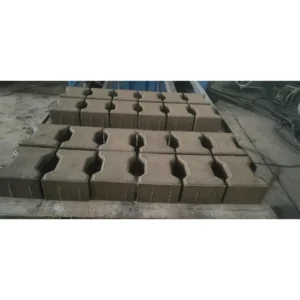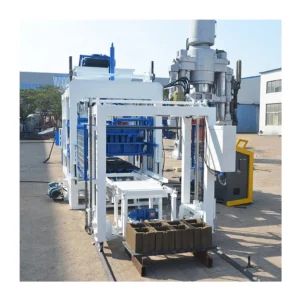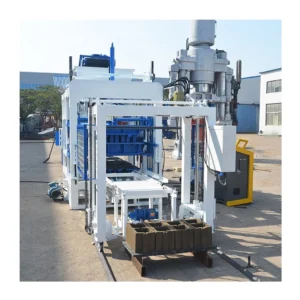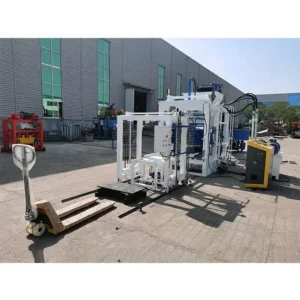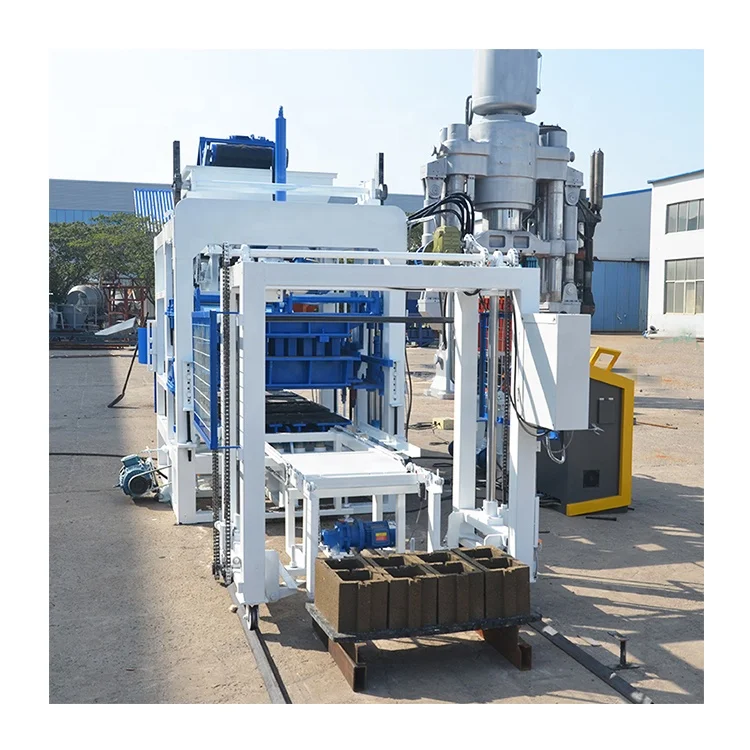
Coordinated Line Timing — every station from raw material batching through pallet stacking is cycle-matched to the QT4-16 press so the host machine never idles waiting for upstream or downstream equipment.
Technical Specifications
| Parameter | Value |
|---|---|
| Model | QT4-16 |
| Product Type | Automatic Hydraulic Concrete Block Making Machine |
| Overall Dimension | 7400 × 1950 × 2800 mm |
| Rated Pressure | 21 MPa |
| Main Vibration Form | Platform Vibration |
| Vibration Frequency | 2800–4500 r/min |
| Vibration Force | 40 kN |
| Pallet Size | 900 × 550 mm |
| Molding Cycle | 15–20 s (basis not stated in source — confirm block format / material / thickness) |
| Demolding Method | Hydraulic |
| Total Mass | 5 T |
| Factory Area | 600 m² |
| Control System | PLC intelligent control with man-machine interface, logic control, production program, malfunction diagnosis, remote control function |
| Standards | CE |
Application Suitability
| Application | Material or Output |
|---|---|
| Hollow block production for wall construction | Crushed stone, sand, cement, fly ash blends |
| Solid block manufacturing for load-bearing structures | Gravel, cement, slag aggregates |
| Paving block and colored paver runs for hardscape projects | Fine sand, cement, pigment additives |
| Interlocking brick and kerbstone for road and drainage works | Coarse aggregate, cement, dust mixes |
What Happens When the Automatic Block Machine Production Line Loses Its Rhythm
The press is only as fast as the slowest station feeding it.
I have stood on plant floors where the host machine sat idle for fifteen seconds per cycle simply because the mixer discharge could not keep up. Multiply that gap by several hundred cycles and the daily shortfall becomes significant. On a QT4-16 automatic block machine production line, the raw material feeding, mixing, pallet feeding, and stacking stages must each complete their task within the press cycle window, otherwise the rated molding cycle becomes a theoretical number rather than an achieved reality. Buyers who evaluate only the press specification often discover the bottleneck after commissioning, when the line is already bolted to the floor [NEED_CITE: common causes of output shortfall in block production lines].
Matching Every Station to the Press Cycle
The QT4-16 runs a molding cycle of 15–20 seconds depending on the block format, material, and thickness being produced. For continuous operation, the batching and mixing station must deliver a fresh batch to the hopper within that same window, and the pallet feeder must present a clean pallet before the press completes demolding. When any single station falls behind, the PLC logic holds the press in a wait state, and throughput drops accordingly. An automatic block machine production line configured with matched station capacities avoids this idle time entirely.
Pallet Flow and Curing Area Coordination
Downstream of the press, wet blocks ride on 900 × 550 mm pallets toward the stacking and curing area. If the stacker cannot index fast enough, pallets queue on the conveyor and eventually back up into the demolding zone. Equally important, the pallet material and dimensions must suit the curing racks and forklifts already on site. A mismatch here means either replacing the handling fleet or living with manual pallet transfers, negating the automation investment [NEED_CITE: pallet handling integration requirements for block plants].
Reading the Specs That Actually Matter
The 21 MPa rated hydraulic pressure and 40 kN vibration force together determine the green density and early strength of the block leaving the mould. Platform vibration at 2800–4500 r/min consolidates the mix evenly across the pallet area, which matters when producing hollow blocks with thin webs or pavers that must survive handling before full cure. The PLC control system manages the entire sequence — from hopper gate timing to vibration duration — and its malfunction diagnosis interface lets operators trace faults without calling off-site support. Total machine mass of 5 T provides the static weight needed to keep the frame stable under repeated vibration cycles, reducing long-term fatigue on the mould clamping points.
The Cost of Skipping Line Integration
Purchasing the press alone and sourcing conveyors, mixers, and stackers separately often leads to interface gaps. Conveyor belt speeds that do not synchronize with pallet indexing, mixers sized for a larger plant that overfeed the hopper, or stackers rated for a different pallet dimension all create downtime that is hard to diagnose from the press HMI alone. Plants that skip the line-level capacity calculation typically spend weeks after installation adjusting station speeds and replacing undersized components [NEED_CITE: post-installation adjustment frequency in unintegrated block lines].
Why Buyers Source the Full Line Here
Block machinery is the single focus, so the QT4-16 press, moulds, pallets, and handling equipment are specified as one matched system rather than assembled from unrelated suppliers. Configuration is set against the buyer’s actual mix design and local aggregate, not pulled from a catalogue default. Mould design covers the formats the buyer’s market sells, including custom drawings when standard formats do not apply. Automation level is selectable — a buyer can start with semi-automatic pallet handling and add automatic stacking later. Installation and commissioning support includes operator training so the crew understands cycle coordination from day one.
Documentation & Verification
- Line layout with capacity calculation stated per block format at each station
- Machine specification sheet confirming hydraulic pressure and vibration ratings
- Mould drawing and format list matched to buyer’s product range
- Pallet specification aligned with curing rack and forklift dimensions
- Hydraulic and electrical schematic for on-site maintenance reference
- Factory test record on buyer’s target block format before dispatch
Installation, Commissioning & Support
- Foundation plan sized to the 7400 × 1950 mm footprint and 5 T operating mass
- Power supply confirmation covering voltage, frequency, and dedicated circuit rating
- Machine assembled and leveled on site with all station interfaces verified
- PLC language and HMI display set to operator’s preferred language before commissioning
- Operator training covering molding cycle adjustment and malfunction diagnosis routines
- Wear parts and mould maintenance schedule provided at handover
Requesting a Line Proposal
Share the block formats you intend to produce, your target daily output, the raw materials available locally, and the curing area dimensions you have on site. Specify the voltage and frequency at your facility, and note any existing conveyors or forklifts the line must connect with. This information allows the automatic block machine production line to be configured around your real conditions rather than generic assumptions.
Frequently Asked Questions
Q: How do I verify that upstream feeding and downstream stacking can keep pace with the press cycle time?
A: Request a line layout document that lists the cycle time at each station — batching, mixing, pallet feeding, pressing, and stacking — calculated for your specific block format. Every station’s figure should fall within or below the press cycle window so no single point creates a bottleneck during continuous production.
Q: What pallet size and material should I choose based on my existing curing area and handling equipment?
A: The standard 900 × 550 mm pallet must clear your curing rack spacing and fit your forklift tine width. Material choice — typically bamboo, PVC, or steel — affects pallet weight, lifespan, and surface finish on the block. Confirm these parameters against your existing infrastructure before the order is placed to avoid costly replacements after delivery.
Q: Which automation level is needed to match my target daily output without over-investing?
A: Start by defining the daily block count your market absorbs, then work backward through the molding cycle to determine required press hours. A semi-automatic pallet feed with manual stacking may suffice for shorter runs, while full automatic stacking and cubing reduce labor on high-volume shifts. The QT4-16 supports upgrade paths between these levels.
Q: How is the complete line configured for my local aggregate and mix design?
A: Provide a sample or laboratory analysis of your local crushed stone, sand, and any supplementary materials like fly ash or slag. The vibration frequency, hydraulic pressure, and cycle duration are then adjusted to match the gradation and moisture characteristics of that mix, ensuring consistent block density and strength from the first batch onward.
Q: What documentation confirms that each station’s capacity is calculated for my specific block format?
A: The line layout and capacity calculation document lists the assumed block format, the cycle time at every station, and the resulting daily output. This document is issued before production begins so you can verify that the automatic block machine production line meets your throughput requirement on paper before it is built.