
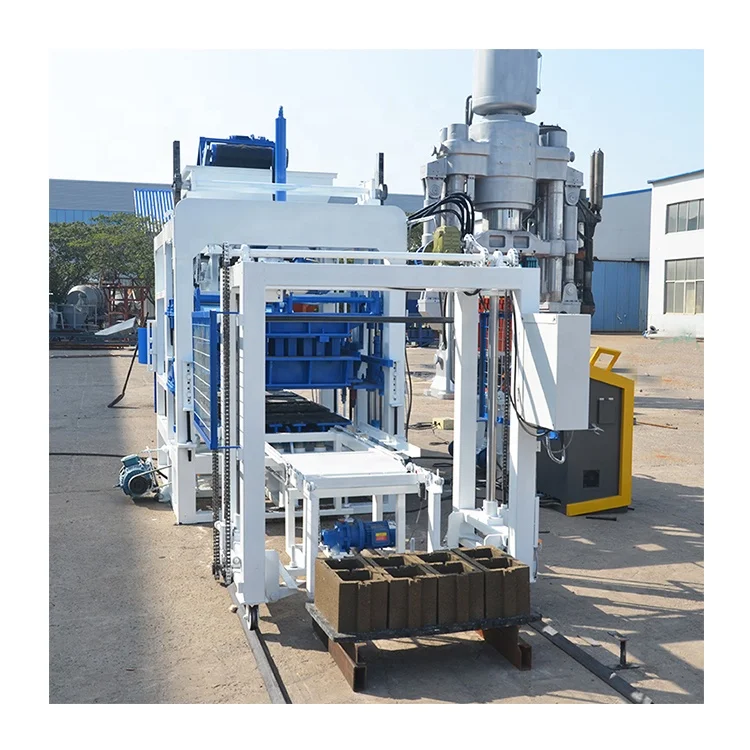
Matched Line Engineering — Every station from material batching to stacking is timed to the QT4-15B press cycle, removing the bottlenecks that leave output stacked by hand and throughput below expectation.
Technical Specifications
| Parameter | Value |
|---|---|
| Model | QT4-15B |
| Product Type | Automatic Concrete Block Making Machine |
| Automation Level | Fully automatic, PLC computer controlled |
| Vibration Mode | Multiaxis synchronizer, vertically downward |
| Mixer System | Multiaxis forced mixer |
| Hydraulic System | High thermal efficiency, low heat generation |
| Frame Construction | High strength steel, special welding technique for vibration shock resistance |
| Guide Bearing | Long-period over-length guide bearing for upper mould and mould box alignment |
| Moulding Cycle | 15–20 seconds |
| Output — 400×200×200 mm hollow block | 900–1,200 pcs/hour, 7,200–9,600 pcs/8 hr |
| Output — 400×150×200 mm block | 1,080–1,440 pcs/hour, 8,640–11,520 pcs/8 hr |
| Output — 400×100×200 mm block | 1,440–1,920 pcs/hour, 11,520–15,360 pcs/8 hr |
| Output — 200×100×60 mm paving block | 2,880–3,840 pcs/hour, 23,040–30,720 pcs/8 hr |
| Output — 240×115×53 mm solid brick | 5,930–6,720 pcs/hour, 47,400–53,760 pcs/8 hr |
| Assembly State | Production line configuration with supporting equipment |
| Warranty | 1 year for whole machine, excluding spare parts |
| Payment Terms | 30% deposit by T/T, 70% balance before delivery |
Application Suitability
| Application | Material or Output |
|---|---|
| Hollow block production | Crushed stone, cement, sand, and fly ash blends for structural wall units |
| Multicellular brick manufacturing | Lightweight aggregate and cement mixes for partition and infill blocks |
| Paving brick production | Fine aggregate, cement, and pigment layers for interlocking and kerb pavers |
| Standard solid brick forming | Dense aggregate and cement for load-bearing masonry units |
| On-site concrete product manufacturing | Locally sourced aggregate adapted to project-specific mix designs |
Why the Mixer and Pallet Feeder Decide Your Real Daily Output
The press is only as fast as the slowest station feeding it or clearing its output.
I once visited a block plant in West Africa where the owner had purchased a QT4-15B from another supplier. The press itself ran fine, but the third-party mixer could not keep up with the 15-second moulding cycle. Every third cycle the hopper ran dry, the press paused, and the operator stood idle. At the other end, pallets were being carried off by hand because the quotation had not included a stacker. The owner told me his actual daily output was barely half the brochure figure. That gap between quoted capacity and real throughput is almost always a line problem, not a press problem. [NEED_CITE: typical output losses from unsynchronised block production stations]
Upstream Consistency: Mixer, Batching, and Feed Timing
The multiaxis forced mixer in the QT4-15B line is specified to match the press cycle rather than treated as a standalone item. When aggregate moisture or particle size shifts between deliveries, the mixer must still deliver a uniform feed within the same 15–20 second window. If the mixer batch time drifts even a few seconds beyond the press cycle, the hopper starves and the automatic block making machine production line loses rhythm for the rest of the shift.
Downstream Flow: Pallet Handling, Stacking, and Curing Rack Transfer
On the exit side, freshly pressed blocks sit on pallets that must move to the curing area before the next cycle drops a new block onto the same pallet position. A pallet feeder and stacker rated for the QT4-15B output keep this flow continuous. When stacking is done manually, the operator becomes the bottleneck and breakage rises as fatigue sets in during the second half of an eight-hour shift. Sizing the curing rack handling system to your existing yard dimensions and forklift capacity avoids a situation where pallets pile up on the floor because the rack spacing does not match. [NEED_CITE: pallet and curing rack sizing for stationary block machine plants]
What the Guide Bearing and Vibration System Mean for Block Consistency
The long-period over-length guide bearing on the QT4-15B keeps the upper mould and mould box aligned through thousands of cycles, which directly affects dimensional tolerance across a full production run. Combined with multiaxis synchronizer vibration delivering force vertically downward, the hydraulic pressure compacts the mix evenly across the pallet area. If vibration and hydraulic pressure are not matched to your specific mix design and local aggregate, block strength varies from the first pallet of the day to the last — a problem that shows up only when the buyer tests compressive strength at the construction site.
The Hidden Cost of a Quotation That Stops at the Press
When supporting stations are left out of the initial quote, the buyer is forced to source the mixer, pallet feeder, and stacker separately. Mismatched cycle times between independently purchased stations cause the press to idle between cycles, and the total line footprint often exceeds what the site can accommodate. Voltage and PLC language confirmed after the press is already built lead to weeks of delayed commissioning while electrical panels are rewired and control screens are reprogrammed. These are not equipment failures — they are planning gaps that compound into lost production from day one. [NEED_CITE: commissioning delays from unconfirmed voltage and control language]
Why Specifying the Full Line Here Makes a Difference
Block machinery is our single focus, so the QT4-15B press, mould, pallet, and handling equipment are specified as one matched system rather than assembled from separate suppliers. Every configuration is set against the buyer’s actual mix design, local aggregate, and target block format — not a catalogue default. Mould design covers the formats your market actually sells, and custom drawings are available when standard options do not match. The automation level is selectable, so a buyer can start with semi-automatic pallet handling and move to fully automatic stacking later without replacing the press. Line layout and capacity calculations state the exact block format each output figure assumes, so you can verify daily tonnage against your real product mix before signing. Installation and commissioning include operator training so your team understands the full line sequence, not just the press controls.
Documentation & Verification
- Line layout and capacity calculation stating the block format assumed for each output tier
- Hydraulic and electrical schematic covering every station in the QT4-15B line, not only the press
- Voltage, frequency, and PLC display language confirmation document signed before production
- Mould drawing and format list matching the pallet size selected for your curing area
- Factory test record run on your target block format before dispatch
- Operation and maintenance manual covering the full line sequence and station-by-station troubleshooting
Installation, Commissioning & Support
- Foundation plan sized to the QT4-15B frame footprint and vibration load, prepared before machine arrival
- Dedicated power circuit matching confirmed voltage and frequency, with isolation for the full line
- Dismantling and container loading plan ensuring the press and supporting stations arrive in sequenced order
- First-run commissioning with PLC parameter tuning for your specific mould cycle and block format
- Operator training covering mixer batching, press cycle, pallet feeding, stacking, and curing rack transfer
- Wear parts and mould replacement list with lead times so first changeover is planned, not reactive
- Scheduled maintenance intervals aligned to the QT4-15B hydraulic system and vibration assembly
Before You Request a Quote
To size the QT4-15B line correctly, share the block formats your market sells along with the daily output you need for each. Tell us about your local aggregate type and mix design so the mixer and vibration settings are configured from the start. Confirm your site’s voltage, frequency, and preferred PLC display language, and let us know the dimensions of your curing yard and the forklift you already have on site.
Frequently Asked Questions
Q: How do I verify the quoted capacity is based on my actual block format?
A: Every capacity figure in our proposal states the exact block dimensions it assumes — for example, the QT4-15B output for 400×200×200 mm hollow blocks differs from that for paving blocks. You can cross-check the daily tonnage against your product mix before confirming the order.
Q: Which supporting stations are included in the line quotation?
A: The standard line quotation covers the press, mixer, pallet feeder, and stacking system. Curing rack handling and cubing stations are configured based on your yard layout and listed separately so you can see exactly what is included and what is optional.
Q: How are cycle times matched between the press and upstream or downstream equipment?
A: Each station’s cycle is calculated against the QT4-15B moulding cycle of 15–20 seconds. The mixer batch time, pallet feed rate, and stacker speed are all set so the press never waits for material or pallet clearance during continuous production.
Q: What electrical and control confirmations are needed before production starts?
A: We require your site voltage, frequency, and preferred PLC display language confirmed in writing before the QT4-15B enters production. This prevents rewiring or reprogramming delays during on-site commissioning.
Q: What site preparation is needed before the line is installed?
A: You will receive a foundation plan matching the QT4-15B vibration load, a power circuit specification for the full line, and a curing yard layout aligned to the selected pallet size. Preparing these before arrival shortens the commissioning period significantly.


