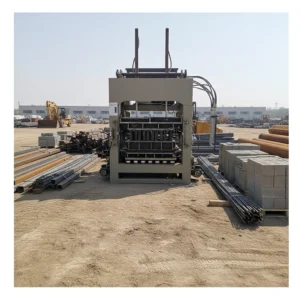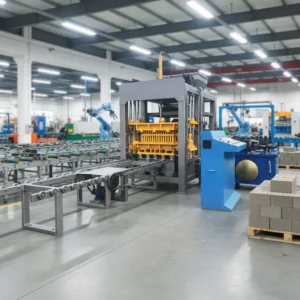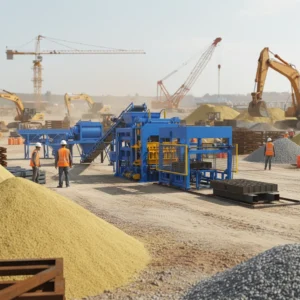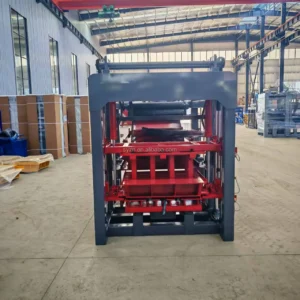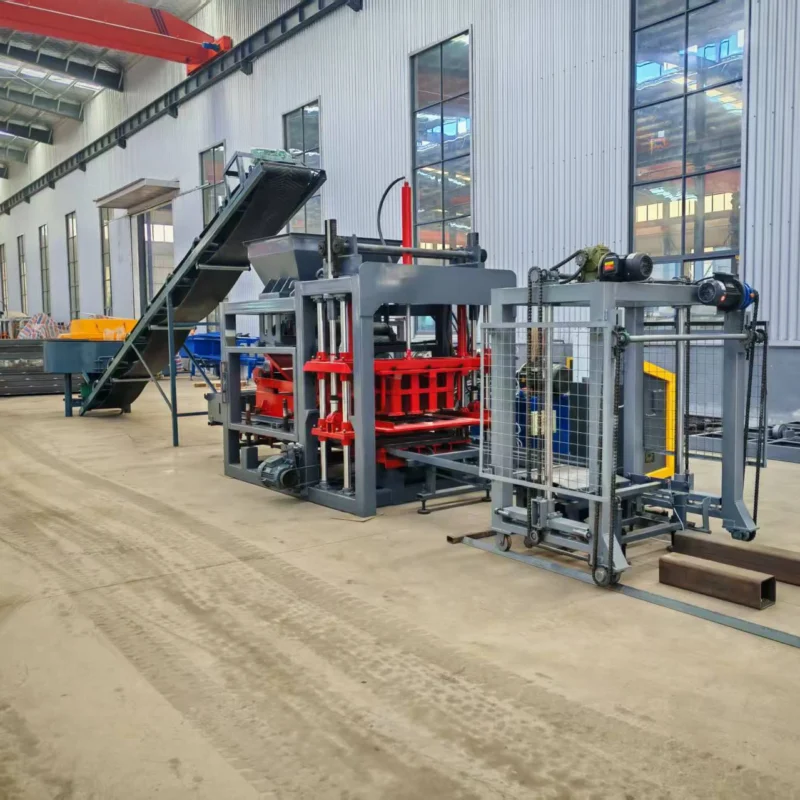
Matched Line Integration — The QT4-15A block press is specified as the timing anchor of a complete production line, where feeding, mixing, pallet circulation and stacking are all calculated against its molding cycle rather than sourced as standalone units.
Technical Specifications
| Parameter | Value |
|---|---|
| Product Type | Fully Automatic Concrete Block Making Machine |
| Model | QT4-15A |
| Overall Dimensions (L×W×H) | 4100×1600×2600 mm |
| Rated Pressure | 16–21 MPa |
| Main Vibration Form | Platform Vibration |
| Vibration Frequency | 4200 r/min |
| Vibration Force | 55 kN |
| Pallet Size | 880×550 mm |
| Molding Cycle | 25–30 s (basis not stated in source — confirm block format / material / thickness) |
| Overall Power | 18.45 kW |
| Total Mass | 4 T |
| Demolding Method | Hydraulic |
| Factory Area Required | 300 m² |
| Automation Level | Fully Automatic |
| Applied Products | Concrete blocks, hollow/solid blocks, pavers, interlocking blocks, curbstone, colored pavers |
| Raw Materials | Crushed stone, sand, cement, dust, fly ash, gravel, slag |
| Warranty | 1 year (whole machine, excluding spare parts) |
Application Suitability
| Application | Material or Output |
|---|---|
| Hollow block production for masonry walls | Crushed stone, sand, cement, fly ash |
| Solid concrete block manufacturing | Gravel, sand, cement mix |
| Interlocking paver production for driveways and walkways | Colored concrete with fine aggregate |
| Kerbstone and curb production for road projects | High-density concrete with coarse gravel |
| On-site block production for housing projects | Locally sourced aggregate and cement |
What "25–30 Seconds per Cycle" Actually Means for Your Line
A cycle time only matters when every upstream and downstream station is timed to match it.
I once watched a QT-class press sit idle for eight seconds every cycle because the pallet return conveyor was two meters too short and the stacker arm was programmed for a slower rhythm. The buyer had compared cycle times across three quotes and picked the fastest number, but the automatic block making machine production line around it was never calculated as one system. Those eight seconds added up to hundreds of missing blocks per shift. [NEED_CITE: synchronization requirements for concrete block production lines]
Synchronizing the Press Cycle with Upstream Feeding
The 25–30 s molding cycle sets the heartbeat for the entire automatic block making machine production line. The mixer must discharge a fresh batch into the feed hopper before the press completes its current cycle, and the raw material batching system must replenish the mixer at a rate that prevents any gap. When the feeding station falls behind, the press waits — and that idle time is invisible on a spec sheet but very visible on a daily output tally.
Pallet Circulation as the Line’s Hidden Bottleneck
The 880×550 mm pallet size governs more than the press cavity. It determines the width of the pallet return conveyor, the shelf spacing on curing racks, and the fork pocket dimensions the buyer’s existing forklift can handle. A pallet that is even slightly incompatible with the curing area forces manual re-stacking at the end of the line, cancelling the benefit of automatic stacking upstream. [NEED_CITE: pallet handling standards in block manufacturing plants]
Reading the Pressure and Vibration Numbers Together
The rated pressure of 16–21 MPa and vibration force of 55 kN at 4200 r/min work as a pair. Hydraulic pressure compresses the mix while platform vibration settles the aggregate into voids. If the mixer delivers a consistency that is too dry for this vibration frequency, the blocks emerge with weak edges. Too wet, and the blocks slump before the stacker can lift them. The mixer output specification must therefore be written to match these press parameters, not chosen independently.
When the Factory Area Decides the Line Layout
A 300 m² factory area requirement frames where the mixer sits relative to the press, how long the pallet return loop can be, and whether the curing racks fit in a straight line or must turn a corner. In a cramped site, the pallet conveyor may need a 90-degree transfer station, which adds a timing point that must be programmed into the automatic block making machine production line control sequence. Skipping this spatial planning before ordering means discovering interference problems during installation.
The Cost of Treating Each Station as a Separate Purchase
Buyers who source the press, mixer, stacker and pallet conveyor from different suppliers often discover timing mismatches during commissioning. The stacker may expect a pallet every 35 seconds while the press delivers one every 25, causing pallets to queue and blocks to cool unevenly. The mixer may batch 500 kg per cycle but the press hopper only holds 300 kg, leaving half the mix sitting and stiffening. [NEED_CITE: integration risks in multi-supplier block plant setups] These are not equipment failures — they are line design failures that surface only after everything is bolted to the floor.
Why the Line Should Be Specified as One Package
Block machinery as a single focus means the QT4-15A press, its pallets, the mixer, the stacking station and the curing rack system are calculated together before anything ships. Configuration is set against the buyer’s actual mix design and local aggregate, not a catalogue default. Pallet size and material are chosen with the buyer’s curing area and forklift in mind. Automation level is selectable so a buyer can begin with semi-automatic pallet handling and add automatic stacking later without replacing the press. Installation and commissioning support covers the full line, not just the press in isolation.
Documentation & Verification
- Line layout drawing showing station spacing and pallet circulation path for the QT4-15A
- Capacity calculation sheet stating the block format assumed for the 25–30 s cycle
- Pallet specification matched to curing rack dimensions and forklift fork width
- Hydraulic and electrical schematic confirming voltage, frequency and PLC language
- Factory test record on buyer’s target block format before dispatch
Installation, Commissioning & Support
- Foundation plan sized to the 4100×1600 mm footprint and 4 T operating mass of the QT4-15A
- Power supply confirmation for the 18.45 kW total load with dedicated circuit breaker rating
- Pallet conveyor alignment checked against 880×550 mm pallets and curing rack shelf spacing
- Mould mounting and cycle timing verified on buyer’s block format during on-site commissioning
- Operator training covering mould change sequence and platform vibration adjustment
- Wear parts list for hydraulic seals and vibration components with recommended reorder intervals
What We Need to Size Your Line
To calculate station timing and confirm that every element of the automatic block making machine production line matches your site, share the block formats you plan to produce, your available factory area and ceiling height, the aggregate and cement sources you will use locally, and your site voltage and frequency. If you already operate forklifts or curing racks, send their dimensions so pallet specifications can be coordinated before production begins.
Frequently Asked Questions
Q: How is the 25–30 s molding cycle verified, and which block format does it assume?
A: The cycle time depends on block thickness, mix consistency and vibration settings. Before quoting, we confirm which block format the cycle figure assumes and run a factory test on that format. The capacity calculation we provide states the format explicitly so you can verify daily output against your product mix rather than relying on a generic catalogue number.
Q: Which supporting stations are included in the line quotation, and which are buyer-supplied?
A: The quotation lists every station from raw material feeding through mixing, pallet circulation, stacking and curing rack handling. Any item the buyer will supply — such as an existing mixer or forklift — is noted separately so there are no gaps. This prevents the common situation where output ends up stacked by hand because a downstream station was never specified.
Q: How is pallet size 880×550 mm coordinated with the curing rack and forklift?
A: Pallet dimensions are checked against your curing rack shelf spacing and forklift fork width before the order enters production. If your existing racks need a different pallet size, the press mould cavity and pallet conveyor are adjusted to match. This coordination is part of the line layout stage, not an afterthought during installation.
Q: How are upstream feed rate and mixer output matched to the press cycle?
A: We calculate the mixer batch size and discharge interval so that fresh material reaches the press hopper before each molding cycle completes. The raw material batching system is sized to keep the mixer continuously replenished. This prevents the press from idling while waiting for the next batch, which is a common cause of lost output on poorly synchronized lines.
Q: What voltage, frequency and control language confirmation is required before production?
A: We confirm your site voltage, frequency and preferred PLC display language before the line enters production. This ensures the electrical panels, motor ratings and control interface match your local supply and operator language, so commissioning is not delayed by rewiring or reprogramming after the equipment arrives on site.