
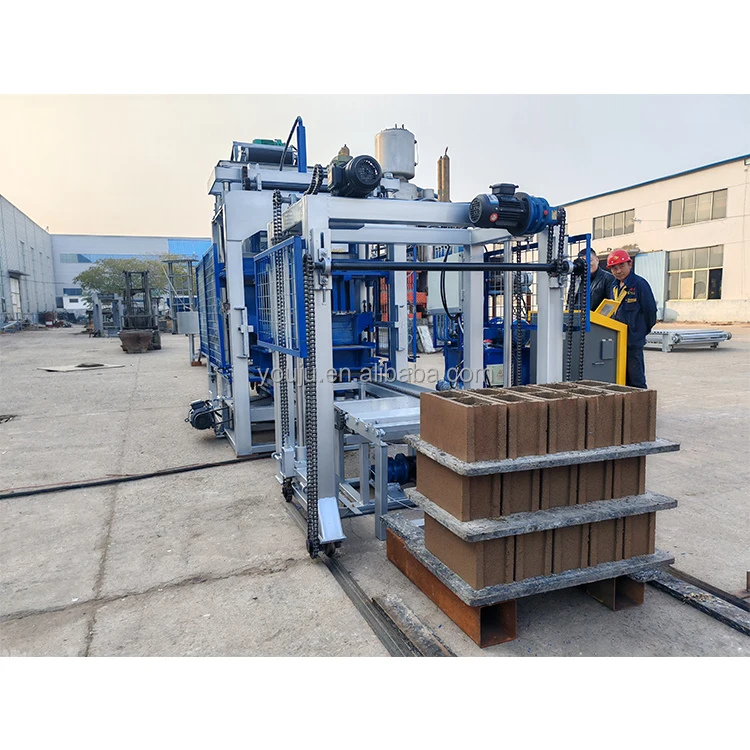
Balanced Line Synchronization — We time every station from raw material feeding through stacking to match the QT4-15 press cycle, so the host machine never waits for upstream or downstream delays.
Technical Specifications
| Parameter | Value |
|---|---|
| Model | QT4-15 |
| Product Type | Hydraulic Block Making Machine |
| Molding Cycle | 15–30s per format (basis to be confirmed) |
| Pallet Size | 900 × 500 mm |
| Vibration Type | Platform vibration |
| Vibration Frequency | 50–70 Hz |
| Product Height Range | 50–220 mm |
| Overall Power | 24.5 kW |
| Demolding Method | Hydraulic |
| Control System | PLC-controlled automatic sequence |
| Mould Format | Interchangeable — hollow block, paver brick, solid brick |
| Output: Hollow 400×200×200 mm | 7,200–9,600 pcs / 8 hr (basis: stated block size) |
| Output: Hollow 400×150×200 mm | 8,640–11,520 pcs / 8 hr (basis: stated block size) |
| Output: Hollow 400×100×200 mm | 11,520–15,360 pcs / 8 hr (basis: stated block size) |
| Output: Paver 200×100×60 mm | 23,040–30,720 pcs / 8 hr (basis: stated block size) |
| Output: Solid 240×115×53 mm | 47,400–53,700 pcs / 8 hr (basis: stated block size) |
| Raw Materials | Fly ash, slag, gangue, sand, crushed stone, cement, water |
| Block Compressive Strength | More than 15 MPa |
Application Suitability
| Application | Material or Output |
|---|---|
| Mid-scale hollow block plant | Fly ash and crushed stone blended with cement |
| Paver brick production for walkways and yards | Sand and fine aggregate with cement binder |
| Solid brick for load-bearing and partition walls | Slag or gangue mixed with local sand |
| On-site production for housing developments | Locally sourced aggregate with portable batching |
| Existing plant expanding product range | Interchangeable moulds across hollow, solid and paver formats |
What "9,600 Blocks per Shift" Leaves Out in a Full Line
The press cycle is only as fast as the slowest station feeding or clearing it.
Buyers often receive a quotation stating the press output at a given cycle time, then discover that the mixer discharges one batch every ninety seconds while the press needs material every thirty. The pallet return conveyor runs at a fixed speed that cannot keep up when thinner blocks shorten the press cycle, and the stacker was never included in the scope. I once spent a week re-timing a European line where the batcher was sized for a smaller press, leaving the host machine idle for over forty seconds per cycle [NEED_CITE: typical station mismatch losses in block production lines]. When you evaluate block production line equipment, every upstream and downstream cycle must be documented against the press rhythm before the order is placed.
How Station Timing Determines Real Daily Output
The QT4-15 completes a moulding cycle in 15–30 seconds depending on block format and material thickness. For the line to sustain that pace, the raw material batcher must deliver a measured charge within the same window, the pallet feeder must present a clean pallet before the press head rises, and the wet-side conveyor must carry the loaded pallet away before the next cycle begins. Supporting equipment for block plant operations must therefore be selected on cycle time, not on nominal hourly capacity alone.
Matching Pallet Circulation to the Curing Area
The 900 × 500 mm pallet defines the footprint of every station. If the curing racks are spaced for a different pallet dimension, the line either needs a re-racking transfer or the buyer replaces the entire rack inventory. We confirm pallet size, material and thickness against the buyer’s existing curing layout and forklift fork width before finalising the pallet return conveyor and stacker specification [NEED_CITE: pallet dimension standards across block curing systems]. This step is part of specifying block production line equipment that actually fits the floor plan.
Reading the Specs That Shape the Line
Platform vibration at 50–70 Hz works together with hydraulic demoulding to compact the mix evenly across the mould cavity. Higher frequency suits fine-aggregate paver mixes, while the lower end handles coarser hollow block blends with fly ash or slag. The 24.5 kW overall power covers the press motor, hydraulic pump and vibration drive; the batching and mixing stations draw additional load, so the total connected power for the full block production line equipment package must be calculated separately. Product height range of 50–220 mm means the same press can run thin pavers and tall hollow blocks, but each format change requires a mould swap and an adjustment to the feed shoe travel — supporting equipment for block plant must allow that changeover without re-wiring the PLC sequence.
The Hidden Cost of an Unbalanced Line
When the mixer is undersized, the press sits idle waiting for material, and the quoted shift output drops noticeably. When the pallet return conveyor is too slow, wet blocks queue on the wet-side table and risk edge damage before they reach the stacker. Buyers who skip specifying the stacking station end up paying manual labour to move pallets that a stacker would handle in the same cycle time [NEED_CITE: labour cost impact of manual pallet handling in block plants]. These losses are rarely visible on the original quotation.
Why Buyers Source the Full Line Here
We specify the mixer, batcher, pallet feeder and stacker as one matched system around the QT4-15, not as separate purchases from different vendors. Each supporting equipment for block plant layout is drawn with station cycle times noted, so the buyer sees where material flows and where buffers exist. Pallet size and material are chosen against the buyer’s actual curing racks and forklift, not a catalogue default. The PLC program is written to include upstream and downstream signals, and the voltage, frequency and display language are confirmed before production starts. Installation covers every station from aggregate bins to the stacking area, so commissioning is one coordinated event rather than separate vendor visits.
Documentation & Verification
- Line layout drawing with each station cycle time noted against the QT4-15 press rhythm
- Pallet specification sheet matched to buyer’s curing rack spacing and forklift fork width
- Voltage, frequency and PLC display language confirmation signed before production
- Factory test record showing press and supporting stations running in sequence
- Hydraulic and electrical schematic covering the full block production line equipment package
- Operation manual covering mould change procedure and daily maintenance intervals
Installation, Commissioning & Support
- Foundation plan accounting for the 24.5 kW press load and vibration isolation pads
- Dedicated electrical circuit sized for total line connected power plus mixer and batcher
- Press delivered in main assemblies; supporting stations shipped flat for on-site bolting
- PLC programme uploaded and station cycle times verified during first production run
- Operator training covers mould change across hollow, paver and solid formats
- Wear parts list identifies hydraulic seals, vibration springs and feed shoe liners
Preparing Your Line Enquiry
To size the supporting equipment for block plant operations around the QT4-15, we need the target block formats and the daily volume for each, the raw materials available locally including aggregate grading, and the dimensions of your existing curing area and forklift. Tell us the site voltage and frequency, the PLC display language your operators require, and whether any upstream batching or downstream stacking equipment is already in place.
Frequently Asked Questions
Q: How do I verify that each station in the line matches the press cycle time?
A: We supply a line layout showing every station — batcher, mixer, pallet feeder, press, stacker — with its individual cycle time written next to the QT4-15 press cycle. Any station slower than the press is flagged and re-sized before the order is finalised, so no bottleneck is hidden.
Q: What pallet size and material should I choose based on my existing curing area and forklift?
A: The QT4-15 uses a 900 × 500 mm pallet. We confirm whether your curing racks and forklift fork width already match this dimension, then specify pallet material — bamboo, steel or PVC — based on your curing temperature and expected pallet lifespan.
Q: Which supporting equipment is included and which is optional?
A: The standard line scope covers the press, pallet feeder and PLC control. Mixer, batcher, belt conveyor and stacker are quoted as configurable options so buyers who already own upstream or downstream equipment can avoid duplication.
Q: How do I confirm voltage, frequency and PLC language before the line ships?
A: We issue a written confirmation sheet listing the exact voltage, frequency and PLC display language for your site. You sign off before production starts, and the factory test record shows the control panel running in that language.
Q: What is the lead time for a complete line versus the press alone?
A: A press-only order ships within a typical multi-week lead time. A full line with mixer, batcher, pallet handling and stacker requires additional weeks for integration testing, and the exact schedule is stated in the quotation once the station list is confirmed.


