
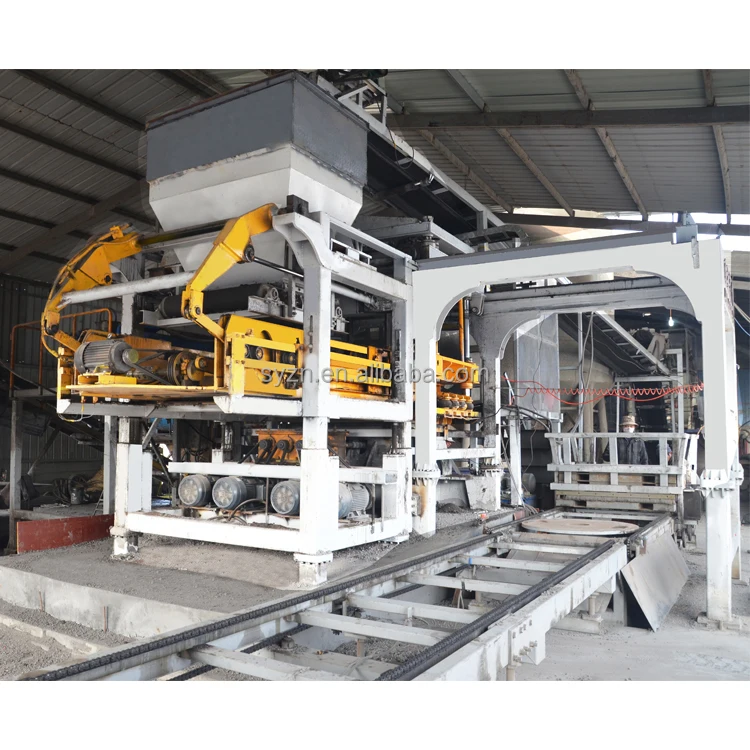
Matched Line Configuration — Raw material feeding, mixing, pressing, stacking, and curing are specified as one timed system around the QT18-25, not assembled from separate suppliers after the contract is signed.
Technical Specifications
| Parameter | Value |
|---|---|
| Model | QT18-25 |
| Product Type | Fully Automatic Pallet-Free Hollow Block Making Machine |
| Brick Height | 50–300 mm |
| Stacking Height | 0–1200 mm |
| Main Vibration Form | Platform Vibration |
| Vibration Frequency | 2800–4500 r/min |
| Pallet Size | 1350 × 1350 × 120 mm (basis to be confirmed — listed in source, contradicts pallet-free designation) |
| Molding Cycle | 15–25 s (basis not stated in source — confirm block format / material / thickness) |
| Vibration Power | 60 kW |
| Hydraulic System Power | 59 kW |
| Driving Method | Hydraulic |
| Demolding Method | Vibration and Hydraulic |
| General Water Consumption | 8 T/Day |
| Factory Area | 2000 m² |
| Control System | PLC with person-machine conversation interface |
| Automation Level | Fully automatic, blocks stacked directly after moulding without pallet |
| Applied Products | Concrete blocks, hollow/solid blocks, pavers, interlocking blocks, curbstone, colored pavers |
| Raw Materials | Crushed stone, sand, cement, dust, fly ash, gravel, slag |
| Key Features | On-site installation and operation training; 1st year free spare parts (excluding quick-wear parts) |
Application Suitability
| Application | Material or Output |
|---|---|
| Large-scale hollow block production plants | Crushed stone, sand, cement, fly ash blends |
| Solid block manufacturing for housing projects | Gravel, cement, slag aggregates |
| Interlocking paver production for municipal works | Colored concrete mixes, fine aggregate |
| Curbstone manufacturing for road infrastructure | High-strength concrete with coarse aggregate |
| On-site block production for development contractors | Locally sourced sand and cement |
What "Molding Cycle 15–25 Seconds" Actually Means for Your Line
A cycle time without a named block format is a number without a context.
I have watched buyers compare quotations from three suppliers, each quoting a different cycle time, none of them stating which block size or mix that figure assumed. The pallet-free block making machine production line then arrives on site, the first production run begins, and the actual cycle stretches well beyond the brochure number because the mix is stickier or the block is taller than whatever the factory tested. Upstream mixers and downstream stackers were sized to a phantom tempo, and now every station is out of sync. [NEED_CITE: capacity calculation standards for concrete block machines]
Station-by-Station Timing Across the Pallet-Free Layout
Because the QT18-25 releases blocks without pallets, the line eliminates pallet feeding, pallet return, and pallet cleaning stations entirely. That simplification shortens the physical footprint and removes a recurring maintenance item, but it also means the stacking station must be precisely timed to receive each layer as the press completes demolding. The pallet-free block making machine production line only runs smoothly when the stacking crane’s travel speed matches the press cycle at every format the buyer plans to produce.
How Upstream Feeding and Mixing Must Keep Pace
Raw material batching and mixing sit ahead of the press, and any delay there propagates downstream immediately. If the mixer discharges slower than the QT18-25 consumes, the press idles and the stated cycle time becomes meaningless. We size the mixer volume and discharge rate against the press’s hopper capacity and the heaviest mix design the buyer intends to run. Fly ash blends, for instance, flow differently from straight crushed-stone mixes, and the screw feeder must handle both without bridging. [NEED_CITE: bulk material flow characteristics for concrete batching]
Reading the Core Specs Beyond the Brochure
The vibration frequency range of 2800–4500 r/min paired with 60 kW of vibration power determines how densely the concrete is compacted inside the mould. Higher frequency works well for fine-aggregate paver mixes, while lower frequency with longer duration suits coarse hollow block fills. The hydraulic system at 59 kW provides the clamp force during vibration and the stripping force during demolding; both actions must be smooth enough to prevent cracking on tall hollow blocks. The PLC with person-machine conversation interface coordinates every station — batching, pressing, stacking — from a single screen, so the operator adjusts cycle parameters without walking the line. Water consumption listed at 8 T/day assumes continuous production; actual usage shifts with mix moisture requirements and local aggregate absorption rates.
The Cost of Sizing Stations in Isolation
When a buyer purchases the press from one supplier and the mixer, stacker, and curing racks from three others, nobody is responsible for the gaps between them. I have seen lines where the stacker could not travel fast enough to clear the press table before the next cycle began, forcing the PLC to insert a dwell that cut daily output noticeably. In another case, the curing rack spacing did not match the block height the buyer actually sold, so half the rack capacity went unused. These mismatches do not show up on any single supplier’s quotation. [NEED_CITE: production line integration challenges in concrete block manufacturing]
Why Line-Level Specification Matters Here
Block machinery is our single focus, which means the QT18-25 press, its moulds, the stacking mechanism, and the curing rack handling are configured as one matched system from the start. We set the configuration against the buyer’s actual mix design and local aggregate, not a catalogue default, because I once spent two weeks on site in the Middle East re-tuning an automatic line after the local sand turned out to carry far more clay than the test samples showed. Mould design covers the formats the buyer’s market actually sells, including custom drawings. Automation level is selectable, so a plant can begin with the pallet-free block making machine production line at full automatic and adjust later. Installation includes operator training so the crew understands not just the press but every station feeding into and out of it.
Documentation & Verification
- Line layout drawing showing station spacing and material flow path for the QT18-25
- Capacity calculation sheet stating the block format assumed for each output figure
- Hydraulic and electrical schematic covering press, mixer, and stacker as one circuit
- Voltage, frequency, and PLC display language confirmation form signed before production
- Factory test record on the buyer’s specified block format and mix before dispatch
- Packing photographs and customs documentation support for container loading
Installation, Commissioning & Support
- Foundation must accommodate 2000 m² factory area with level tolerance for the QT18-25 platform vibration system
- Electrical supply must deliver combined vibration and hydraulic load near 120 kW with dedicated circuit protection
- On-site assembly and alignment of press, stacker, and curing racks typically completed within one week
- PLC language and parameter sets loaded and verified against buyer’s confirmed voltage and frequency before first run
- Operator training covers mould change procedure, stacking height adjustment up to 1200 mm, and daily maintenance checks
- First-year spare parts coverage excludes quick-wear items; wear parts list provided at handover
What We Need to Configure Your Line
Before we build a quotation, we need your target block formats with dimensions, the daily volume each format must reach, and a sample of your local raw material so we can test mix behavior on our floor. Confirm your site’s voltage, frequency, and the language your operators will use on the PLC screen. If you already have upstream mixers or downstream curing racks in place, share their specifications so we can verify cycle compatibility with the QT18-25.
Frequently Asked Questions
Q: How is daily output calculated per block format on the QT18-25?
A: Daily output depends on the block format, mix design, and confirmed cycle time for that specific product. We provide a capacity calculation sheet that states the assumed block dimensions and molding cycle for every format you plan to produce, so the figure you see is tied to your actual product mix rather than a generic catalogue number.
Q: Which stations are included in the line quotation versus buyer-supplied?
A: The quotation covers the QT18-25 press, raw material feeding, mixing, automatic stacking, and curing rack handling as one package. Items such as the curing yard, forklift, and external water supply connections are typically buyer-supplied. We confirm the boundary in the line layout drawing before production begins.
Q: How do upstream and downstream stations avoid bottlenecking the press?
A: We match mixer discharge rate and stacker travel speed against the press cycle for each block format. If one station runs slower, the PLC inserts a dwell that reduces effective output. The station-by-station timing document in our quotation shows where each piece of equipment sits relative to the press tempo.
Q: What factory area and utility requirements does the complete line demand?
A: The QT18-25 line requires approximately 2000 m² of covered factory space and a general water supply around 8 T/day during continuous production. Electrical capacity must support the combined vibration and hydraulic power draw. Exact utility requirements are confirmed in the line layout once block formats and automation level are set.
Q: What is the installation sequence and commissioning duration on site?
A: Our engineers handle foundation verification, press assembly, station alignment, and electrical connection, typically completing installation in about one week. Commissioning includes test runs on your confirmed block format with your local material, followed by operator training on the PLC interface, mould change, and stacking controls.


