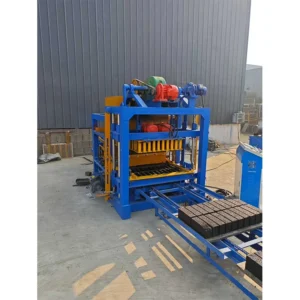
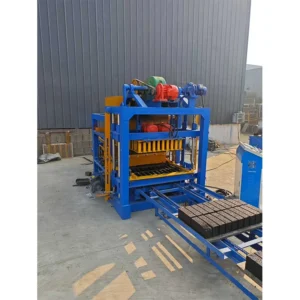
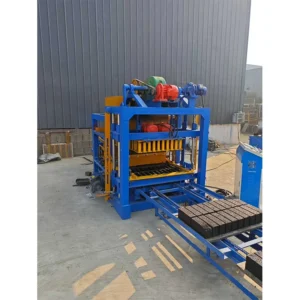
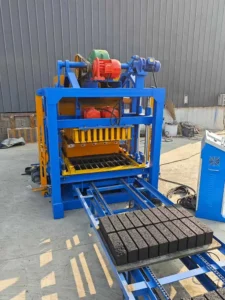
![QT14-15 Automatic Block Making Machine Production Line – Complete Line8 + 1 + 0 + 8 + 9 = 26 26 mod 6 = 2 → 句式结构: [品类词] [机型号或规格] | [站点修饰词] 26 mod 3 = 2 → 第三层选 Production Line 结果: QT14-15 Automatic Block Making Machine | Production Line](https://shiyuemachinery.com/wp-content/uploads/2026/04/Hba9e7f3b0d2c4620b68759488507a8adn-1.webp)
Line-Level Cycle Matching — Every station from the forced mixer through the pallet return is timed against the 15–20 second press cycle so the QT14-15 is never left waiting at any point in the automatic block making machine production line.
Technical Specifications
| Parameter | Value |
|---|---|
| Model | QT14-15 |
| Product Type | Automatic Concrete Block Making Machine |
| Vibration Mode | Multiaxis synchronizer vibration (vertically downward) |
| Mixer System | Multiaxis forced mixer system |
| Hydraulic System | High thermal efficiency, low heat productivity |
| Control System | Computer controlled, fully automatic |
| Rack Construction | High strength steel with special welding technique (vibration shock resistant) |
| Guide Bearing | Long-period over length guide bearing |
| Moulding Cycle | 15–20 s |
| Output (400×200×200mm hollow block, 4 pcs/mould) | 900–1,200 pcs/hour, 7,200–9,600 pcs/8hr |
| Output (400×150×200mm block, 5 pcs/mould) | 1,080–1,440 pcs/hour, 8,640–11,520 pcs/8hr |
| Output (400×100×200mm block, 8 pcs/mould) | 1,440–1,920 pcs/hour, 11,520–15,360 pcs/8hr |
| Output (200×100×60mm paving block, 16 pcs/mould) | 2,880–3,840 pcs/hour, 23,040–30,720 pcs/8hr |
| Output (240×115×53mm solid brick, 28 pcs/mould) | 5,930–6,720 pcs/hour, 47,400–53,700 pcs/8hr |
| Rated Power | Confirm with manufacturer |
| Voltage & Frequency | Confirm with manufacturer |
| Overall Dimensions (L×W×H) | Confirm with manufacturer |
| Pallet Size | Confirm with manufacturer |
| Stacking Method | Confirm with manufacturer |
| Automation Level | Fully automatic |
| Warranty | 1 year (excluding spare parts) |
Application Suitability
| Application | Material or Output |
|---|---|
| Hollow block production | Crushed stone, cement, sand, fly ash aggregate blends |
| Multicellular brick production | Lightweight aggregate and cementitious mixes |
| Paving brick production | Dense aggregate with high cement content |
| Standard solid brick production | Fine sand, cement, and mineral powder blends |
| Kerbstone production | Coarse aggregate with reinforced cement matrix |
What "9,600 Blocks per Shift" Actually Means for Your Line
A capacity number without its format, mould cavity count, and cycle time is just marketing.
Plant owners regularly see an eight-hour output figure on a quotation and assume it applies to whatever block they plan to sell. In reality, that figure was calculated for one specific format — usually the largest hollow block with the fewest cavities per mould. The moment you switch to a smaller paving block or a solid brick, the pallet count per cycle changes, the mixer demand shifts, and the curing rack throughput requirement jumps. I have watched entire automatic block making machine production lines stall at the stacker because nobody recalculated the downstream rhythm when the block format changed [NEED_CITE: mismatched station cycle times in multi-format block plants]. The QT14-15 capacity figures above are each tied to a named block size and mould cavity count so you can size every supporting station honestly from day one.
Raw Material Feed and Mixer Sizing Around the Press
The multiaxis forced mixer system is specified to keep pace with the QT14-15 press cycle. When the moulding cycle runs at 15–20 seconds, the mixer must deliver a homogenous batch to the hopper before the next pallet indexes into position. A mixer that is undersized for this rhythm will leave the press idling, and an oversized mixer will let material sit and begin setting. The forced mixing action handles aggregate of varying density and moisture content, which matters when your local sand or crushed stone supply fluctuates between deliveries. This is where the automatic block making machine production line either holds its rhythm or starts to drift.
Pallet Circulation and Curing Rack Coordination
Every pallet that exits the press must travel through the stacking station, onto the curing rack, through the curing area, and back to the pallet feeder before the press needs it again. If the pallet return loop is slower than the press cycle, pallets accumulate at the exit and the line backs up. I once saw a high-output press in a tropical climate pile hundreds of loaded pallets at the exit because the curing rack handling system was sized for a slower machine [NEED_CITE: pallet bottleneck in block production line]. The QT14-15 line layout must account for the pallet count at every stage — in the press, in the stacker, on the racks, and in the return conveyor — so the total pallet pool matches your daily output target without surplus tying up capital.
Reading the Numbers That Matter
The vibration mode uses a multiaxis synchronizer driving force vertically downward into the mould box. This matters because vertical vibration compacts the mix uniformly across the full pallet area rather than concentrating force at the centre, which is where uneven block density and corner breakage originate. The high-strength steel rack with special welding technique is designed to absorb continuous vibration shock without developing fatigue cracks at the joints — a structural requirement when the press runs multiple shifts per day. The long-period over length guide bearing keeps the mould head aligned through millions of cycles, reducing the chance that misalignment causes uneven block height across the pallet. Together, these specifications determine whether the automatic block making machine production line maintains block quality at full speed or begins producing rejects after the first few months [NEED_CITE: vibration fatigue and guide bearing wear in block presses].
The Cost of Sizing Only the Press
When a buyer focuses the quotation on the press alone and treats the mixer, stacker, and pallet system as afterthoughts, the weakest station becomes the real capacity of the entire line. A mixer that cannot keep up forces the press to pause between cycles. A pallet return conveyor that is too slow causes loaded pallets to queue at the exit, risking damage to freshly pressed blocks. A stacker that is not rated for the line output creates a manual bottleneck where workers pull pallets by hand, defeating the purpose of full automation. These imbalances rarely show up during the factory test, where each station is run independently. They appear on the first day of continuous production when every station must run in sequence without pause [NEED_CITE: station imbalance in automatic block production lines].
Why the Line Is Configured as One System
Block machinery is the single focus here, which means the press, mould, pallet, and handling equipment are specified as one matched system rather than assembled from separate suppliers. The configuration is set against your actual mix design, local aggregate, and target block format — not pulled from a catalogue default. Mould design covers the formats your market actually sells, including custom drawings when standard moulds do not match local block dimensions. The automation level is selectable so a buyer can begin with a semi-automatic pallet handling arrangement and move to full automatic stacking and cubing later. Installation and commissioning support includes operator training so the crew understands the line rhythm, not just the press controls.
Documentation & Verification
- Line layout drawing showing every station from material feed to cubing with confirmed cycle times
- Capacity calculation document stating block format, mould cavity count, and cycle time for each output figure
- Pallet specification sheet with size, material, and return system matched to your curing area
- Hydraulic and electrical schematic for the full line including all supporting stations
- Voltage, frequency, and PLC control language confirmation signed off before production
- Factory test record running the complete line sequence with your selected mould installed
Installation, Commissioning & Support
- Foundation plan showing load points for the high-strength rack and vibration isolation requirements
- Electrical supply specification with dedicated circuit rating for the full line including mixer and stacker
- Machine dismantling and container loading plan with arrival estimate stated before shipment
- On-site commissioning with full line cycle time verification against the 15–20 second press rhythm
- Operator training covering mould change procedure, PLC fault reading, and daily maintenance checkpoints
- Wear parts and mould list with part numbers for first replacement order
What to Include in Your Inquiry
To configure the automatic block making machine production line around your actual conditions, the useful starting information includes your target block formats and daily output per format, the dimensions and layout of your available production and curing area, and the voltage and frequency at your site along with your preferred PLC display language. If you already have forklifts, curing racks, or raw material silos in place, those dimensions and capacities shape the pallet size and supporting equipment selection.
Frequently Asked Questions
Q: How is line throughput verified against the block format I actually produce?
A: Every capacity figure is calculated from a specific block size, mould cavity count, and the 15–20 second cycle time. When you confirm your primary format, the output is recalculated for that exact mould so your line layout and supporting equipment are sized to your real production target rather than a generic number.
Q: How do supporting stations stay synchronised with the press cycle?
A: The mixer output rate, pallet feeder speed, stacker cycle, and curing rack handling are each set against the press moulding cycle. The line layout document shows the timing at every station so no single point runs slower than the 15–20 second press rhythm and causes a backlog.
Q: Can the pallet size be matched to my existing curing area and forklift?
A: Yes. Pallet dimensions and material are confirmed against your curing rack spacing, curing area footprint, and forklift tine width before production begins. This avoids a situation where pallets arrive that do not fit the racks or handling equipment you already have on site.
Q: What electrical and control details are confirmed before the line ships?
A: Voltage, frequency, PLC brand, and control display language are all confirmed in writing before production starts. This prevents a situation where the line arrives and the local supply does not match the motor ratings or the operators cannot read the fault codes on the screen.
Q: What supporting equipment is included versus sourced separately?
A: The quotation covers the press, mixer, pallet feeder, stacker, and conveyors as one line. Curing racks, forklifts, and raw material silos are typically buyer-sourced. The line layout drawing clearly marks which stations are included and which interface points connect to your existing equipment.