
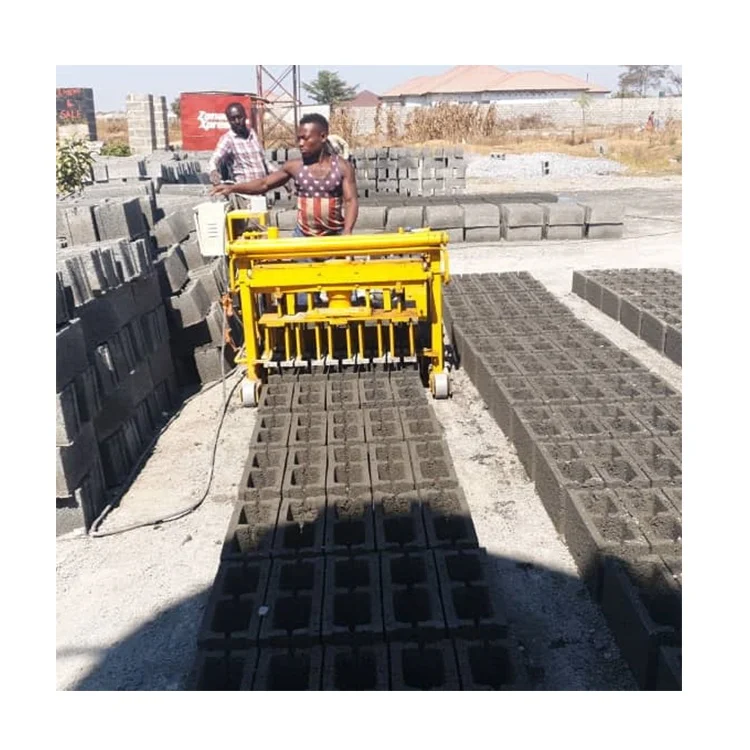
Line-Synchronized Feeding — Raw material batching and mixing stations are sized to the QMY4-30’s 30-second cycle so the press is never left waiting for the next load.
Technical Specifications
| Parameter | Value |
|---|---|
| Model | QMY4-30 |
| Product Type | Mobile Concrete Block Making Machine |
| Rated Power | 5 kW |
| Voltage & Frequency | Configurable to target market (basis to be confirmed) |
| Control System | Manual / semi-automatic operation |
| Overall Dimensions (L×W×H) | 1200×1200×1100 mm |
| Net Weight | 950 kg |
| Cycle Time | 30 seconds |
| Output Capacity | 480 pcs/h based on 400×200×200 mm hollow block, 4 pcs/mould; 600 pcs/h based on 400×150×200 mm block, 5 pcs/mould; 840 pcs/h based on 400×100×200 mm block, 7 pcs/mould |
| Pallet Requirement | Not required (mobile egg-laying type) |
| Mould Format | Hollow block and solid brick; changeable moulds |
| Automation Level | Manual / semi-automatic |
| Raw Materials | Cement, sand, crushed stones, slag |
| Assembly State | Fully assembled, mobile unit |
Application Suitability
| Application | Material or Output |
|---|---|
| On-site hollow block production for building contractors | Cement, sand, crushed stone mixes laid directly on compacted ground |
| Remote housing project block supply | Slag and aggregate blends produced without fixed plant infrastructure |
| Small-scale entrepreneurial block plant start-up | Solid brick and hollow block formats from locally sourced sand and cement |
| Project-site kerb and partition block manufacturing | Crushed stone and cement mixes with changeable mould formats |
What "480 Pieces per Hour" Leaves Out When the Mixer Can’t Keep Up
A mobile concrete block making machine production line only meets its rated cycle when every upstream station delivers on time.
The QMY4-30 presses a block every 30 seconds. If the pan mixer takes longer to deliver a consistent batch, or if raw material feeding is done by hand with a shovel, the press sits idle and real daily output falls well short of the per-hour figure. I have seen operators blame the machine when the bottleneck was actually a half-bag mixer two stations back. Sizing the mixer batch volume and the feed conveyor rate to the press cycle is the difference between a mobile block line that runs and one that waits [NEED_CITE: line synchronization principles for concrete block production].
Raw Material Feed Stations Sized to the Press Cycle
The QMY4-30 demands a fresh batch every 30 seconds. A mobile concrete block making machine production line built around it must include a mixer whose batch volume and discharge time align with that rhythm. A single-shaft or pan mixer rated for the target mix volume, paired with a belt or screw feeder moving aggregate from the stockpile to the mixer hopper, prevents the operator from rushing or short-loading batches.
Curing and Handling Without Fixed Infrastructure
Because the QMY4-30 is an egg-laying machine, it leaves freshly pressed blocks directly on the ground. This removes the need for pallets and curing racks but shifts the burden to the curing area layout. The production line must account for a flat, compacted surface large enough for a full day’s output, with water access for curing and clear pathways so workers or a small loader can move cured blocks without disturbing fresh ones [NEED_CITE: on-site curing area requirements for egg-laying block machines].
Reading the Specs That Actually Matter on Site
The 5 kW rated power covers both the vibration motor and the hydraulic system on a compact 1200×1200×1100 mm frame. At 950 kg net weight, the machine is light enough to relocate across a project site yet heavy enough to generate the vibration force needed for block compaction. The 30-second cycle holds across all three listed block formats — 400×200×200 mm, 400×150×200 mm, and 400×100×200 mm — because the mould change swaps the cavity count rather than altering the press stroke. The absence of a pallet system means the vibration energy transfers directly into the ground-formed block, making the ground preparation quality a direct factor in block density and edge definition.
The Hidden Cost of Skipping the Line Layout
When a buyer purchases the QMY4-30 as a standalone press and sources the mixer, feeder, and curing setup separately, the stations rarely synchronize. The mixer may be too small, forcing two batches per cycle. The curing area may be too close to the press path, causing freshly laid blocks to be kicked or cracked. Voltage and frequency may arrive unconfirmed, delaying first startup while an electrician sources a step-down transformer on site. Each of these gaps costs production days, and they are all preventable with a single coordinated line specification [NEED_CITE: common commissioning delays in mobile block machine installations].
Why Specify the Whole Line Here
Block machinery is a single focus, so the QMY4-30 press, its moulds, and the supporting feeding and mixing stations are specified as one matched system rather than assembled from separate suppliers. Configuration starts from the buyer’s actual mix design and local aggregate, not a catalogue default. Mould design covers the hollow and solid formats the buyer’s market actually sells. Automation level is selectable, so a contractor can begin with manual feeding and add a belt conveyor later. Installation support includes operator training on cycle pacing so every station keeps the press fed.
Documentation & Verification
- Line layout drawing with capacity calculation per block format
- Machine specification sheet with matched mould drawing and format list
- Voltage and control language confirmation sheet before dispatch
- Factory test record on buyer’s target block format
- Raw material feed configuration matched to local aggregate
- Operation and maintenance manual with wear parts list
Installation, Commissioning & Support
- Flat compacted ground area prepared to dimensions matching daily QMY4-30 output volume
- 5 kW power supply confirmed for site voltage and frequency before machine arrival
- Fully assembled unit offloaded and positioned without foundation bolts
- First-run cycle pacing adjusted between mixer discharge and press start
- Operator trained on mould change procedure and block format switching
- Wear parts and mould replacement schedule provided at commissioning
Before You Request a Quote
Share the block formats your project or market requires, the daily volume you need to sustain, and the raw materials available on site including sand type and aggregate grading. Confirm the local voltage and frequency at your project location, the control display language your operators need, and the dimensions of the flat area you can allocate for curing. If you already have a mixer or material feeder in use, provide its batch capacity and discharge rate so the mobile concrete block making machine production line can be matched around it.
Frequently Asked Questions
Q: How is output capacity calculated and which block format does each figure assume?
A: Each output figure is tied to a specific block size and mould cavity count. The QMY4-30 produces 480 pieces per hour based on 400×200×200 mm hollow blocks at 4 per mould, 600 pieces per hour based on 400×150×200 mm blocks at 5 per mould, and 840 pieces per hour based on 400×100×200 mm blocks at 7 per mould, all at a 30-second cycle.
Q: What supporting equipment is needed around the QMY4-30 to form a complete line?
A: A mixer with batch volume matched to the press cycle, a raw material feeder moving aggregate from stockpile to mixer, and a flat compacted curing area sized for daily output. Water access for curing and clear handling pathways around the egg-laying zone complete the mobile concrete block making machine production line setup.
Q: How do cycle times between stations need to match so the machine is not left idle?
A: The QMY4-30 presses every 30 seconds. The mixer must discharge a full batch within that window, and the feeder must replenish the mixer before the next batch is called. If any upstream station takes longer, the press waits and real hourly output drops below the rated figure.
Q: Can the machine be configured for the mix design and aggregate at my site?
A: Yes. Configuration starts from your local sand type, aggregate grading, and cement ratio. The vibration parameters and mould clearance are adjusted to match, so block strength and surface finish meet your project requirements rather than a generic catalogue standard.
Q: What voltage, frequency, and documentation must I confirm before the machine arrives?
A: Confirm your site voltage and frequency, plus the PLC or control display language your operators read. Documentation includes the line layout, specification sheet, mould drawings, factory test record, and an operation manual. Verifying these before shipment avoids commissioning delays once the mobile block machine reaches your project site.


