
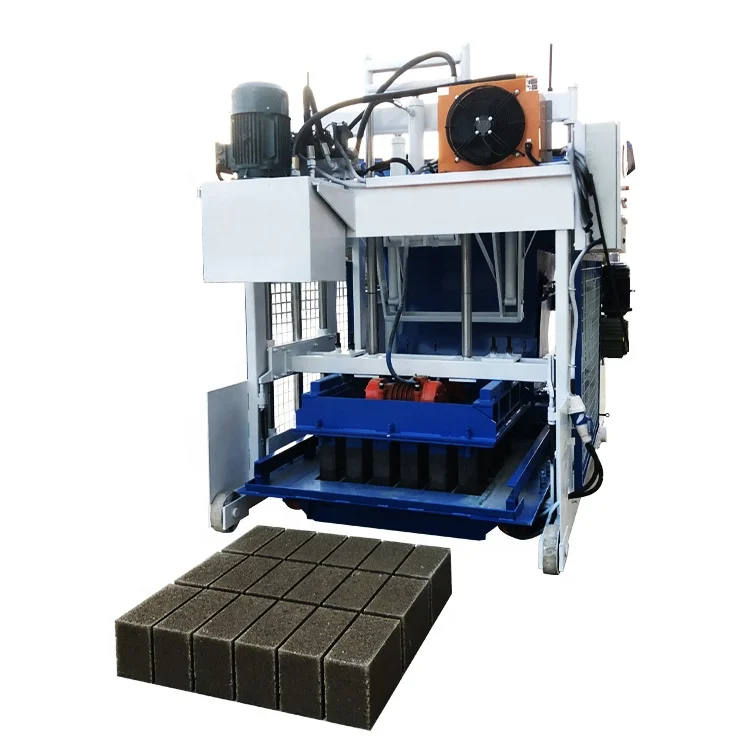
Integrated Line Layout — The QMY18-15 egg-laying press is specified as the centre of a mobile block production line, with mixing, feeding, and curing stations arranged to match its cycle time and travel path.
Technical Specifications
| Parameter | Value |
|---|---|
| Model | QMY18-15 |
| Product Type | Mobile Egg Laying Concrete Block Making Machine |
| Rated Power | 24 kW |
| Working Method | Hydraulic |
| Control System | PLC |
| Output Capacity | Approx. 3,400 pcs per shift (basis: 400×200×200mm hollow block; shift length and smaller formats to be confirmed) |
| Pallet Requirement | None (egg-laying, blocks formed directly on ground) |
| Voltage & Frequency | Customized to buyer’s local industrial supply (values to be confirmed) |
| Mould Options | Customizable per buyer requirement (hollow block confirmed; other formats on request) |
| Automation Level | Mobile egg-laying, semi-automatic with PLC control |
Application Suitability
| Application | Material or Output |
|---|---|
| On-site hollow block production for housing projects | Concrete mix with crushed stone, sand, and cement on cleared and levelled ground |
| Remote infrastructure site block manufacturing | Standard concrete mix designs with locally available aggregate |
| First-stage block plant for entrepreneurs | Hollow and solid block formats without pallet investment |
| Building material distributor serving remote sites | Transportable mixing and feeding setup alongside the press |
What "No Pallets Required" Actually Means for Your Line
The no-pallet egg-laying design removes an entire material handling loop, but it shifts the planning burden to ground preparation, curing space, and machine travel logistics.
Many mobile block machine quotations stop at the press. Pallet handling, stacking, and curing are left out, which means the blocks you produce sit on the ground and the crew spends the rest of the shift moving them by hand. With the QMY18-15, there are no pallets to buy, store, or return — but the line around it must be designed so that the machine never stops waiting for mixed material to arrive or for fresh blocks to set hard enough for the next pass [NEED_CITE: mobile egg laying block machine production line layout principles]. I have seen contractors lose an entire day’s output because the curing zone was too small and the machine had to double back over blocks that had not set.
Mixing Station Placement and Cycle-Time Matching
A mobile egg laying block machine production line lives or dies by how well the mixer keeps up with the press. The QMY18-15 runs on a 24 kW rated power supply and uses hydraulic pressure to form each block in sequence as it travels. If the mixer is undersized or positioned too far from the travel path, the operator stands idle between cycles, and the quoted shift output becomes theoretical. The mixer capacity and batch time must be calculated against the press cycle so that fresh concrete is always available at the feed point.
Ground Preparation and Curing Zone Layout
The egg-laying method demands a flat, compacted travel surface. Every block is deposited directly on the ground, which means the curing area is the production area. The layout must allow the QMY18-15 to complete its travel loop without crossing paths with blocks that have not yet cured enough to handle. I once helped a buyer who assumed any flat dirt would work; after the first rain, the machine sank into soft patches and produced uneven blocks across an entire run. Planning the curing zone length, surface compaction, and weather protection is part of line design, not an afterthought [NEED_CITE: ground bearing requirements for egg-laying block machines].
Hydraulic Pressure, PLC Control, and Batch Consistency
The hydraulic working method paired with PLC control gives the QMY18-15 consistent compaction across every cycle within a shift. Vibration force and hydraulic pressure must be matched to the buyer’s specific mix design and local aggregate — a setting that works for one sand-to-cement ratio may produce weak blocks with another. The PLC allows operators to store and recall parameters for different block formats, reducing the guesswork when switching moulds. This is especially important on project sites where the raw material source can change from one delivery to the next.
What Happens When Line Stations Are Specified in Isolation
When the mixer, feeder, and curing plan are sourced separately from the press, the cycle times rarely align. The result is a mobile egg laying block machine production line where the press waits for material or the mixer runs continuously with nowhere to send the output. On one site, the contractor bought a mixer rated for twice the press capacity, thinking bigger was safer — but the excess output sat in the hopper, losing workability before the QMY18-15 could use it. Matching every station to the press cycle is the only way to capture the real daily throughput [NEED_CITE: batch-to-cycle time matching in mobile block production].
Why Specifying the Line Together Matters
The QMY18-15 is configured against the buyer’s actual mix design, local aggregate, and target block format rather than a catalogue default. Every supporting station — mixer, material feed, curing area plan — is specified as part of one matched system. Mould design covers the formats the buyer’s market actually sells, and custom mould drawings are available when standard options do not fit. Voltage, frequency, and PLC display language are confirmed in writing before production, so commissioning is not delayed when the machine arrives on site. Line layout drawings show mixer position, machine travel path, and curing area with capacity stated per block format and per shift. Installation support includes operator training and a wear parts list from day one.
Documentation & Verification
- Line layout drawing with mixer placement, travel path, and curing area sized per block format
- Capacity calculation sheet stating shift length and block dimensions assumed
- Voltage, frequency, and PLC language confirmation record signed before production
- Hydraulic and electrical schematic matching the as-built configuration
- Factory test record on buyer’s specified block format before dispatch
- Operation and maintenance manual with wear parts and mould replacement schedule
Installation, Commissioning & Support
- Ground compaction and level tolerance verified before the QMY18-15 arrives on site
- Dedicated 24 kW power circuit with confirmed voltage and frequency at the connection point
- Machine delivered in transport-ready state with dismantling plan for site access constraints
- PLC parameters set to buyer’s mix design and block format during commissioning
- Operator training covering mould change procedure and hydraulic pressure adjustment
- Wear parts and mould list supplied for first-year maintenance planning
What to Include in Your Inquiry
Share the block formats your market demands, the shift length you plan to run, and the local aggregate and cement types available on your project site. Include your site dimensions — travel path length, curing area size, and any overhead clearance limits — along with your local industrial voltage and frequency. If you already own a mixer or material handling equipment, specify its capacity so the line can be matched around it.
Frequently Asked Questions
Q: What supporting equipment is needed around the QMY18-15 to form a complete mobile production line?
A: A mixer sized to match the press cycle, a material feed arrangement positioned along the machine’s travel path, and a prepared curing surface are the minimum. The line is planned so that mixed concrete is always available and fresh blocks have sufficient space to set before the QMY18-15 completes its loop and returns to the same area.
Q: How is the 3,400 pieces per shift figure verified?
A: That capacity is based on producing 400×200×200mm hollow blocks over a standard shift. Smaller block formats will yield higher counts per shift. The exact figure depends on your shift length, mould format, and whether the mixer and feed stations can sustain continuous supply to the press.
Q: How should the curing area be planned for uninterrupted production?
A: The curing surface must be long enough that the QMY18-15 completes its travel loop before returning to blocks that were laid first. Ground compaction, surface flatness, and weather protection all affect how quickly blocks gain enough strength to handle. We include curing area dimensions in the line layout drawing.
Q: What voltage and PLC language options are available?
A: Voltage and frequency are customized to your local industrial supply and confirmed in writing before production begins. The PLC display language is set to your operator’s preference. Both are documented in the pre-production confirmation record to avoid commissioning delays on arrival.
Q: How does mould change affect daily output on a mobile egg-laying machine?
A: Switching between block formats requires stopping the QMY18-15, changing the mould, adjusting hydraulic and vibration parameters in the PLC, and clearing the travel path for the new format. The line layout accounts for a dedicated mould change zone so that this downtime does not disrupt the curing area or material feed.


